Kirjojen hintavertailu. Mukana 12 390 323 kirjaa ja 12 kauppaa.

Kirjahaku

Etsi kirjoja tekijän nimen, kirjan nimen tai ISBN:n perusteella.

18 kirjaa tekijältä Ken Brown

The Right to Learn

The Right to Learn

Ken Brown

Routledge
2001
sidottu
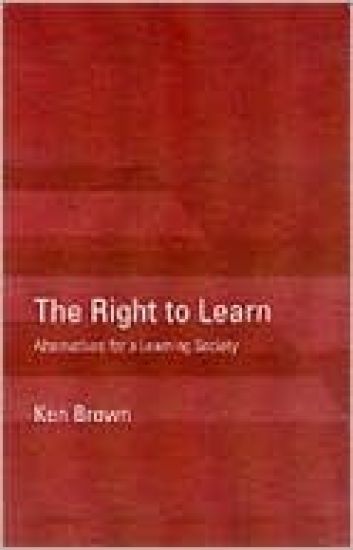
The concept of the 'learning society' brings to mind access to education for all and a culture of lifelong learning. But government interventions in education such as the National Curriculum and standardized tests have only served to consolidate the connection between learning and schooling. Schools, furthermore, now have to juggle an increasingly diverse and incompatible range of tasks, providing equal opportunities while catering for individual needs and hitting academic attainment targets while preparing pupils for life in the global workplace. In this climate, what is the future for a democratic system of education? This important book aims to encourage debate about alternative ways of providing education, and discusses how these are being practiced now in Britain, Europe and the USA. Taking the issue of human rights and access as a central theme, the author examines the current state of education provision and the possibilities for its future. This book will be of interest to specialists in education, politics and philosophy, and also to those seeking alternative ways of educating their children.
The Right to Learn

The Right to Learn

Ken Brown

Routledge
2001
nidottu
The concept of the 'learning society' brings to mind access to education for all and a culture of lifelong learning. But government interventions in education such as the National Curriculum and standardized tests have only served to consolidate the connection between learning and schooling. Schools, furthermore, now have to juggle an increasingly diverse and incompatible range of tasks, providing equal opportunities while catering for individual needs and hitting academic attainment targets while preparing pupils for life in the global workplace. In this climate, what is the future for a democratic system of education? This important book aims to encourage debate about alternative ways of providing education, and discusses how these are being practiced now in Britain, Europe and the USA. Taking the issue of human rights and access as a central theme, the author examines the current state of education provision and the possibilities for its future. This book will be of interest to specialists in education, politics and philosophy, and also to those seeking alternative ways of educating their children.

One Putt

One Putt

Ken Brown

Hamlyn
2020
sidottu
REVISED AND UPDATED!"As well as being a great tool for instruction, it's also a fascinating insight into one of the world's best putters." Tommy FleetwoodClimb the ladder to achieve one-putts by choosing the right putter, achieving an immaculate set up, reading the greens, acquiring touch and feel and honing your skills through drills with One Putt.This book also includes some stunning bespoke photography from Getty's No.1 golf photographer as well as many shots of today's leading Pros shot especially for the book.With TV's best-loved golf analyst, Ken Brown's own analysis and stories from a wealth of experience, this heavily illustrated, easy-to-follow book will make honing this golfing skill easy and entertaining.
Education, Culture and Critical Thinking
Published in 1998. Interest in the subject of "critical thinking" has mounted, seeking ways to transcend rote learning and to remedy a widely perceived lack of critical, analytical abilities amongst school students. A growing literature on "teaching thinking" and "problem solving" maintains this commitment, reflecting a common belief that thinking skills of a general nature can not only be identified, but can be taught successfully. The paucity of empirical evidence that intellectual skills thus identified actually transfer between domains of thought or subject matters has done little to diminish faith in the possiblity that this is achievable. The principal message of this book is that theories of critical thinking which disregard its historical origins and dialectical, traditional character are likely to be seriously flawed. All human societies exhibit problem solving abilities, often of a high order - all language and thought is fundamentally criteriological. Relevant distinctions between critical thought and its alternative are found in history and culture, in dialogue and criticism, not just in the operations of individual minds.The critical traditions embody a sovereign principle - a criterion of the effectiveness of educational institutions to represent the legacy and social liberties and democratic values in which they are deeply enmeshed.
Education, Culture and Critical Thinking
Published in 1998. Interest in the subject of "critical thinking" has mounted, seeking ways to transcend rote learning and to remedy a widely perceived lack of critical, analytical abilities amongst school students. A growing literature on "teaching thinking" and "problem solving" maintains this commitment, reflecting a common belief that thinking skills of a general nature can not only be identified, but can be taught successfully. The paucity of empirical evidence that intellectual skills thus identified actually transfer between domains of thought or subject matters has done little to diminish faith in the possiblity that this is achievable. The principal message of this book is that theories of critical thinking which disregard its historical origins and dialectical, traditional character are likely to be seriously flawed. All human societies exhibit problem solving abilities, often of a high order - all language and thought is fundamentally criteriological. Relevant distinctions between critical thought and its alternative are found in history and culture, in dialogue and criticism, not just in the operations of individual minds.The critical traditions embody a sovereign principle - a criterion of the effectiveness of educational institutions to represent the legacy and social liberties and democratic values in which they are deeply enmeshed.
The Scarecrow's Hat

The Scarecrow's Hat

Ken Brown

Peachtree Publishers
2011
nidottu
In this classroom favorite, a resourceful chicken enlists her farm friends to get a coveted hat from Scarecrow. A delightful circular tale and fall read-aloud Chicken really admires Scarecrow's straw hat. Scarecrow would gladly trade his hat for a walking stick to rest his tired arms. Chicken doesn't have a walking stick to trade--but she knows someone who does. Author-illustrator Ken Brown pairs vivid, realistic watercolors with an inventive plot, engaging sequencing, and repetition to tell a charming circular story packed with relatable themes of friendship, bartering, and problem-solving. This award-winning title is an ideal story time choice for autumn and harvest themes.
Ice

Ice

Ken Brown

The Choir Press
2023
nidottu
Gloucester, 2017. New language teacher Julie attends the school's science group, run by Peter, where a chance comment reawakens in her a childhood memory, a dream, where she is looking out over a stretch of water and experiencing feelings of sorrow and loss. As the group discusses parascience and the potential of the undiscovered world, she wonders if there might be more to it than a flight of imagination. London, 1860. George has never questioned his duty to the family fruit and vegetable trade at Covent Garden, but as the business is looking to expand he starts to envision new possibilities. He is torn between loyalty to his family and a desire to be part of the quickly modernising world. Peter and Julie begin a relationship which is troubled by a growing obsession about the past, and ideas that might question established scientific thinking. But could Julie be right about the possible connections between the past and the present? And if so, could there be present-day consequences of an 1867 disaster which occurred on the treacherous ice of Regents Park lake?
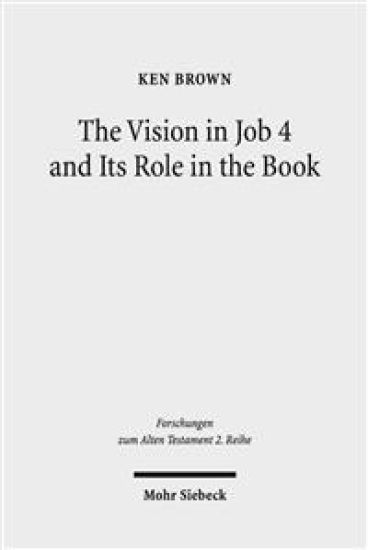
The Vision in Job 4 and Its Role in the Book
Near the beginning of the Joban Dialogues, Job's friend Eliphaz is attributed a remarkably subversive vision (Job 4:12-21). Laced with images of divine judgment and deception, this vision undermines the very foundation of the friends' theology, and closely conforms to Job's. In particular, the vision's distinctive corporeal imagery and its conclusion that anyone can suddenly perish reflect Job's characteristic style, and form the basis for his accusations of divine injustice. In this study, Ken Brown argues that the tensions between the vision's present attribution to Eliphaz and its role in the dialogue run much deeper than is generally perceived, and can only be resolved through a reassessment of the book's development, both synchronic and diachronic. Brown suggests that the present order of Job 3-4 and 25-27 is neither original nor accidental, but reflects an intentional reframing of the dialogue, and anticipates similar moves across the earliest reception of the book.This work was awarded the Manfred Lautenschlaeger Award for Theological Promise 2016.
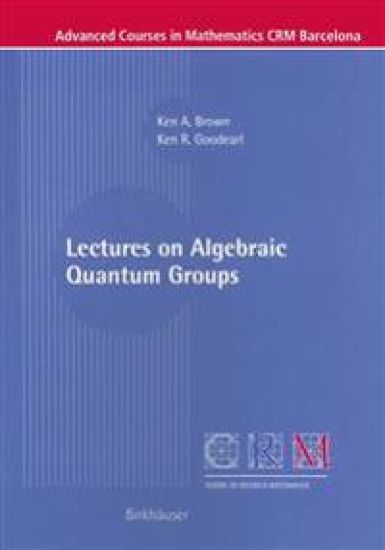
Lectures on Algebraic Quantum Groups

Lectures on Algebraic Quantum Groups

Ken Brown; Ken R. Goodearl

Birkhauser Verlag AG
2002
nidottu
In September 2000, at the Centre de Recerca Matematica in Barcelona, we pre­ sented a 30-hour Advanced Course on Algebraic Quantum Groups. After the course, we expanded and smoothed out the material presented in the lectures and inte­ grated it with the background material that we had prepared for the participants; this volume is the result. As our title implies, our aim in the course and in this text is to treat selected algebraic aspects of the subject of quantum groups. Sev­ eral of the words in the previous sentence call for some elaboration. First, we mean to convey several points by the term 'algebraic' - that we are concerned with algebraic objects, the quantized analogues of 'classical' algebraic objects (in contrast, for example, to quantized versions of continuous function algebras on compact groups); that we are interested in algebraic aspects of the structure of these objects and their representations (in contrast, for example, to applications to other areas of mathematics); and that our tools will be drawn primarily from noncommutative algebra, representation theory, and algebraic geometry. Second, the term 'quantum groups' itself. This label is attached to a large and rapidly diversifying field of mathematics and mathematical physics, originally launched by developments around 1980 in theoretical physics and statistical me­ chanics. It is a field driven much more by examples than by axioms, and so resists attempts at concise description (but see Chapter 1. 1 and the references therein).