Kirjojen hintavertailu. Mukana 11 244 527 kirjaa ja 12 kauppaa.

Kirjahaku

Etsi kirjoja tekijän nimen, kirjan nimen tai ISBN:n perusteella.

31 kirjaa tekijältä Ken Ford

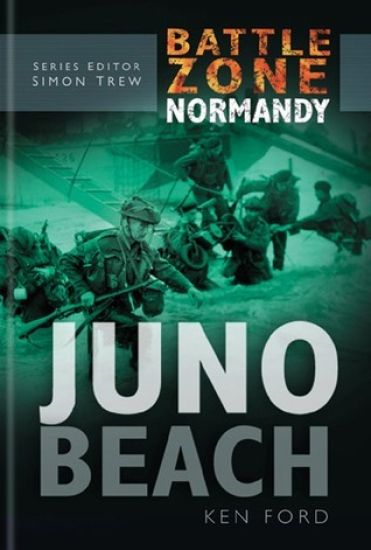
Battle Zone Normandy: Juno Beach

Battle Zone Normandy: Juno Beach

Ken Ford

The History Press Ltd
2004
sidottu
Canadian troops landing on Juno Beach on 6 June 1944 were fulfilling the promise made by their government in 1939, 'to take up arms against an aggressor state whose policy threatened to destroy free government everywhere.'It was a noble cause about which the Canadian people remain extremely proud. Canadian 3rd Division, assaulting the Normandy beaches to help liberate the French people from Nazi tyranny, numbered many descendants of European forebears. Famous Canadian formations with European antecedents such as the New Brunswick Regiment, La Regiment de la Chaudiere, the Stormont, Dundas and Glengarry Highlanders and the Queen's Own Rifles of Canada overcame chaos on the beaches and endured heavy casualties.Their determination and drive saw them progress further inland than troops from any other of the Allied beachheads. The Juno Beach landings were just the start of the Canadians' long struggle to Germany and victory. In the coming days they would face some of Hitler's toughest troops, including 12 SS-Panzer Division 'Hitlerjugend', in a war of ideals where duty faced fanaticism and surrender often led to massacre.Ken Ford takes the reader back to the battlefields of June 1944, revisiting the scenes of the fighting in the green fields and lanes of Normandy, identifying the places that remain from the war and remembering the young men who fell in the service of Canada and the Allied cause.
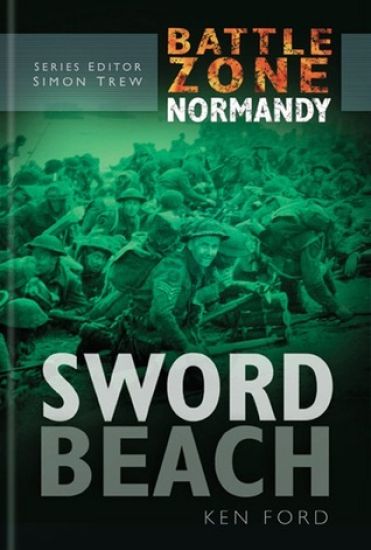
Sword Beach

Sword Beach

Ken Ford

Sutton Publishing Ltd
2004
sidottu
When British 3rd Infantry Division landed on Sword Beach in Normandy on D-Day, it was the most powerful to date, comprising infantry, armour, commandos, self propelled artillery and anti-tank guns, specialist assault armour and a host of support units. Covered by a tactical air force and supported by the offshore guns of the Royal Navy, the division assaulted Sword Beach with a force that was unstoppable. Within hours of the first touchdown tanks and infantry were ashore, fanning out across the countryside to enlarge the lodgement and sending an armoured thrust towards their first objective, Caen, just seven miles away. Then it all went wrong. Sword was the only Allied beachhead to suffer armoured counterattack by a German panzer division on D-Day and from then on the invaders struggled to make any progress. Advances that should have been measured in miles were reduced to a few hedgerows, or a field here and a wood there. Caen was not captured for seven more weeks. Covering both the triumph of the Sword Beach landings and the disappointment of the failure to capitalise on that early success, the first seven days that British troops were back on the soil of mainland Europe make a fascinating story. Ken Ford allows the reader to stand on the spot where momentous decisions were made, see how and why the battle lost its momentum and understand why the Caen attack slowed almost to stalemate.
Mailed Fist

Mailed Fist

Ken Ford

The History Press Ltd
2005
sidottu
Formed in 1940, the British 6th Armoured Division was in the thick of the action in North Africa from December 1942 in the climactic encounters with the Deutsches Afrika Korps. Combining eye witness accounts, unit war diaries and unpublished sources, this is a history of this distinguished division.
D-Day Commando

D-Day Commando

Ken Ford

The History Press Ltd
2005
nidottu
48 Royal Marine Commando began its life in March 1944 and was disbanded in the UK in January 1946. In its short but active life it always seemed to be in the thick of fighting .In fact, a history 48 RM Commando is a history of the last year of the war in Europe. In participated in the D-Day invasion and landed on Juno Beach on 6 June 1944, fought as infantry in the bloody battles for Normandy, helped clear the Channel ports, undertook a second amphibious landing during the Walcheren campaign, raided across the Maas in Holland and then took part in the army of occupation in Germany. During the whole of this period it was in almost continuous contact with the enemy.It is surprising, then, that the story of 48 RM Commando has not been made available to a wider audience. Apart from a small booklet written by one of its veterans and published in 1946, it has never been the subject of a complete history of its own. Based on eyewitness accounts, official unit war diaries and published and unpublished sources and supported by a selection of maps, line drawings and archive photographs, this is a gripping and authoritative history of an elite formation.
Assault on Sicily

Assault on Sicily

Ken Ford

The History Press Ltd
2007
sidottu
On the night of 9/10 July 1943, an Allied armada of 2,590 vessels launched one of the largest combined operations of the Second World War - the invasion of Sicily, Operation 'Husky'. Over the next thirty-eight days, half a million British, Canadian, American and French soldiers, sailors, and airmen grappled with their German and Italian counterparts for control of this rocky outcrop of Hitler's 'Fortress Europe'. The Allied assault on Sicily featured airborne and amphibious landings; mountain warfare; international rivalry; poorly performing troops; tenacious German resistance; and, improvements in tactical air support and the ultimate Allied victory on the island. Almost the whole of the progress of the Second World War is illustrated by this one campaign. It was the only action where the whole Allied war effort was brought to bear on a single objective, with one army commanded by Patton and one army commanded by Montgomery. Both men were insufferable egoists and insubordinate commanders; they always chose to do their own thing, regardless of others' sensibilities and always with one eye on how history would see them.The seeds of rivalry between these two key Allied commanders that were sown in the Sicily campaign eventually grew to fruition in the battles for Normandy and the Ardennes.
Assault on Sicily

Assault on Sicily

Ken Ford

Sutton Publishing Ltd
2007
sidottu
On the night of 9/10 July 1943, an Allied armada of 2,590 vessels launched one of the largest combined operations of the Second World War - the invasion of Sicily, Operation 'Husky'. Over the next 38 days, half a million British, Canadian, American and French soldiers, sailors, and airmen grappled with their German and Italian counterparts for control of this rocky outcrop of Hitler's 'Fortress Europe'. The Allied assault on Sicily featured airborne and amphibious landings; mountain warfare; international rivalry; poorly performing troops; tenacious German resistance; and, improvements in tactical air support and the ultimate Allied victory on the island. Almost the whole of the progress of the Second World War is illustrated by this one campaign. It was the only action where the whole Allied war effort was brought to bear on a single objective, with one army commanded by Patton and one army commanded by Montgomery. Both men were insufferable egoists and insubordinate commanders; they always chose to do their own thing, regardless of others' sensibilities and always with one eye on how history would see them. The seeds of rivalry between these two key Allied commanders that were sown in the Sicily campaign eventually grew to fruition in the battles for Normandy and the Ardennes.
Operation Neptune 1944

Operation Neptune 1944

Ken Ford

Osprey Publishing
2014
nidottu
The naval plan behind the Normandy landings that aided the success of the Allied invasion of France.The story of Operation Neptune was, of course, more than just a tale of planning, building and logistics. It had action a-plenty and the emotive tales of bravery, ingenuity and determination by the crews of the ships involved brought credit to the naval traditions of the Allied nations.Battleships, cruisers and destroyers bombarded enemy positions; midget submarines pointed the way to the beaches; minesweepers worked secretly by night to clear lanes; landing craft of all sizes braved enemy fire and mines to deposit their loads on the beaches and naval beach parties endured shellfire and machine guns to bring order to the beaches. Royal Navy commandos and US naval engineers dealt with beach obstacles against rising tides in the face of withering enemy fire. Losses during Neptune and the days after the assault were quite heavy.In this detailed, illustrated account, Ken Ford unpacks the operation that had more casualties amongst its vessels than any other naval enterprise in World War II.
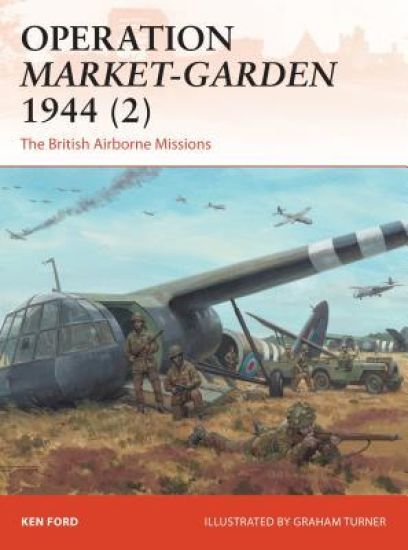
Operation Market-Garden 1944 (2)

Operation Market-Garden 1944 (2)

Ken Ford

Osprey Publishing
2016
nidottu
Osprey's trilogy on Operation Market-Garden continues with a fascinating account of the British airborne assault on the bridge across the Rhine at Arnhem.With Germany being pushed back across Europe the Allied forces looked to press their advantage with Operation Market-Garden, a massive airborne assault that, if successful, could have shortened the war in the west considerably.The ground advance consisted of an armoured thrust by the British XXX Corps, while the US 82nd and 101st US Airborne Divisions secured the bridges at Eindhoven and Nijmegen and the British 1st Airborne Division and Polish 1st Airborne Brigade were tasked with seizing the final bridge at Arnhem to secure the route. What they did not realise was that the 9. SS and 10. SS-Panzer Divisions were nearby, ready to reinforce the local garrison and fend off the Allied assault.Focusing on the role played by these British and Polish troops, Ken Ford examines Operation Market-Garden in its entirety, from the early planning through to the early setbacks and eventual catastrophic conclusion.
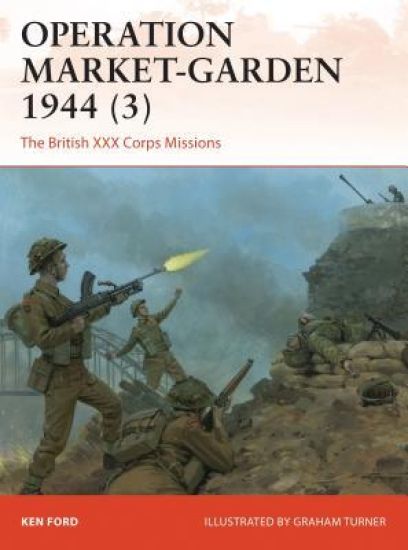
Operation Market-Garden 1944 (3)

Operation Market-Garden 1944 (3)

Ken Ford

Osprey Publishing
2018
nidottu
The final instalment in Osprey's trilogy on Operation Market-Garden, this is a fascinating account of the British XXX Corps assault towards the Rhine at Arnhem.Field Marshal Montgomery's plan to get Second British Army behind the fortifications of the German Siegfried Line in 1944 led to the hugely ambitions Operation Market-Garden. Part of this plan called for a rapid advance from Belgium through Holland up to and across the lower Rhine by the British XXX Corps along a single road already dominated by airborne troops. Their objective along this road was the bridge at Arnhem, the target of British and Polish airborne troops. Once XXX Corps had reached this bridge it would then make for the German industrial area of the Ruhr. The operation was bold in outlook but risky in concept.Using specially commissioned artwork and detailed analysis, Ken Ford completes this trilogy on Operation Market-Garden by examining this attack which, if successful, could have shortened the war in the west considerably. Yet it turned out to be a bridge too far.
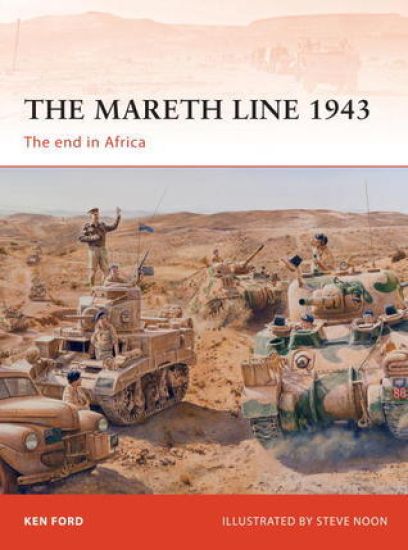
The Mareth Line 1943

The Mareth Line 1943

Ken Ford

Osprey Publishing
2012
nidottu
A highly illustrated account of the hard fighting in North Africa, from the battle of El Alamein to defeat of the Axis forces in May 1943.The battle of El Alamein saw the shattering of Germany’s hopes for victory in North Africa and from this point on the end was inevitable. In the six months that passed before the final surrender there was much hard fighting, as the defeated German and Italian armies sought to hold off the encroaching Eighth Army.Rommel, his health suffering, fought a number of major actions during this campaign before his forces settled into the pre-war French defensive position the Mareth Line. All the way he was pursued by an increasingly confident Eighth Army under the command of General Montgomery, although he was unable to outflank the retreating German and Italian forces decisively, and Rommel was even able to divert forces to inflict a sharp defeat on the newly arrived US forces at Kasserine Pass in February 1943. This was one of Rommel’s last acts in the Desert War as his health problems forced his return to Germany shortly afterwards.In this detailed examination, Ken Ford explores the lead-up to and execution of the last great battle of the Desert War, as the veteran formations of the British Eighth Army took on their foes in the Afrikakorps for the final time in the major set-piece battle for the Mareth Line.
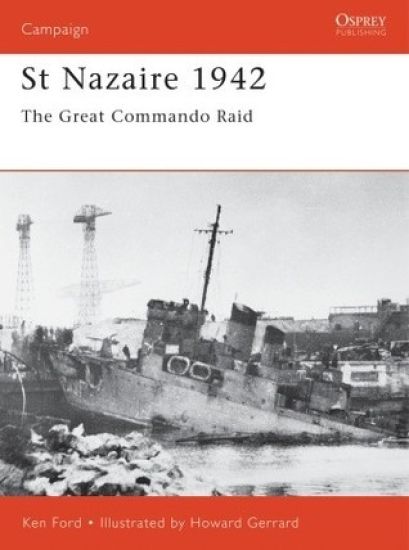
St Nazaire 1942

St Nazaire 1942

Ken Ford

Osprey Publishing
2001
nidottu
A richly illustrated examination of the British raid on the port of St Nazaire: one of the most daring actions of World War II.The port lies at the mouth of the River Loire and in 1942, as well as a U-Boat base, contained the massive 'Normandie' dock, the only facility on the Atlantic coast large enough to accommodate the German pocket battleship Tirpitz.This book tells the story of the raid that denied the use of the dock to the Tirpitz, the sister ship of the Bismarck, and constituted a crucial victory for the British Combined Operations in the Battle of the Atlantic.
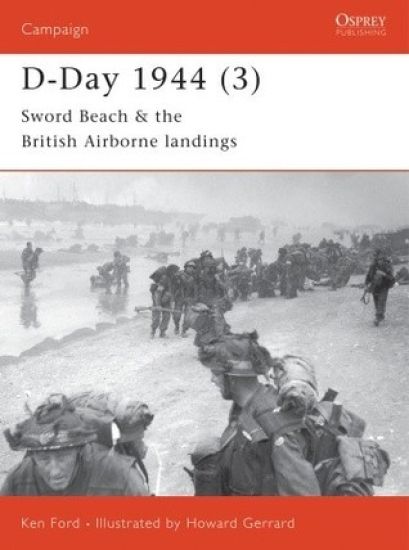
D-Day 1944 (3)

D-Day 1944 (3)

Ken Ford

Osprey Publishing
2002
nidottu
A highly illustrated and detailed study of the Sword Beach & the British Airborne Landings. At 0016hrs on 6 June 1944 a Horsa glider ground to a halt a mere 60 yards from the Orne Canal bridge at Bénouville in Normandy. A small group of British paratroopers burst from it and stormed the bridge within minutes. The Allied liberation of Nazi-occupied Europe had begun. Within a few hours landing craft would swarm towards Ouistreham as British 3rd Division stormed ashore at Sword Beach.The battle would then begin to break through to relieve the paratroopers. In the third of the D-Day volumes Ken Ford details the assault by British 6th Airborne Division and the British landings on Sword Beach that secured the vital left flank of the invasion.
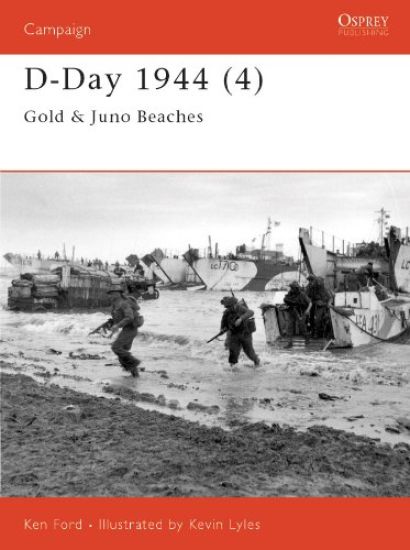
D-Day 1944 (4)

D-Day 1944 (4)

Ken Ford

Osprey Publishing
2002
nidottu
A highly illustrated and detailed study of the Gold and Juno Beaches Landings Operation Overlord, the Allied invasion of Normandy, was the greatest sea-borne military operation in history. At the heart of the invasion and key to its success were the landings of British 50th Division on Gold Beach and Canadian 3rd Division on Juno Beach.Not only did they provide the vital link between the landings of British 3rd Division on Sword Beach and the Americans to the west on Omaha, they would be crucial to the securing of the beachhead and the drive inland to Bayeux and Caen.In the fourth D-Day volume Ken Ford details the assault that began the liberation of Nazi-occupied Europe.
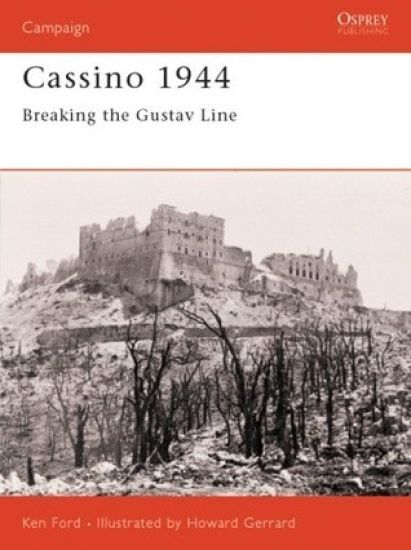
Cassino 1944

Cassino 1944

Ken Ford

Osprey Publishing
2004
nidottu
An illustrated account of the battle for Cassino: probably the most bitter struggle of the entire Italian campaign.The dominating peak of Montecassino crowned by its magnificent but doomed medieval monastery was the key to the entire Gustav Line, a formidable system of defences that stretched right across the Italian peninsula. This position completely dominated the Liri valley and Route 6, the strategically vital road to Rome. Between January and May 1944 the Allies struggled amid inhospitable terrain and dreadful weather to dislodge the German paratroops that tenaciously defended the vital mountaintop.Featuring in-depth explanation alongside illustrations and full-colour maps, Ken Ford’s book details the dramatic events of the battle to break the Gustav Line.
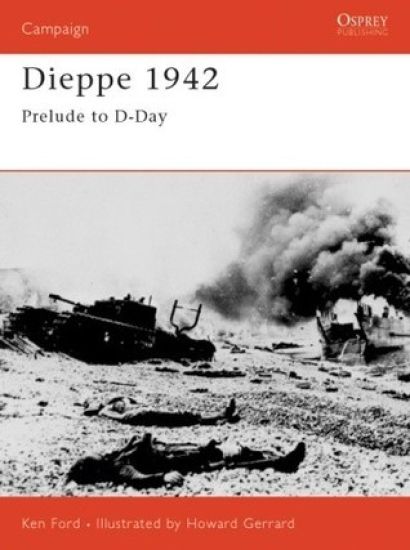
Dieppe 1942

Dieppe 1942

Ken Ford

Osprey Publishing
2003
nidottu
A compact, illustrated examination of the Dieppe raid of August 1942: one of the most controversial actions of World War II.Operation ‘Jubilee’ was a frontal assault on a fortified port landing the latest equipment and armour directly on to the beach. The main force would destroy the port facilities while other smaller landings dealt with anti-aircraft and coastal batteries. The raid itself turned into a fiasco. The assault force was pinned down on the beach and three quarters of the 5,000 troops landed were lost.Featuring archive photography and full-colour maps, this book analyses the disastrous raid and examines contrasting conclusions drawn by the Allies and the Germans.
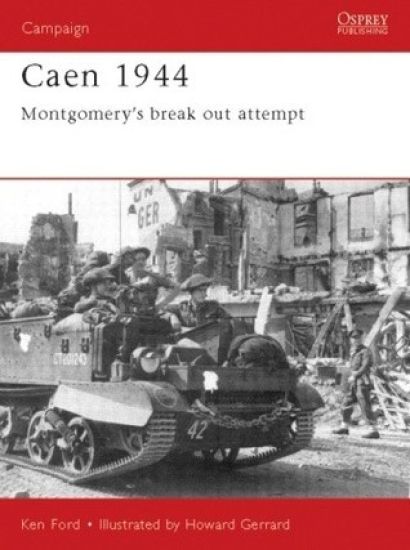
Caen 1944

Caen 1944

Ken Ford

Osprey Publishing
2004
nidottu
One of the key objectives of British forces on D-Day was the capture of the strategically vital city of Caen.General Montgomery saw Caen as the key to Normandy and the springboard for the Allied breakout, but so did the Germans and the city did not fall. It took three major offensives and more than 30 bloody days of struggle to finally take Caen. In the process the city was controversially devastated and its civilian population decimated. The Allies paid a high price for Caen but the horrific German casualties bled their forces in Normandy white.In this concise, illustrated volume, Ken Ford shows how Caen helped open the way for the American breakout in Operation Cobra.
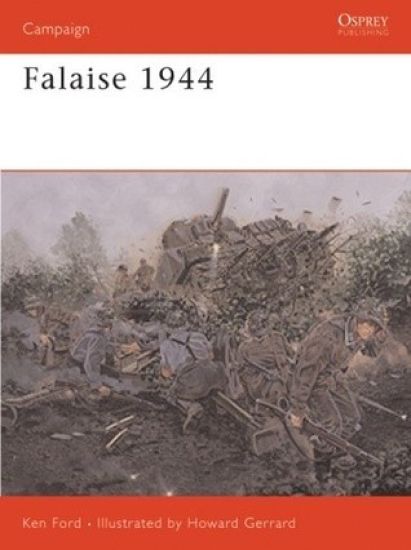
Falaise 1944

Falaise 1944

Ken Ford

Osprey Publishing
2005
nidottu
The battle around Falaise in Normandy during August 1944 saw the destruction of the German Seventh army. This book details the chain of events which led to the German retreat and the ensuing liberation of France.The British and American breakout battles had released motorised units to wage a more mobile war against the German static defensive tactics. At Falaise, the armoured units of US Third Army encircled the German Seventh Army, squeezed them into an ever-smaller cauldron of chaos and crushed them against the advancing British Second Army.The results were devastating: those troops able to escape the disaster fled, those who remained were killed or captured and vast quantities of armour and equipment were lost.
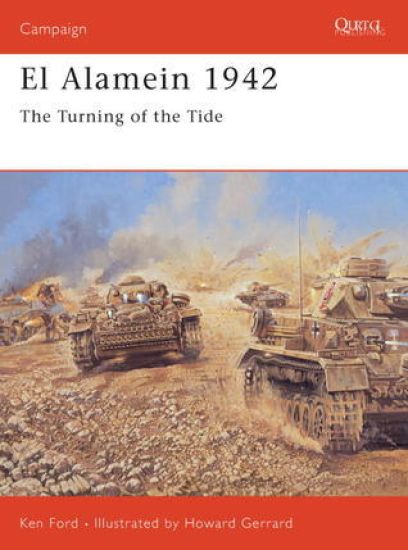
El Alamein 1942

El Alamein 1942

Ken Ford

Osprey Publishing
2005
nidottu
Featuring illustrations throughout, a detailed look at the battle of El Alamein, which marked the turning point in Britain's fortunes in the Second World War.There were three separate battles between July and November 1942, all of which were fought to halt the advance of Rommel's army towards the Suez Canal. This final battle at El Alamein, fought in October and November, saw the continuous bombardment of the German line that Rommel was instructed to hold at all costs by Hitler himself. The Allies shattered the German defences, and Rommel led a westward retreat in order to salvage what was left of the Afrika Korps.This book provides an in-depth analysis of the battle that turned the tide in favour of the Allies in Africa.