Kirjojen hintavertailu. Mukana 11 244 527 kirjaa ja 12 kauppaa.

Kirjahaku

Etsi kirjoja tekijän nimen, kirjan nimen tai ISBN:n perusteella.

6 kirjaa tekijältä Kenneth B. Lifshitz

Donderburg's Pumpkin Vine

Donderburg's Pumpkin Vine

Kenneth B. Lifshitz

Createspace Independent Publishing Platform
2010
nidottu
'Donderburg's Pumpkin Vine' provides a detailed commentary on the frantic preparations made in advance of the long awaited British push, led by the British Navy up the Hudson Valley that occurred in early October of 1777. Other events in Canada had evolved that made the valley's defense critical; Gentleman Johnny Burgoyne was thrusting down thru the Adirondack wilderness towards Albany. The defenses in the Hudson, or North River as it was called, were essential to keeping the British bottled up in New York City and preventing the juncture of Henry Clinton with Burgoyne. Such a juncture, lending them control of the valley, would have split the colonies in two and effectively ended the war. One individual, of remarkable skill (and somewhat dubious morals), an engineer named Thomas Machin was made responsible for creating and designing these defenses by the Commander in Chief George Washington himself. The outcome of the war in every sense hung by the links of that chain he himself had designed, built and emplaced. We chart Thomas Machin's early career from the siege of Boston through his arrival the Hudson Valley pursuant to his assignment to the chain(s) projects and then his part in the Sullivan Expedition of 1779 in damming Lake Otsego and finally through his participation in an artillery bet between Henry Knox and Rochambeau at the siege of Yorktown. This book is based on exhaustive an original research. It gives a unique insight into the various machinations and agendas that even amidst the fomented panic, fueled and gave shape to the great project of the defenses. Excerpt from the Prologue: The Corduroy Road was not completed, indeed not started; the weal of the common good not yet raised. Thus it would remain until late in '79 by which time the war and its clamor had migrated southward along with the honking geese. For now the way would south from New Windsor would remain barred, at least to George Washington and his tired, gaunt troops making their winter trek like ghosts through the snow to their winter quarters in New Jersey and Pennsylvania. For now it would remain, like them perhaps, only the fabric and substance of a pipe dream, --the only sound along it, the swishing of the pines and the faint echo of harness traces jangling amidst the damping snow as the indisputably real and solid oxen hustled their cargoes like spoons down the mountain to meet the gaping mouth of war.
monoville

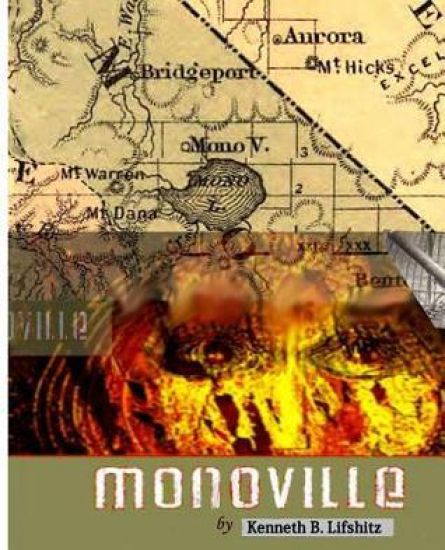
monoville

Kenneth B. Lifshitz

Createspace Independent Publishing Platform
2010
nidottu
Life can be for some a process of progressive marginalization. Life at sea often draws those who prefer to live in those margins, seeking an existence at the very periphery of society, evading its standards even while nominally serving its aims. When Mandelbrot Feuerstool, a member of the U.S. Coastal Survey, finds himself unwillingly trapped in a cycle that draws beyond the pale by the apparent suicide of his captain, Archibald MacRae, he embraces this process. Crossing the line, his own aims become the equivalent of and indistinguishable from criminality, thenceforth finding his only rationale in the commission of further crimes. This complex and compellingly written novel set in post-gold-rush California, Oregon and Washington State revolves around the activities of the individuals in the U.S. Coastal Survey who map the contours of the West Coast as the influx of gold seekers and others swells the bays and ports of the cities. Feuerstool, lurks fitfully and uncomfortably among the intellectuals, painters, scientists and engineers of the survey. His shipboard existence begins to unravel with a trivial disagreement with the Captain of the U.S.C.S Active, John Alden, over the ship's milk ration, this dispute occurring just after the shipboard suicide of the Captain MacRae on the sister ship, U.S.C.S. Ewing. Surprisingly it is the former not the latter that seems most to preoccupy the mind of the quirky Captain Alden. Set in the years leading up to the Civil War, 1855-61 in the American West we find a divided society where larger and larger segments are being progressively disaffected from one another and as the country and West finds itself transformed not just with the Colt 45 but with the moral and scientific imagination. Feuerstool must learn to navigate not only the uncharted, sometimes brutal waters of the Pacific but the shifting boundaries of his own increasingly twisted physical and moral imagination. In refusing to accept boundaries, moral or physical, the gun comes into play as the role of moral arbiter of those boundaries. Then and only then do we learn what physical or emotional lines we are really willing cross. When Feuerstool, unable to answer the questions that pursue him, jumps ship he finds himself assailed by new demons both real and imagined. A natural polymorph, he continually transforms himself even while acting as his own judge and jury--granting himself license to continue in his increasingly questionable pursuits. We find ourselves spectators to this personal transformation and we find him pursued not only by his demons but by newly elected legislator from Mono County, California, T.N. Machin, this for the alleged murder of his prospecting partner Kirlew Hume, a murder committed on an Indian sacred site in the Bishop Tuff. Machin eventually must choose whether to continue the pursuit of Feuerstool or abandon it and take up his elected position in the legislature. Increasingly both their choices hinge on the ability to make sense of the crime or crimes that Feuerstool has committed, (and the growing realization that there are consequences also for those who either abandon or defer the pursuit of justice). Machin, by assuming his elected position must forfeit the moral high ground. Feuerstool, will do the same but through his knack for imitation (and without seemingly forfeiting anything). Like the west itself, the characters do not reach out to welcome the reader's inspection. They seek rather to evade it. Like T.N. Machin, they must determine for themselves when and if the search for meaning and justice should be abandoned. Feuerstool creates for himself the form of his own retribution and it is the utter rationality of his irrationality that makes the punishment so bizarre and him such an intriguingly complex character This is not just a story about the American West but of defining the frontiers of our own personal existenc
Collected Short Stories

Collected Short Stories

Kenneth B. Lifshitz

Createspace Independent Publishing Platform
2011
nidottu
Part I of this collection is mostly autobiographical vignettes written just after the author's (abbreviated) stint at Cornell University -- (with the exception of 'Execution at the Fiar', which was written much later). 'They are presented in chronological order as best I can remember and are of such diverse styles as to resist even the simple act of collating them into a book in any other logical manner. The attentive reader will discern the reason that the styles are so diverse as adolescent experimentation. (Suffice it to say this was a period of experimentation in many ways.) Part II are more modern stories composed mostly as short pieces presented first on blogs and social media.
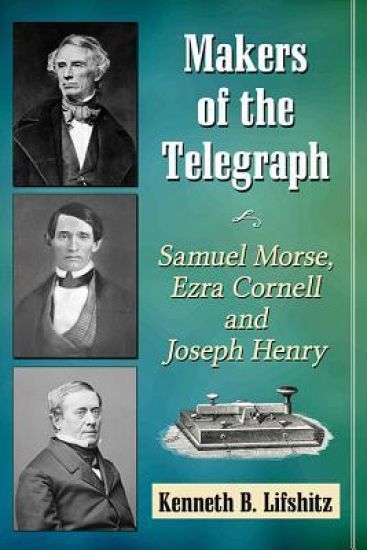
Makers of the Telegraph

Makers of the Telegraph

Kenneth B. Lifshitz

McFarland Co Inc
2017
pokkari
The single-wire telegraph revolutionized long distance communication but it was not the brainchild of one inventor, Samuel Morse. His colleagues and employees--specifically Ezra Cornell and Joseph Henry--made crucial contributions. Examining the careers of the three men and the key events, this book presents Morse as primarily a businessman and consolidator of ideas who, frequently in conflict with his associates, sought to present the telegraph as a uniform system under his sole imprimatur. The battle between Morse and Cornell over the invention of the magnetic relay was central to the drama. What emerges is a complex portrait of three ambitious and brilliant innovators and the age in which they lived.