Kirjojen hintavertailu. Mukana 11 717 486 kirjaa ja 12 kauppaa.

Kirjahaku

Etsi kirjoja tekijän nimen, kirjan nimen tai ISBN:n perusteella.

10 kirjaa tekijältä Kenneth C. Barnes

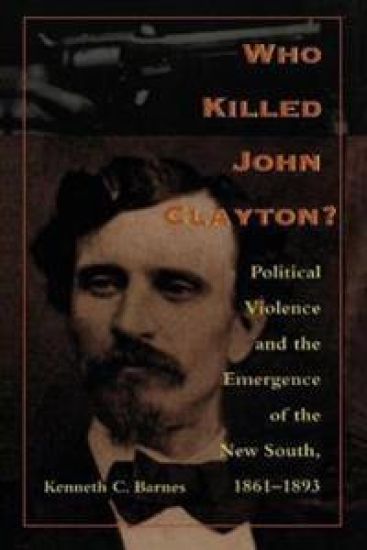
Who Killed John Clayton?

Who Killed John Clayton?

Kenneth C. Barnes

Duke University Press
1998
sidottu
In 1888 a group of armed and masked Democrats stole a ballot box from a small town in Conway County, Arkansas. The box contained most of the county’s black Republican votes, thereby assuring defeat for candidate John Clayton in a close race for the U.S. Congress. Days after he announced he would contest the election, a volley of buckshot ripped through Clayton’s hotel window, killing him instantly. Thus began a yet-to-be-solved, century-old mystery. More than a description of this particular event, however, Who Killed John Clayton? traces patterns of political violence in this section of the South over a three-decade period. Using vivid courtroom-type detail, Barnes describes how violence was used to define and control the political system in the post-Reconstruction South and how this system in turn produced Jim Crow. Although white Unionists and freed blacks had joined under the banner of the Republican Party and gained the upper hand during Reconstruction, during these last decades of the nineteenth century conservative elites, first organized as the Ku Klux Klan and then as the revived Democratic Party, regained power-via such tactics as murdering political opponents, lynching blacks, and defrauding elections.This important recounting of the struggle over political power will engage those interested in Southern and American history.
Who Killed John Clayton?

Who Killed John Clayton?

Kenneth C. Barnes

Duke University Press
1998
pokkari
In 1888 a group of armed and masked Democrats stole a ballot box from a small town in Conway County, Arkansas. The box contained most of the county’s black Republican votes, thereby assuring defeat for candidate John Clayton in a close race for the U.S. Congress. Days after he announced he would contest the election, a volley of buckshot ripped through Clayton’s hotel window, killing him instantly. Thus began a yet-to-be-solved, century-old mystery. More than a description of this particular event, however, Who Killed John Clayton? traces patterns of political violence in this section of the South over a three-decade period. Using vivid courtroom-type detail, Barnes describes how violence was used to define and control the political system in the post-Reconstruction South and how this system in turn produced Jim Crow. Although white Unionists and freed blacks had joined under the banner of the Republican Party and gained the upper hand during Reconstruction, during these last decades of the nineteenth century conservative elites, first organized as the Ku Klux Klan and then as the revived Democratic Party, regained power-via such tactics as murdering political opponents, lynching blacks, and defrauding elections.This important recounting of the struggle over political power will engage those interested in Southern and American history.
A Vast Bundle of Opportunities

A Vast Bundle of Opportunities

Kenneth C. Barnes

TAYLOR FRANCIS LTD
2023
sidottu
The conventional view of religion is that the basic truths were settled long ago, that all we have to do is to accept them and behave accordingly. Essentially then, there is no room for originality. To be religious we have to be followers, adherents, to be convinced, addicted, to be in a position to say: we are right, you are wrong. In A Vast Bundle of Opportunities, originally published in 1975, Kenneth Barnes maintains that this is a sterile condition of mind. Religion is not a separate kind of experience; it includes our whole selves and all that we do. It follows that if art and science can be creative and originative, so also must religion be, if it is real. If it is the Christian religion we are thinking of, then to try to ‘imitate’ Jesus is to kill him stone dead. To make him an ideal is to put him away. But to respond to him is to come alive as creators and originators.The writer, as the founder of an unusual kind of boarding school – Wennington School, Wetherby – knows what it is like to live in the midst of incessant enterprising activity; in his own life he knows what it feels like to be a scientist, an artist, a craftsman. He asks if there are ways we can deliberately choose by which we can become originators. He takes the philosophy of John Macmurrray to show what freedom could mean to us, and the more recent writings of Arthur Koestler and Edouard de Bono to suggest that the obvious development of creativeness in science can be encouraged in the total approach to life and human problems. Life then becomes an experience of endless discovery, a continual opening up of possibilities.
A Vast Bundle of Opportunities

A Vast Bundle of Opportunities

Kenneth C. Barnes

TAYLOR FRANCIS LTD
2025
nidottu
The conventional view of religion is that the basic truths were settled long ago, that all we have to do is to accept them and behave accordingly. Essentially then, there is no room for originality. To be religious we have to be followers, adherents, to be convinced, addicted, to be in a position to say: we are right, you are wrong. In A Vast Bundle of Opportunities, originally published in 1975, Kenneth Barnes maintains that this is a sterile condition of mind. Religion is not a separate kind of experience; it includes our whole selves and all that we do. It follows that if art and science can be creative and originative, so also must religion be, if it is real. If it is the Christian religion we are thinking of, then to try to ‘imitate’ Jesus is to kill him stone dead. To make him an ideal is to put him away. But to respond to him is to come alive as creators and originators.The writer, as the founder of an unusual kind of boarding school – Wennington School, Wetherby – knows what it is like to live in the midst of incessant enterprising activity; in his own life he knows what it feels like to be a scientist, an artist, a craftsman. He asks if there are ways we can deliberately choose by which we can become originators. He takes the philosophy of John Macmurrray to show what freedom could mean to us, and the more recent writings of Arthur Koestler and Edouard de Bono to suggest that the obvious development of creativeness in science can be encouraged in the total approach to life and human problems. Life then becomes an experience of endless discovery, a continual opening up of possibilities.
Anti-Catholicism in Arkansas

Anti-Catholicism in Arkansas

Kenneth C. Barnes

University of Arkansas Press
2016
sidottu
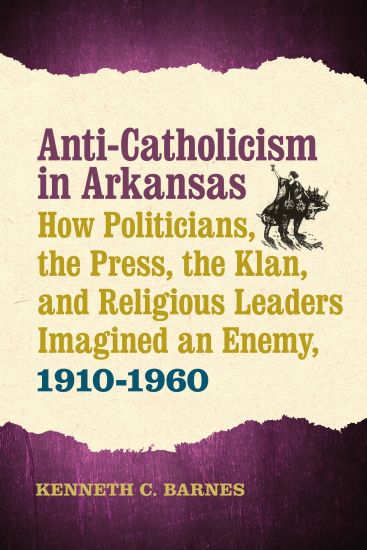
The masthead of the Liberator, an anti-Catholic newspaper published in Magnolia, Arkansas, displayed from 1912 to 1915 an image of the Whore of Babylon. She was an immoral woman sitting on a seven-headed beast, holding a golden cup “full of her abominations,” and intended to represent the Catholic Church.Propaganda of this type was common during a nationwide surge in antipathy to Catholicism in the early twentieth century. This hostility was especially intense in largely Protestant Arkansas, where for example a 1915 law required the inspection of convents to ensure that priests could not keep nuns as sexual slaves.Later in the decade, anti-Catholic prejudice attached itself to the campaign against liquor, and when the United States went to war in 1917, suspicion arose against German speakers—most of whom, in Arkansas, were Roman Catholics.In the 1920s the Ku Klux Klan portrayed Catholics as “inauthentic” Americans and claimed that the Roman church was trying to take over the country’s public schools, institutions, and the government itself. In 1928 a Methodist senator from Arkansas, Joe T. Robinson, was chosen as the running mate to balance the ticket in the presidential campaign of Al Smith, a Catholic, which brought further attention.Although public expressions of anti-Catholicism eventually lessened, prejudice was once again visible with the 1960 presidential campaign, won by John F. Kennedy.Anti-Catholicism in Arkansas illustrates how the dominant Protestant majority portrayed Catholics as a feared or despised “other,” a phenomenon that was particularly strong in Arkansas.
The Ku Klux Klan in 1920s Arkansas

The Ku Klux Klan in 1920s Arkansas

Kenneth C. Barnes

University of Arkansas Press
2021
sidottu
The Ku Klux Klan established a significant foothold in Arkansas in the 1920s, boasting more than 150 state chapters and tens of thousands of members at its zenith. Propelled by the prominence of state leaders such as Grand Dragon James Comer and head of Women of the KKK Robbie Gill Comer, the Klan established Little Rock as a seat of power second only to Atlanta. In The Ku Klux Klan in 1920s Arkansas, Kenneth C. Barnes traces this explosion of white nationalism and its impact on the state's development.Barnes shows that the Klan seemed to wield power everywhere in 1920s Arkansas. Klansmen led businesses and held elected offices and prominent roles in legal, medical, and religious institutions, while the women of the Klan supported rallies and charitable activities and planned social gatherings where cross burnings were regular occurrences. Inside their organization, Klan members bonded during picnic barbeques and parades and over shared religious traditions. Outside of it, they united to direct armed threats, merciless physical brutality, and torrents of hateful rhetoric against individuals who did not conform to their exclusionary vision.By the mid-1920s, internal divisions, scandals, and an overzealous attempt to dominate local and state elections caused Arkansas's Klan to fall apart nearly as quickly as it had risen. Yet as the organization dissolved and the formal trappings of its flamboyant presence receded, the attitudes the Klan embraced never fully disappeared. In documenting this history, Barnes shows how the Klan's early success still casts a long shadow on the state to this day.
The Ku Klux Klan in 1920s Arkansas

The Ku Klux Klan in 1920s Arkansas

Kenneth C. Barnes

University of Arkansas Press
2021
nidottu
The Ku Klux Klan established a significant foothold in Arkansas in the 1920s, boasting more than 150 state chapters and tens of thousands of members at its zenith. Propelled by the prominence of state leaders such as Grand Dragon James Comer and head of Women of the KKK Robbie Gill Comer, the Klan established Little Rock as a seat of power second only to Atlanta. In The Ku Klux Klan in 1920s Arkansas, Kenneth C. Barnes traces this explosion of white nationalism and its impact on the state’s development.Barnes shows that the Klan seemed to wield power everywhere in 1920s Arkansas. Klansmen led businesses and held elected offices and prominent roles in legal, medical, and religious institutions, while the women of the Klan supported rallies and charitable activities and planned social gatherings where cross burnings were regular occurrences. Inside their organization, Klan members bonded during picnic barbeques and parades and over shared religious traditions. Outside of it, they united to direct armed threats, merciless physical brutality, and torrents of hateful rhetoric against individuals who did not conform to their exclusionary vision.By the mid-1920s, internal divisions, scandals, and an overzealous attempt to dominate local and state elections caused Arkansas’s Klan to fall apart nearly as quickly as it had risen. Yet as the organization dissolved and the formal trappings of its flamboyant presence receded, the attitudes the Klan embraced never fully disappeared. In documenting this history, Barnes shows how the Klan’s early success still casts a long shadow on the state to this day.
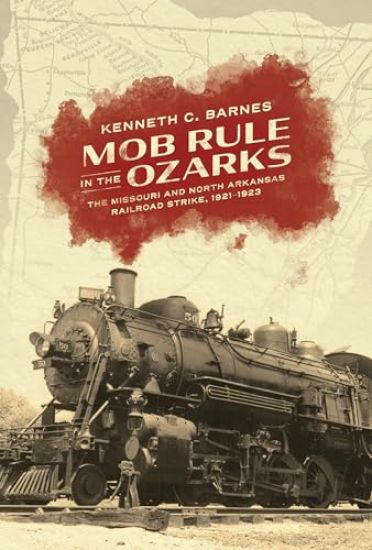
Mob Rule in the Ozarks

Mob Rule in the Ozarks

Kenneth C. Barnes

University of Arkansas Press
2025
sidottu
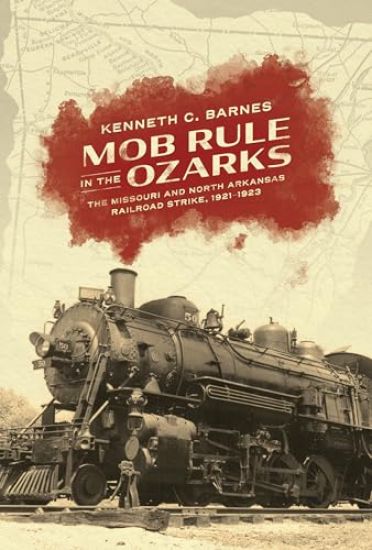
On January 15, 1923, a crowd of more than a thousand angry men assembled in Harrison, Arkansas, near the headquarters of the M&NA Railroad, which ran through the heart of the Ozark Mountains. The mob was prepared to use any measure necessary to end the strike of railroad employees that had dragged on for nearly two years, endangering livelihoods and businesses in an area with few other means of transportation. Supported by local officials, the mob terrorized strikers and sympathizers—many were stripped and beaten, and one man was lynched, hanged from the railroad bridge south of town. Over the next several days, similar riots broke out in other towns along the M&NA line, including Leslie and Heber Springs. This violence effectively brought to a close one of the longest rail strikes in American history—the only one, in fact, ended by a mob uprising. In Mob Rule in the Ozarks, Kenneth C. Barnes documents how the M&NA Railroad strike reflected some of the major economic concerns that preoccupied the United States in the wake of World War I, and created a rupture within communities of the Ozarks that would take years to heal. The conflict also foreshadowed, for both the region and the country, the pendulum’s swing back to moneyed interests, away from Progressive Era gains for labor. Poignantly for Barnes, who sees parallels between this historic struggle and present-day political tensions, the strike revealed the fragile line between civil order and mob rule.
Mob Rule in the Ozarks

Mob Rule in the Ozarks

Kenneth C. Barnes

University of Arkansas Press
2024
nidottu
On January 15, 1923, a crowd of more than a thousand angry men assembled in Harrison, Arkansas, near the headquarters of the M&NA Railroad, which ran through the heart of the Ozark Mountains. The mob was prepared to use any measure necessary to end the strike of railroad employees that had dragged on for nearly two years, endangering livelihoods and businesses in an area with few other means of transportation. Supported by local officials, the mob terrorized strikers and sympathizers—many were stripped and beaten, and one man was lynched, hanged from the railroad bridge south of town. Over the next several days, similar riots broke out in other towns along the M&NA line, including Leslie and Heber Springs. This violence effectively brought to a close one of the longest rail strikes in American history—the only one, in fact, ended by a mob uprising. In Mob Rule in the Ozarks, Kenneth C. Barnes documents how the M&NA Railroad strike reflected some of the major economic concerns that preoccupied the United States in the wake of World War I, and created a rupture within communities of the Ozarks that would take years to heal. The conflict also foreshadowed, for both the region and the country, the pendulum’s swing back to moneyed interests, away from Progressive Era gains for labor. Poignantly for Barnes, who sees parallels between this historic struggle and present-day political tensions, the strike revealed the fragile line between civil order and mob rule.
Nazism, Liberalism, and Christianity

Nazism, Liberalism, and Christianity

Kenneth C. Barnes

The University Press of Kentucky
1991
sidottu
The Great Depression devastated the economies of both Germany and Great Britain. Yet the middle classes in the two countries responded in vastly different ways. German Protestants, perceiving a choice among a Bolshevik-style revolution, the chaos and decadence of Weimar liberalism, and Nazi authoritarianism, voted Hitler into power and then acquiesced in the resulting dictatorship. In Britain, Labour and Tory politicians moved gingerly together to form a National Government that muddled through the Depression with piecemeal reform. In this troubling book about troubled times, Kenneth Barnes looks into the question of how theologians and church leaders contributed to a cultural matrix that predisposed Protestants in these two countries to very different political alternatives. Holding fast to the liberal social gospel, British churchmen diagnosed the problems of the 1920s and the Depression ao solvable and called for genuine reforms, many of which foreshadowed the coming welfare state. German leaders, in contrast, were terrified by the socioeconomic and political problems of the Weimar era and offered no social message or solution. Despairingly, they referred the problems to secular politicians and after 1933 beat the drum for obedience to the Nazi state. Based on extensive research in European archives, especially the rich papers of the interwar ecumenical movement housed at the World Council of Churches in Geneva, this book examines key intellectual figures such as Karl Barth, Paul Tillich, Dietrich Bonhoeffer, and Archbishop William Temple, as well as many lesser known church officials and theologians. Barnes brings to life the intellectual struggles and dilemmas of the interwar period to help explain why good people could, for moral and religious reasons, choose opposing courses of political action.