Kirjojen hintavertailu. Mukana 12 016 292 kirjaa ja 12 kauppaa.

Kirjahaku

Etsi kirjoja tekijän nimen, kirjan nimen tai ISBN:n perusteella.

6 kirjaa tekijältä Kenneth Dyson

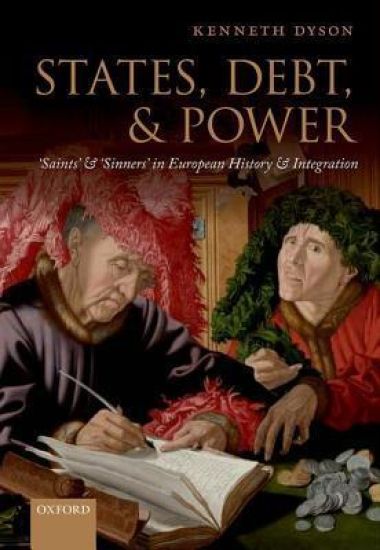
States, Debt, and Power

States, Debt, and Power

Kenneth Dyson

Oxford University Press
2014
sidottu
States, Debt, and Power argues for the importance of situating our contextually influenced thinking about European states and debt within a commitment to historically informed and critical analysis. It teases out certain broad historical patterns. The book also examines the inescapably difficult and contentious judgements about 'bad' and 'good' debt; about what constitutes sustainable debt; and about distributive justice at times of sovereign debt crisis. These judgements offer insight into the nature of power and the contingent nature of sovereign creditworthiness. Three themes weave through the book: the significance of creditor-debtor state relations in defining asymmetry of power; the context-specific and constructed character of debt, above all in relation to war; and the limitations of formal economic reasoning in the face of radical uncertainty. Part I examines case studies from Ancient Greece to the modern Euro Area and brings together a wealth of historical data that cast fresh light on how sovereign debt problems are debated and addressed. Part II looks at the conditioning and constraining framework of law, culture, and ideology and their relationship to the use of policy instruments. Part III shows how the problems of matching the assumption of liability with the exercise of control are rooted in external trade and financial imbalances and external debt; in financial markets and vulnerability to banking crisis; in the character of the 'private governance of public debt'; in who has power over indicators of sustainability; in domestic institutional and political arrangements; and in sub-national fiscal governance. Part IV looks at how the problems of mismatch between liability and control take on an acute form within the historical context of European monetary union, above all in Euro Area debt crises.
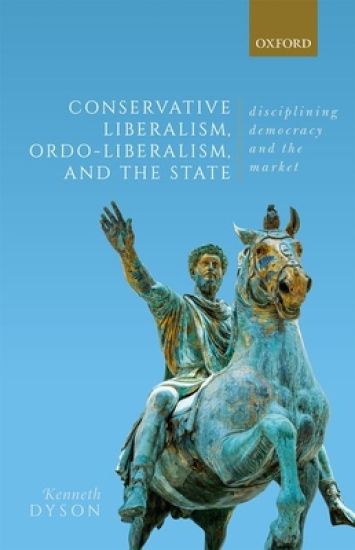
Conservative Liberalism, Ordo-liberalism, and the State

Conservative Liberalism, Ordo-liberalism, and the State

Kenneth Dyson

Oxford University Press
2021
sidottu
This book uses extensive original archival and elite interview research to examine the attempt to rejuvenate liberalism as a means of disciplining democracy and the market through a new rule-based economic and political order. This rebirth took the form of conservative liberalism and, in its most developed form, Ordo-liberalism. It occurred against the historical background of the great transformational crisis of liberalism in the first part of the twentieth century. Conservative liberalism evolved as a cross-national phenomenon. It included such eminent and cultured liberal economists as James Buchanan, Frank Knight, Henry Simons, Ralph Hawtrey, Jacques Rueff, Luigi Einaudi, Walter Eucken, Friedrich Hayek, Alfred Müller-Armack, Wilhelm Röpke, Alexander Rüstow, and Paul van Zeeland, as well as leading lawyers like Louis Brandeis, Franz Böhm, and Maurice Hauriou. Conservative liberals also played a formative role in establishing new international networks, notably the Mont Pèlerin Society. The book investigates the rich intellectual inheritance of this variant of new liberalism from aristocratic liberalism, ethical philosophy, and religious thought. It also locates the social basis of conservative liberalism and Ordo-liberalism in the cultivated bourgeois intelligentsia. The book goes on to examine the attempts to embed this new disciplinary form of liberalism in Britain, France, Germany, Italy, and the United States, and to consider the determinants of its varying significance across space and over time. It concludes by assessing the historical significance and contemporary relevance of conservative liberalism and Ordo-liberalism as liberalism confronts a new transformational crisis at the beginning of the new millennium. Is their promise of disciplining democracy and the market a hollow one?
The Politics of the Euro-Zone

The Politics of the Euro-Zone

Kenneth Dyson

Oxford University Press
2000
sidottu
The Euro-Zone represents the single most important step in European Integration since 1957 and one of the boldest economic, monetary, and political projects in modern history. In this first major study, the author examines the major political questions raised by the birth of the Euro-Zone on January 1 1999 and argues for a more politically informed analysis and assessment of its nature, operation, and prospects. How does the Euro-Zone operate? What does it mean for European States and for the political strategies of governments? How is its operation to be explained? What are its prospects for stability? What kinds of policies are needed to strengthen its capacity to withstand crisis? The book stresses the ECB-centric nature of the Euro-Zone and its implications both for policy and polices in Europe and for theories of integration. The ECB emerges as a powerful 'policy pusher' and 'ideational leader', with an authority and power exceeding that of the European Commission in the integration process. Dyson examines the elated problems of social justice, democratic consent, and identity. He also argues that the Euro-Zone represents a process of transition to the EU as a 'stabilization Staten An innovative aspect of the book is its application of a strength-strain model for the purpose of analyzing and assessing the stability of the Euro-Zone. It concludes that the stability of the Euro-Zone will be strongly conditioned by three factors: how Kantian rather than Hobbesian or Lockeian its political culture proves to be, with a key reproducibility failing here on the quality of political leadership; its possession of policy interments to tackle liquidity as well as debt traps; and the speed and efficiency of mechanisms of 'bench marking, policy transfer, and 'lesson-drawing'.
Small and Medium Sized Enterprises

Small and Medium Sized Enterprises

Kenneth Dyson

Routledge
1989
nidottu
The single European market after 1992 presents a major challenge to small and medium-sized companies in the Community. Whether it is developing exports and/or fighting off new imports, Europe's entrepreneurs will have to `think European'. Moreover, the European Community institutions themselves have developed special policies designed to promote the interests of Europe's smaller companies. This volume explains how the EC's policies towards small and medium-sized enterprises have developed and what they currently entail. It guides the reader through the various EC policy initiatives and the new legislation - including that in the `1992' package - relevant to the smaller business company. It offers summaries of the key EC documents concerned, and presents a full listing of all the other relevant proposals and policies. Like the others in this series, the volume is both comprehensive and up-to-date: it discusses not only what the EC has done which is relevant to small businesses, but also what it is proposing to do in the future.
The State Tradition in Western Europe
Why have continental European societies developed the idea of the abstract impersonal state as the fundamental institution of political rule? Why, on the other hand, has this idea played a relatively insignificant part in the history of English-speaking countries? It is to such questions that this major study is addressed. With clarity and conciseness, Kenneth Dyson examines the fascinating tapestry of thought about public authority that the state tradition represents, and identifies the major individual contributions to that tapestry. In addition to offering a clear conceptualisation of state, he deals with such key issues as the role of the intellectual, the social function of state theories, and the difficulties of accommodating state and democracy.
Small and Medium Sized Enterprises

Small and Medium Sized Enterprises

Kenneth Dyson

Routledge
2017
sidottu
The single European market after 1992 presents a major challenge to small and medium-sized companies in the Community. Whether it is developing exports and/or fighting off new imports, Europe's entrepreneurs will have to `think European'. Moreover, the European Community institutions themselves have developed special policies designed to promote the interests of Europe's smaller companies. This volume explains how the EC's policies towards small and medium-sized enterprises have developed and what they currently entail. It guides the reader through the various EC policy initiatives and the new legislation - including that in the `1992' package - relevant to the smaller business company. It offers summaries of the key EC documents concerned, and presents a full listing of all the other relevant proposals and policies. Like the others in this series, the volume is both comprehensive and up-to-date: it discusses not only what the EC has done which is relevant to small businesses, but also what it is proposing to do in the future.