Kirjojen hintavertailu. Mukana 11 244 527 kirjaa ja 12 kauppaa.

Kirjahaku

Etsi kirjoja tekijän nimen, kirjan nimen tai ISBN:n perusteella.

11 kirjaa tekijältä Kenneth E. Boulding

Stable Peace

Stable Peace

Kenneth E. Boulding

University of Texas Press
1978
nidottu
The human race has often put a high value on struggle, strife, turmoil, and excitement. Peace has been regarded as a utopian, unattainable, perhaps dull ideal or as some random element over which we have no control. However, the desperate necessities of the nuclear age have forced us to take peace seriously as an object of both personal and national policy. Stable Peace attempts to answer the question, If we had a policy for peace, what would it look like? A policy for peace aims to speed up the historically slow, painful, but persistent transition from a state of continual war and turmoil to one of continual peace. In a stable peace, the war-peace system is tipped firmly toward peace and away from the cycle of folly, illusion, and ill will that leads to war. Boulding proposes a number of modest, easily attainable, eminently reasonable policies directed toward this goal. His recommendations include the removal of national boundaries from political agendas, the encouragement of reciprocal acts of good will between potential enemies, the exploration of the theory and practice of nonviolence, the development of governmental and nongovernmental organizations to promote peace, and the development of research in the whole area of peace and conflict management. Written in straightforward, lucid prose, Stable Peace will be of importance to politicians, policy makers, economists, diplomats, all concerned citizens, and all those interested in international relations and the resolution of conflict.
The Structure of a Modern Economy

The Structure of a Modern Economy

Kenneth E. Boulding

Palgrave Macmillan
1993
sidottu
This book is a study of the American economy from 1929 to 1989 through the analysis of national income statistics and other data. It reaches important conclusions regarding the causes of unemployment, the relation of inflation to the stock of liquid assets and the budget deficit, the proportion of the population in poverty, the gap between interest and profit rates, the relation of productivity to income. These conclusions are discussed using graphs and diagrams extensively.
Image

Image

Kenneth E. Boulding

The University of Michigan Press
1956
nidottu
Behavior depends on the image—the sum of what we think we know and what makes us act the way we do. The image lies behind the actions of every individual. It accounts for the growth of every cause. To recognize the image is to begin to understand the scientist, the believer, the crusader, the soldier. To know its shape is the key to psychoanalysis, public opinion polling, and social psychology. Professor Kenneth Boulding, eminent economist and author of Organizational Revolution, illuminates with the image of all modern knowledge: biology, psychology, sociology, political science, economics, and history. And he proposes a new science, "eiconics," to restructure all that is presently known about man.
Three Faces of Power

Three Faces of Power

Kenneth E. Boulding

SAGE Publications Inc
1990
nidottu
Three Faces of Power offers the best of Kenneth Boulding: bold, innovative perspectives on past and present concepts. His creative analysis lays the groundwork for important future debates about power. Boulding explains that power can be divided into three major categories: threat power; economic power; and integrative power. Turning general deterrence theory on its head, he argues that the greatest error is to regard threat power as fundamental, for it is not effective unless it is reinforced by economic and integrative power. His conclusion has wide-ranging application to everything from the nuclear weapons debate to intimate personal relationships. Power. The word alone evokes images of great empires, of human misery, of personal triumphs and failures. Yet power has been--and continues to be--one of the most misunderstood concepts known to mankind. Now, in a fascinating new volume, Kenneth Boulding marshalls his remarkable intellectual talents to explore and analyze the nature of power. Three Faces of Power offers the best of Kenneth Boulding: bold, innovative perspectives on past and present concepts. His creative analysis lays the groundwork for important future debates about power. Boulding explains that power can be divided into three major categories: o Threat power, destructive in nature and applied particularly to political life. o Economic power, resting largely on the power to produce and exchange items--and on the constantly changing distribution of property ownership. o Integrative power, based on such relationships as legitimacy, respect, affection, love, community, and identity. Turning general deterrence theory on its head, Boulding argues that the greatest error is to regard threat power as fundamental, for it is not effective unless it is reinforced by economic and integrative power. His conclusion has wide-ranging application to everything from the nuclear weapons debate to intimate personal relationships. Three Faces of Power provides a refreshingly optimistic and challenging call to a world future secured through the power of human interaction and knowledge. It will prove essential reading for students and academics in all areas of the social sciences, especially peace studies, political science, sociology, family studies, communication, organizational studies, social psychology, and international relations. "With deft strokes of wit and delightfully apt analogies Boulding shares his profound insights into the most important component of human relations--power; its manifestations in brutal exploitation, in give and take relations among equals, and in mutually nurturing cooperating human beings. Boulding's inimitable charm shines through the plain language of common experience on every page of this book for everyone." --Anatol Rapoport, University of Toronto "Original, as always." --Future Survey "This book is vintage Boulding. Few people writing today in social science, much less in economics, give evidence of the broad erudition which Boulding invariably displays. He chooses examples of the points he wishes to make with breathtaking leaps through history and culture. The reader who dips into this book by Boulding is in for a challenging and thought-provoking experience." --The Journal of Economic Issues "Innovative and fascinating." --The Futurist "This is an immensely charming book, easily readable, written in a plain, almost folksy prose-style....It glides effortlessly over its topic." --Organization Studies "The value of reading this book is that of personal discovery. Besides the many glittering economic ideas and suggestions lying about like diamonds in a field, his essay provokes self-knowledge. You as an economist will know a lot more about yourself and the failures and successes of your profession after reading this book." --American Journal of Agricultural Economics "Three Faces of Power is Kenneth Boulding's innovative and thought-provoking study of power, in which he categorically rejects the traditional importance of threat (destructive) power. Instead, he offers a bold, new thesis: 'It is integrative power that is the most dominant and significant form of power, in the sense that neither threat power nor economic power can achieve very much in the absence of legitimacy, which is one of the more important aspects of integrative power.' . . . Well written and provocative, Three Faces of Power is both scholarly and down to earth. Undeniably, Three Faces of Power will stimulate much discussion about power, but, equally important, it is an eloquent plea for peace." --International Journal on World Peace
Economics As a Science

Economics As a Science

Kenneth E. Boulding

University Press of America
1988
nidottu
Useful for early and intermediate level college economics classes, this book introduces those with some knowledge of economics to the larger scientific background of the subject. Specifically, it focuses on economics as a behavioral science, as a political science, a mathematical science, a moral science and finally it looks at the successes and failures of economics and what it portends for the future. Originally published in 1970 by McGraw-Hill, this edition contains an updated appendix and new preface.
The Meaning of the 20th Century

The Meaning of the 20th Century

Kenneth E. Boulding

University Press of America
1988
nidottu
As relevant today as when it was first published in 1965 by Harper and Row, this book looks at the 20th century as a critical era in the great transition from a civilized to a post-civilized society. The 20th century itself is seen as an ongoing evolutionary process. The author focuses on three "traps" which would prevent this transition from taking place: the "war trap", the "population trap", and the "entropy trap". And he outlines strategies for the 21st century for overcoming these traps.
The Economics of Human Betterment

The Economics of Human Betterment

Kenneth E. Boulding

State University of New York Press
1985
sidottu
The Economics of Human Betterment is a comparative look at economic change and social progress. It is about betterment-a change or process-and about institutions and countries as they evolve. It is about human betterment-and therefore concerned with perceived welfare and the identification of basic human needs. And it is about economics, but about means as means, not means as ends. This book asks in what way productive activities (whether free market or planned, whether in developed or in developing countries) influence and reflect basic human values.The essays contained herein represent some of the best up-to-date accounts available on such topics as the welfare state in Holland or the relationship between growth and betterment in Singapore. Other essays take in the United Kingdom, Japan, India, and the planned economy of the Soviet Union. The contributors are all well-known experts in their own field. And their essays reveal a common conviction that economics is about people first, and about things only in so far as they contribute to human betterment.
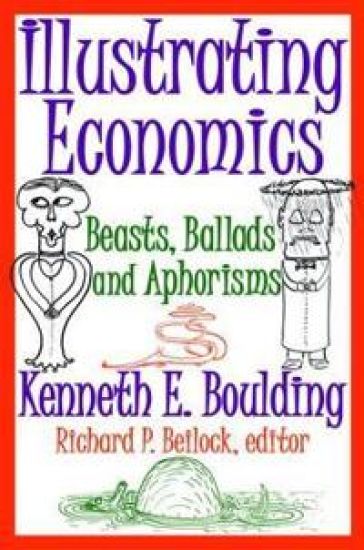
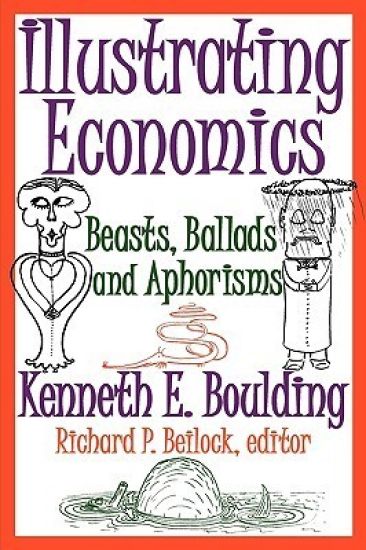
Illustrating Economics

Illustrating Economics

Kenneth E. Boulding

Routledge
2017
sidottu
This volume is a sampling of quips, verses, drawings, and even the music of one of the most original and versatile minds of the twentieth century, Kenneth Boulding prominent economist, lecturer, and author.The driving force behind Kenneth Boulding's wideranging book is that he truly en joys all that he does. Indeed, his greatest accomplishment may very well be that he was a profoundly happy man. This is reflected in works that are laced with beauty, wit, and extraordinary imagery-works that are often composed and appeared in the most unexpected of places. In the midst of one of the classic textbooks of his generally staid profession, Economic Analysis, Boulding introduced the "bathtub theorem." Illustrating Economics: Beasts, Ballads and Aphorisms is a collection of similar instances and, as such, it is fun.The reader should be advised that the book contains traps. Boulding coats his ideas with sugar to please his audience as well as promote consumption. He describes peace as "a drab girl with an olive branch corsage whom no red-blooded American (or Russian) could conceivably warm up to." The reader smiles at the recognition of the truth inherent within the image and ponders the irony of why so fine a state as peace should be regarded as dull, and so ugly a condition as war should be regarded as romantic. This book is for enjoyment, but it should carry the following warning: Caution-Reading this may be stimulating to your intellect.
The Structure of a Modern Economy

The Structure of a Modern Economy

Kenneth E. Boulding

Palgrave Macmillan
1993
nidottu
This book is a study of the American economy from 1929 to 1989 through the analysis of national income statistics and other data. It reaches important conclusions regarding the causes of unemployment, the relation of inflation to the stock of liquid assets and the budget deficit, the proportion of the population in poverty, the gap between interest and profit rates, the relation of productivity to income. These conclusions are discussed using graphs and diagrams extensively.
Illustrating Economics

Illustrating Economics

Kenneth E. Boulding

AldineTransaction
2009
nidottu
This volume is a sampling of quips, verses, drawings, and even the music of one of the most original and versatile minds of the twentieth century, Kenneth Boulding prominent economist, lecturer, and author.The driving force behind Kenneth Boulding's wideranging book is that he truly en joys all that he does. Indeed, his greatest accomplishment may very well be that he was a profoundly happy man. This is reflected in works that are laced with beauty, wit, and extraordinary imagery-works that are often composed and appeared in the most unexpected of places. In the midst of one of the classic textbooks of his generally staid profession, Economic Analysis, Boulding introduced the "bathtub theorem." Illustrating Economics: Beasts, Ballads and Aphorisms is a collection of similar instances and, as such, it is fun.The reader should be advised that the book contains traps. Boulding coats his ideas with sugar to please his audience as well as promote consumption. He describes peace as "a drab girl with an olive branch corsage whom no red-blooded American (or Russian) could conceivably warm up to." The reader smiles at the recognition of the truth inherent within the image and ponders the irony of why so fine a state as peace should be regarded as dull, and so ugly a condition as war should be regarded as romantic. This book is for enjoyment, but it should carry the following warning: Caution-Reading this may be stimulating to your intellect.
Towards a New Economics

Towards a New Economics

Kenneth E. Boulding

Edward Elgar Publishing Ltd
1992
sidottu
Kenneth Boulding has, in the course of a long and distinguished career, made a seminal contribution to many branches of economics. This major book presents in one volume a selection of his most important recent papers and essays. In the first part of the book, Professor Boulding pushes economics towards a more evolutionary type of theory, towards a greater interest in the real world and towards some fairly specific theoretical positions. He stresses the importance of positive-feedback as well as equilibrium processes. The second part focuses on the grants economy, that is the study of the economics of one-way transfers. In part three, he turns his attention to international economic relations particularly the economics of conflict in unilateral national defence. The final part is on ecological systems, stressing that economies are essentially an eco-system of commodities, part of the total eco-system of the world, which is undergoing a constant and irreversible evolutionary change.