Kirjojen hintavertailu. Mukana 11 244 527 kirjaa ja 12 kauppaa.

Kirjahaku

Etsi kirjoja tekijän nimen, kirjan nimen tai ISBN:n perusteella.

3 kirjaa tekijältä Kenneth Falconer

Fractals

Fractals

Kenneth Falconer

Oxford University Press
2013
nidottu
Many are familiar with the beauty and ubiquity of fractal forms within nature. Unlike the study of smooth forms such as spheres, fractal geometry describes more familiar shapes and patterns, such as the complex contours of coastlines, the outlines of clouds, and the branching of trees. In this Very Short Introduction, Kenneth Falconer looks at the roots of the 'fractal revolution' that occurred in mathematics in the 20th century, presents the 'new geometry' of fractals, explains the basic concepts, and explores the wide range of applications in science, and in aspects of economics. This is essential introductory reading for students of mathematics and science, and those interested in popular science and mathematics. ABOUT THE SERIES: The Very Short Introductions series from Oxford University Press contains hundreds of titles in almost every subject area. These pocket-sized books are the perfect way to get ahead in a new subject quickly. Our expert authors combine facts, analysis, perspective, new ideas, and enthusiasm to make interesting and challenging topics highly readable.
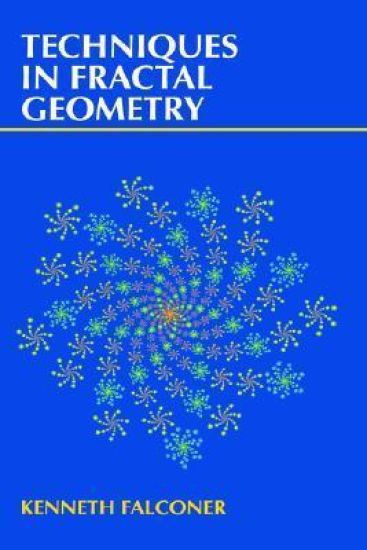
Techniques in Fractal Geometry

Techniques in Fractal Geometry

Kenneth Falconer

John Wiley Sons Inc
1997
sidottu
Following on from the success of Fractal Geometry: Mathematical Foundations and Applications, this new sequel presents a variety of techniques in current use for studying the mathematics of fractals. Much of the material presented in this book has come to the fore in recent years. This includes methods for studying dimensions and other parameters of fractal sets and measures, as well as more sophisticated techniques such as thermodynamic formalism and tangent measures. In addition to general theory, many examples and applications are described, in areas such as differential equations and harmonic analysis. This book is mathematically precise, but aims to give an intuitive feel for the subject, with underlying concepts described in a clear and accessible manner. The reader is assumed to be familiar with material from Fractal Geometry, but the main ideas and notation are reviewed in the first two chapters. Each chapter ends with brief notes on the development and current state of the subject. Exercises are included to reinforce the concepts. The author's clear style and up-to-date coverage of the subject make this book essential reading for all those who with to develop their understanding of fractal geometry.
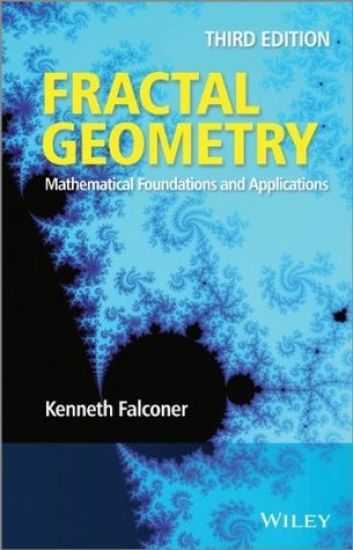
Fractal Geometry

Fractal Geometry

Kenneth Falconer

Wiley-Blackwell
2014
sidottu
The seminal text on fractal geometry for students and researchers: extensively revised and updated with new material, notes and references that reflect recent directions. Interest in fractal geometry continues to grow rapidly, both as a subject that is fascinating in its own right and as a concept that is central to many areas of mathematics, science and scientific research. Since its initial publication in 1990 Fractal Geometry: Mathematical Foundations and Applications has become a seminal text on the mathematics of fractals. The book introduces and develops the general theory and applications of fractals in a way that is accessible to students and researchers from a wide range of disciplines. Fractal Geometry: Mathematical Foundations and Applications is an excellent course book for undergraduate and graduate students studying fractal geometry, with suggestions for material appropriate for a first course indicated. The book also provides an invaluable foundation and reference for researchers who encounter fractals not only in mathematics but also in other areas across physics, engineering and the applied sciences. Provides a comprehensive and accessible introduction to the mathematical theory and applications of fractalsCarefully explains each topic using illustrative examples and diagramsIncludes the necessary mathematical background material, along with notes and references to enable the reader to pursue individual topicsFeatures a wide range of exercises, enabling readers to consolidate their understandingSupported by a website with solutions to exercises and additional material www.wileyeurope.com/fractal Leads onto the more advanced sequel Techniques in Fractal Geometry (also by Kenneth Falconer and available from Wiley)