Kirjojen hintavertailu. Mukana 11 342 296 kirjaa ja 12 kauppaa.

Kirjahaku

Etsi kirjoja tekijän nimen, kirjan nimen tai ISBN:n perusteella.

10 kirjaa tekijältä Kenneth J. Arrow

Collected Papers of Kenneth J. Arrow

Collected Papers of Kenneth J. Arrow

Kenneth J. Arrow

Harvard University Press
1984
sidottu
Unlike the papers of some other great economists, those of Kenneth Arrow are being read and studied today with even greater care and attention than when they first appeared in the journals. The publication of his collected papers will therefore be welcomed by economists and other social scientists and in particular by graduate students, who can draw from them the deep knowledge and the discernment in selection of scientific problems that only a master can offer. The author has added headnotes to certain well-known papers, describing how he came to write them.In this first volume, Arrow takes up the basic question of whether collective choices can be made in such a way as to reflect individual preferences. The seminal 1950 paper that opens the volume shows that given certain reasonable conditions that social choices must satisfy to reflect individual preferences, it is impossible to make a choice among all sets of alternatives without violating some of the conditions. The subsequent papers extend, deepen, and clarify these results and examine the concept of justice, both in the abstract and in economic models. The volume also contains searching critiques of the theories of justice of John Rawls and Robert Nozick.
Collected Papers of Kenneth J. Arrow

Collected Papers of Kenneth J. Arrow

Kenneth J. Arrow

The Belknap Press
1984
sidottu
Unlike the papers of some other great economists, those of Kenneth Arrow are being read and studied today with even greater care and attention than when they first appeared in journals. This publication of his collected papers, to be completed in seven topical volumes, will be welcomed by economists and other social scientists and in particular by graduate students, who can draw from them the deep knowledge and taste in the selection of scientific problems that only a master can offer.This volume is concerned with the foundations of neo-classical economic analysis. General equilibrium is a theory of prices in which all of the actions of the economic agents in an economy are determined simultaneously and in a decentralized fashion. The price system, determined in competitive markets, guides actions for both firms and individual consumers. All of the complex interrelations of the economy are distilled into the determination of this price system.In these papers, Arrow examines the conditions under which such a price system would exist. He also clarifies the conditions under which the system can or cannot achieve an optimum. In the latter case, when “market failures” are present, he shows the role of a benevolent government in helping to overcome the induced inefficiencies.
Collected Papers of Kenneth J. Arrow

Collected Papers of Kenneth J. Arrow

Kenneth J. Arrow

Harvard University Press
1984
sidottu
Unlike the papers of some other great economists, those of Kenneth Arrow are being read and studied today with even greater care and attention than when they first appeared in the journals. The publication of his collected papers will therefore be welcomed by economists and other social scientists and in particular by graduate students, who can draw from them the deep knowledge and the discernment in selection of scientific problems that only a master can offer. The author has added headnotes to certain well-known papers, describing how he came to write them.The third volume of Kenneth Arrow's Collected Papers concerns the basic concept of rationality as it applies to an economic decision maker. In particular, it addresses the problem of choice faced by consumers in a multicommodity world and presents specific models of choice useful in economic analysis. It also discusses choice models under uncertainty, giving the basic theory and critiques of this theory based on experimental evidence and applications. Among the major papers are "Alternative Approaches to the Theory of Choice in Risk-Taking Situations," a masterly survey of subjective probability and choice theory, and "The Theory of Risk Aversion," an exposition of the theory of choice under uncertainty.
Collected Papers of Kenneth J. Arrow

Collected Papers of Kenneth J. Arrow

Kenneth J. Arrow

Harvard University Press
1984
sidottu
Unlike the papers of some other great economists, those of Kenneth Arrow are being read and studied today with even greater care and attention than when they first appeared in the journals. The publication of his collected papers will therefore be welcomed by economists and other social scientists and in particular by graduate students, who can draw from them the deep knowledge and the discernment in selection of scientific problems that only a master can offer. The author has added headnotes to certain well-known papers, describing how he came to write them.This volume begins with Arrow's papers on statistical decision theory, which served as a foundation for his work on the economics of information. As he writes in his preface, "Statistical method was an example for the acquisition of information. In a world of uncertainty, it was no great leap to realize that information is valuable in an economic sense." The later, applied papers, which operationalize the theory of the early ones, include essays on the demand for information, the economic value of screening devices, and the effect of incomplete information on the structure of organizations, futures markets, and insurance.
Collected Papers of Kenneth J. Arrow

Collected Papers of Kenneth J. Arrow

Kenneth J. Arrow

Harvard University Press
1985
sidottu
Unlike the papers of some other great economists, those of Kenneth Arrow are being read and studied today with even greater care and attention than when they first appeared in the journals. The publication of his collected papers will therefore be welcomed by economists and other social scientists and in particular by graduate students, who can draw from them the deep knowledge and the discernment in selection of scientific problems that only a master can offer. The author has added headnotes to certain well-known papers, describing how he came to write them.The study of production is central to economic theory, and capital and its accumulation are two of the most interesting aspects of the modern production process. Capital may take the form of inventories of inputs, inventories of outputs, or machines and other fixed goods. The essential and unique aspect of all types of capital is that it must be accumulated as the result of prior stages of the production process. This gives the dynamic theory of production a recursive structure that can be exploited by economic analysis. The optimization of production under recursive conditions lends itself to general mathematical methods of dynamic programming and optimal control theory. This is the main theme of the essays included in this fifth volume of Kenneth Arrow's Collected Papers.
Collected Papers of Kenneth J. Arrow

Collected Papers of Kenneth J. Arrow

Kenneth J. Arrow

Harvard University Press
1985
sidottu
Unlike the papers of some other great economists, those of Kenneth Arrow are being read and studied today with even greater care and attention than when they first appeared in the journals. The publication of his collected papers will therefore be welcomed by economists and other social scientists and in particular by graduate students, who can draw from them the deep knowledge and the discernment in selection of scientific problems that only a master can offer. The author has added headnotes to certain well-known papers, describing how he came to write them.Although economic theory has been Kenneth Arrow's comparative advantage as well as his special interest, from time to time he has turned his attention to applied problems, often with unexpected results. A request from the Ford Foundation to write a survey of health economics led to his famous paper, "Uncertainty and the Welfare Economics of Medical Care," which raised for the first time many issues in the economics of information, particularly what are now called incentive compatibility issues. Other fruitful papers included in this volume deal with racial discrimination, the cost of oil imports, health insurance, environmental resources, and urban economics. Arrow's main interest in studying these disparate problems has been their potential source for new theory as well as their policy applications.
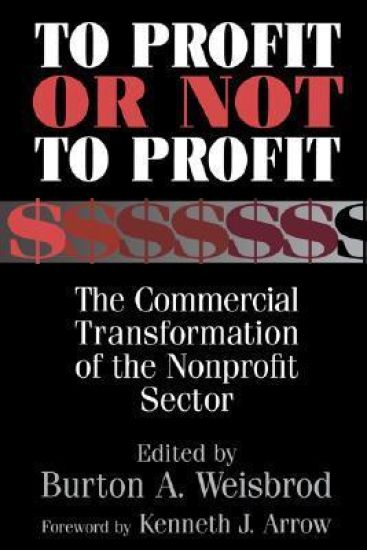
To Profit or Not to Profit

To Profit or Not to Profit

Kenneth J. Arrow

Cambridge University Press
1998
sidottu
Nonprofit organizations are increasingly resembling private firms in a transformation bringing with it a shift in financial dependence from charitable donation to commercial sales activity. This book examines the reasons and consequences of the mimicry of private firms by fundraising nonprofits. User fees and revenue from ‘ancillary’ activities are mushrooming, with each having important side effects: pricing out of the market certain target groups; or distracting the nonprofit from its central mission. The authors focus first on issues that apply to nonprofits generally: the role of competition, analysis of nonprofit organization behavior, the effects of distribution goals and differential taxation of nonprofit and for-profit activity revenue, the effects of changes in donations on commercial activity, and conversions of nonprofits to for-profits. They then turn to specific industries: hospitals, universities, social service providers, zoos, museums, and public broadcasting. The book concludes with recommendations for research and for public policy toward nonprofits.
To Profit or Not to Profit

To Profit or Not to Profit

Kenneth J. Arrow

Cambridge University Press
2000
pokkari
Nonprofit organizations are increasingly resembling private firms in a transformation bringing with it a shift in financial dependence from charitable donation to commercial sales activity. This book examines the reasons and consequences of the mimicry of private firms by fundraising nonprofits. User fees and revenue from ‘ancillary’ activities are mushrooming, with each having important side effects: pricing out of the market certain target groups; or distracting the nonprofit from its central mission. The authors focus first on issues that apply to nonprofits generally: the role of competition, analysis of nonprofit organization behavior, the effects of distribution goals and differential taxation of nonprofit and for-profit activity revenue, the effects of changes in donations on commercial activity, and conversions of nonprofits to for-profits. They then turn to specific industries: hospitals, universities, social service providers, zoos, museums, and public broadcasting. The book concludes with recommendations for research and for public policy toward nonprofits.
On Ethics and Economics

On Ethics and Economics

Kenneth J. Arrow

Routledge
2016
sidottu
Part intellectual autobiography and part exposition of complex yet contemporary economic ideas, this lively conversation with renowned scholar and public intellectual Kenneth J. Arrow focuses on economics and politics in light of history, current events, and philosophy as well. Reminding readers that economics is about redistribution and thus about how we treat each other, Arrow shows that the intersection of economics and ethics is of concern not just to economists but for the public more broadly. With a foreword by Amartya Sen, this book highlights the belief that government can be a powerful force for good, and is particularly relevant in the current political climate and to the lay reader as well as the economist.
On Ethics and Economics

On Ethics and Economics

Kenneth J. Arrow

Routledge
2016
nidottu
Part intellectual autobiography and part exposition of complex yet contemporary economic ideas, this lively conversation with renowned scholar and public intellectual Kenneth J. Arrow focuses on economics and politics in light of history, current events, and philosophy as well. Reminding readers that economics is about redistribution and thus about how we treat each other, Arrow shows that the intersection of economics and ethics is of concern not just to economists but for the public more broadly. With a foreword by Amartya Sen, this book highlights the belief that government can be a powerful force for good, and is particularly relevant in the current political climate and to the lay reader as well as the economist.