Kirjojen hintavertailu. Mukana 12 155 262 kirjaa ja 12 kauppaa.

Kirjahaku

Etsi kirjoja tekijän nimen, kirjan nimen tai ISBN:n perusteella.

13 kirjaa tekijältä Kenneth King

Writing in Motion

Writing in Motion

Kenneth King

Wesleyan University Press
2003
nidottu
Kenneth King is one of America's most inventive postmodern choreographers. His dancing has always reflected his interest in language and technology, combining movement with film, machines, lighting and words both spoken and written. King is also conversant in philosophy, and some of his most influential dances have been dedicated to and in dialogue with the work of such philosophers as Susanne K. Langer, Edmund Husserl and Friedrich Nietzsche. Since the 1960s, he has performed his dance to texts both spoken and prerecorded-texts intended to stand separately as literary works. Writing in Motion spans more than thirty years and is collected here for the first time. It includes essays, performance scripts of King's own work, art criticism, philosophy and cultural commentary. Dense with movement, these writings explode and reconfigure the familiar, crack syntax open, and invent startling new words. Dancing, to King, is"writing in space," and writing is a dance of ideas. Whether referencing Aristotle, Langer, Simone de Beauvoir, MTV, Maurice Blanchot or Marshall McLuhan, King's delightfully lavish prose is very much "in motion."
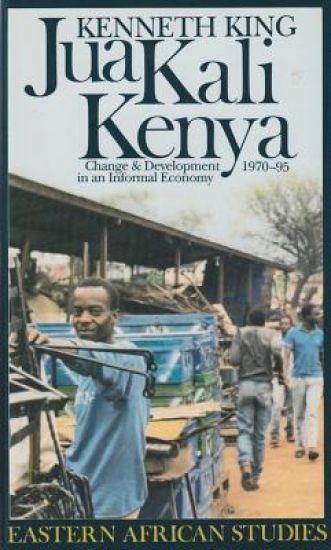
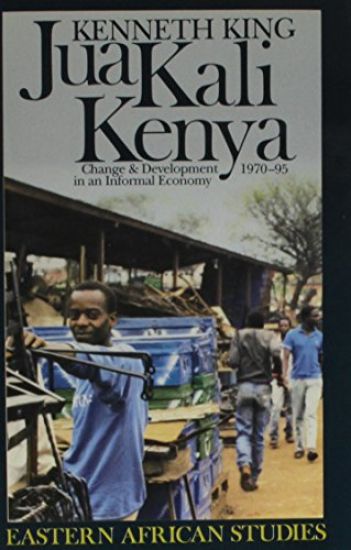
Jua Kali Kenya

Jua Kali Kenya

Kenneth King

Ohio University Press
1996
pokkari
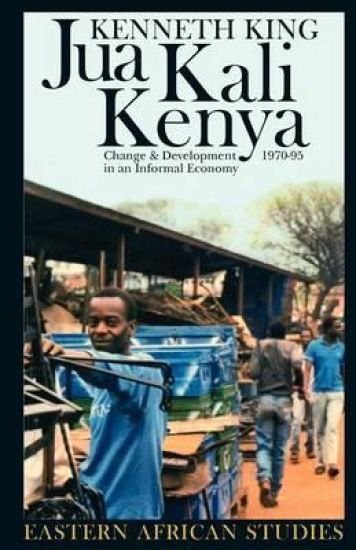
Kenya was where the term "informal sector" was first used in 1971. During the 1980s the term "jua kali"—in Swahili "hot sun"—came to be used of the informal sector artisans, such as carworkers and metalworkers, who were working under the hot sun because of a lack of premises. Gradually it came to refer to anybody in self-employment. And in 1988 the government set up the Jua Kali Development Programme. In this remarkable book Kenneth King brings the subject alive through the photographs and life histories of jua kali people. He has also revisited, twenty years later, many of the artisans whom he interviewed exhaustively in the period from 1972 to 1974 and about whom he wrote in The African Artisan, one of the first full-length studies to be published on the informal sector. For donors, NGOs, and national governments, the book offers many relevant examples, and some cautions, about what has been achieved by ordinary Kenyans, mostly without government support. It will prove equally valuable for students and teachers of development policy, technology policy, and education and training policies not least because of its superb bibliography of over 700 entries related to small enterprise development.
Jua Kali Kenya

Jua Kali Kenya

Kenneth King

James Currey
1996
pokkari
Rich and informative study of the informal economy in Kenya. During the 1980s the term jua kali (Kiswahili for 'hot sun') came to refer to anybody working in self-employment in Kenya. This text brings the informal sector alive through the photographs and life histories of jua kali people, and offers an analysis of what has been achieved by ordinary Kenyans. North America: Ohio U Press; Kenya: EAEP
Germs Gone Wild

Germs Gone Wild

Kenneth King

Pegasus Books
2011
nidottu
Battling a new generation of corporate giants and uncovering threats right in our own backyard, Kenneth King’s Germs Gone Wild reveals the massive expansion of America's bio-defense research labs and the culture of deception surrounding hundreds of facilities that have opened since 9/11. King experienced the menace of bio-defense research firsthand when local government and business leaders tried to lure a new facility to his hometown in Kentucky. Researching the safety claims, he not only found many of them to be completely false, but was also horrified by the lack of oversight and the recklessness with which these labs genetically modified pathogens like smallpox, Ebola, and influenza without a care for what happened to the public if there was ever a “leak.” And yet the greed that drove the development of these labs has effectively counteracted any cautionary checks by the government and universities. All have been seduced by the economic gains and corporate stipends that come with compliance and turning a blind eye. But now, the reality of these labs and the germs they manipulate will finally be brought to light, as King examines the controversies surrounding plants from Maryland to Boston and Utah, to the Department of Homeland Security’s dubious National Bio-and-Agro-Facility (NBAF) project, and the precautions—or lack thereof—being taken to protect us all from a deadly pandemic.
China's Aid and Soft Power in Africa

China's Aid and Soft Power in Africa

Kenneth King

James Currey
2013
pokkari
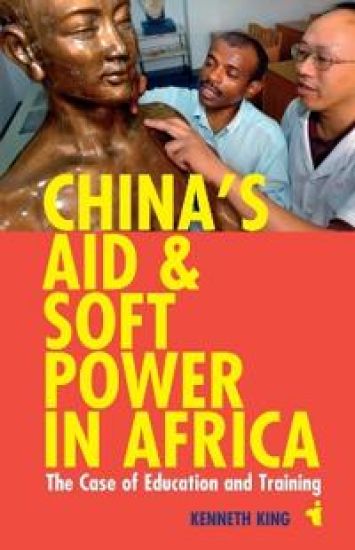
China's increasing role as an education donor in Africa, and the significance of this both economically and politically. Why does China run one of the world's largest short-term training programmes, with plans to bring 30,000 Africans to China between 2013 and 2015? Why does it give generous support to 31 Confucius Institutes teaching Mandarin and Chinese culture at many of Africa's top universities from the Cape to Cairo? Why is China one of the very few countries to increase the number of full scholarships for Africans to study in its universities,a total of 18,000 anticipated between 2013 and 2015? China claims to have been involved for 60 years in South-South cooperation of mutual benefit to China and Africa. While its dramatic economic and trade impact, particularly on Africa, has caught global attention, little focus has yet been given to its role as an education donor - and especially to the critical role of China's support for training and human resource development for Africans inChina, and within Africa itself. It is vital that we understand what is going on, and why education is so important in China-Africa relations. Here is hard evidence from Ethiopia, South Africa and Kenya of the dramatic growth ofChina's soft power and increasing impact in capacity-building, and of the implications of this for Africa, China and the world.
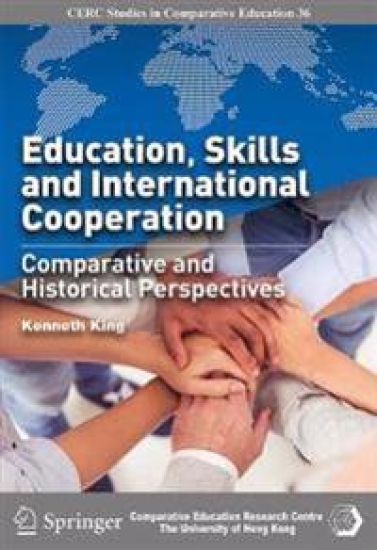
Education, Skills and International Cooperation

Education, Skills and International Cooperation

Kenneth King

Springer Nature Switzerland AG
2019
sidottu
This book highlights some of Kenneth King’s diverse contributions to international and comparative education, African studies and development studies over more than four decades. From his pioneering work on the first educational commissions to Africa, through his research on skills training in the informal sector, and on to his critical analysis of education analysis in development agencies, this book makes influential materials available in one place. Appropriately, it illustrates his career-long connections with Kenya, but also his more recent engagement with Japan, China and India. It is the first CERC volume to pay significant attention to the policies and politics of skills development.Kenneth King is an Emeritus Professor of the University of Edinburgh. He was based in and directed its Centre of African Studies for many years, and lectured on international perspectives in education and training in its School of Education. His research interests have addressed the politics and planning of skills development, including in the informal sector of the economy, aid policies towards education of both Western and Asian donors, and higher education cooperation. He founded NORRAG, the network for international policies and cooperation in education and training, in 1986, and edited NORRAG News until 2016. He was President of the British Association for International and Comparative Education (BAICE) from 2014-2016, and was one of the founding members of the UK Forum on International Education and Training (UKFIET).
India's Development Diplomacy and Soft Power in Africa

India's Development Diplomacy and Soft Power in Africa

Kenneth King

MANOHAR PUBLISHERS AND DISTRIBUTORS
2024
sidottu
Indian state and non-state actors have deployed their soft power in Africa from India’s independence. Since then, as a result of internal shifts brought on by economic liberalisation, the rise of the political right and the quest for greater regional and global influence, India’s geopolitical imaginary has changed. Hitherto shaped by a shared sense of postcolonial marginality, Third Worldism and South-South cooperation, the country’s relationship with Africa is being reconfigured by a growing sense of Indian exceptionalism. This volume explores key elements at the heart of this Africa policy, from India’s capacity-building for Africa to its global educational ambitions.
Jua Kali Kenya

Jua Kali Kenya

Kenneth King

Ohio University Press
1996
sidottu
Kenya was where the term "informal sector" was first used in 1971. During the 1980s the term "jua kali"—in Swahili "hot sun"—came to be used of the informal sector artisans, such as carworkers and metalworkers, who were working under the hot sun because of a lack of premises. Gradually it came to refer to anybody in self-employment. And in 1988 the government set up the Jua Kali Development Programme. In this remarkable book Kenneth King brings the subject alive through the photographs and life histories of jua kali people. He has also revisited, twenty years later, many of the artisans whom he interviewed exhaustively in the period from 1972 to 1974 and about whom he wrote in The African Artisan, one of the first full-length studies to be published on the informal sector. For donors, NGOs, and national governments, the book offers many relevant examples, and some cautions, about what has been achieved by ordinary Kenyans, mostly without government support. It will prove equally valuable for students and teachers of development policy, technology policy, and education and training policies not least because of its superb bibliography of over 700 entries related to small enterprise development.
Knowledge for Development?

Knowledge for Development?

Kenneth King; McGrath Simon

Zed Books Ltd
2004
nidottu
In 1996, the World Bank President, James Wolfensohn, declared that his organization would henceforth be 'the knowledge bank'. This marked the beginning of a new discourse of knowledge-based aid, which has spread rapidly across the development field. This book is the first detailed attempt to analyse this new discourse. Through an examination of four agencies -- the World Bank, the British Department for International Development, the Japan International Cooperation Agency and the Swedish International Development Cooperation Agency -- the book explores what this new approach to aid means in both theory and practice. It concludes that too much emphasis has been on developing capacity within agencies rather than addressing the expressed needs of Southern 'partners'. It also questions whether knowledge-based aid leads to greater agency certainty about what constitutes good development.
Footnotes

Footnotes

Elena Alexander; Jill Johnston; Douglas Dunn; Marjorie Gamso; Ishmael Houston-Jones; Kenneth King; Yvonne Meier; Sarah Skaggs

Routledge
1998
sidottu
The writings of six choreographers are assembled in this book and the leap they have taken to go from the medium of choreography into written text constitutes a form of translation. Some of the texts investigate the possibilities of written language as invention, others use it as a means to illustrate specific tenets or describe choreographic projects. All yield insight into the process of coaxing language from the body.
Footnotes

Footnotes

Elena Alexander; Jill Johnston; Douglas Dunn; Marjorie Gamso; Ishmael Houston-Jones; Kenneth King; Yvonne Meier; Sarah Skaggs

Routledge
1998
nidottu
The writings of six choreographers are assembled in this book and the leap they have taken to go from the medium of choreography into written text constitutes a form of translation. Some of the texts investigate the possibilities of written language as invention, others use it as a means to illustrate specific tenets or describe choreographic projects. All yield insight into the process of coaxing language from the body.