Kirjojen hintavertailu. Mukana 11 244 527 kirjaa ja 12 kauppaa.

Kirjahaku

Etsi kirjoja tekijän nimen, kirjan nimen tai ISBN:n perusteella.

4 kirjaa tekijältä Kenneth L. Schmitz

At the Centre of the Human Drama

At the Centre of the Human Drama

Kenneth L. Schmitz

The Catholic University of America Press
1994
nidottu
Kenneth L. Schmitz examines the writings of Karol Wojtyla, from his early dramas to his later theological works. Wojtyla's primary philosophical interest lies in the field of ethics, but Schmitz also points out that Wojtyla's interest is worked out in the context of an understanding of the nature and destiny of human beings. Relying upon many translations (some not available in English) of Wojtyla's work, Schmitz locates Wojtyla's philosophy of human nature in the broad tradition of Christian personalism. More importantly, perhaps, Schmitz shows that Wojtyla relied upon phenomenological methodology to explore the inner region of human experience while endorsing the general lines of traditional metaphysics as represented in the work of the great philosophers of the Middle Ages. Finding that a coherent philosophical view is present throughout much of Wojtyla's work, Schmitz also discovers that Wojtyla's sensitivity to both modern and ancient thought and culture was already present in the work of the pope as a young student in Kracow. As Pope John Paul II continues to make his mark in the history of the Roman Catholic church and of the world, this book aims to be valuable to philosophers, theologians and educated readers who wish to learn more about the thought of the leader of one of the world's major religions.
The Texture of Being

The Texture of Being

Kenneth L. Schmitz

The Catholic University of America Press
2020
nidottu
Kenneth Schmitz has spent an illustrious career as a philosopher striving to unite what Hegel called the ""being of the ancients""--their deep engagement with metaphysics--to ""the subjectivity of the moderns""--the modern concern with the interior life and historical particularity of human beings. Schmitz has sought to show how these concerns are two aspects of one ""single philosophical life"" which, far from being a pointless exercise, reflects an intellectually and spiritually fruitful human existence.In this volume, Schmitz brings his encyclopedic knowledge of the Western philosophical tradition to bear in a wide-ranging series of essays grouped under three headings: Being, Man, and God. He brings disparate philosophical traditions into conversation, such as classical Aristotelian-Thomistic metaphysics, the modern critical rationalism of Kant, the idealist synthesis of Hegel, the postmodern deconstructionism of Derrida and Foucault, and the personalist phenomenology of Scheler, Von Hildebrand, and Wojtyla.Schmitz explores re-situating classical metaphysics, with its confidence in the human ability to reach speculative truth, into a post-Enlightenment world that rejects the possibility, yet which values human interior richness. Schmitz believes, for instance, that we can have meaningful discourse about God's existence and about the role of beauty in helping us recognize that being is a gift received.Diverse in topics yet unified in purpose, this volume brings together Schmitz's penetrating and rich insight into being, produced over many years, to offer readers a magisterial study from one of the great Christian philosophers of our time.
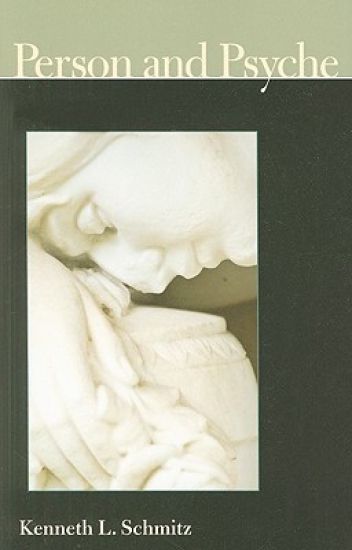
Person and Psyche

Person and Psyche

Kenneth L. Schmitz

The Institute for the Psychological Sciences Press
2009
nidottu
Psychology and Philosophy are distinct disciplines, yet close neighbors. Each discipline studies the human being as a single consciousness, and for all of their differences, there is a remarkably intimate relation between their contributions to a truthful understanding of the human person. Philosophy provides a foundation and horizon for the life of consciousness that engages in the very activities so precisely analyzed by psychology. Both the dimensions of philosophical reflection and psychic activity are essential aspects of the integrity and psychic health of the human person - a remarkable being who is unique in its self presence and the most interior of beings, yet also relational with others and the most open to all of being. These properties of relational uniqueness and open interiority shape our actions, which at their best are open to truth and the perfective power of being in general. At the same time the human person at his or her best is conscious of admiration of the panoply of being, and even further, open to adoration of being in its ultimate form - God. In chapter one of ""Person and Psyche"", Kenneth Schmitz reflects upon the general foundation of each and every kind of being, with especial reference to human beings. In chapter two, he addresses the dynamics with which we are endowed in the very origins of our human nature. In chapter three, these two principles are considered in light of the sphere of human freedom, with the value and promise that freedom holds for the human person. It is particularly in the concluding chapter four that Schmitz deliberates upon some of the issues that arise in psychology and psycho-therapy in order to identify their significance for understanding the transcendental characteristics of being, with marked attention to truth, goodness, and beauty. He also searches out the significance of psychological and therapeutic issues for the primitive inclinations with which our human nature is endowed, and takes them up in consideration of that freedom that is the human person's crown and exaltation, even as that freedom penetrates and transforms the human psyche.