Kirjojen hintavertailu. Mukana 11 244 527 kirjaa ja 12 kauppaa.

Kirjahaku

Etsi kirjoja tekijän nimen, kirjan nimen tai ISBN:n perusteella.

87 kirjaa tekijältä Kenneth W. Thompson

Political Realism and the Crisis of World Politics

Political Realism and the Crisis of World Politics

Kenneth W. Thompson

Princeton University Press
2015
pokkari
In this arresting volume Kenneth Thompson has combined academic research with acute observation in approximately equal proportions. Research has been focused on the theories and practices of those who, whether in thought or action, have played an influential part in the development of American foreign policy during the past decades. Originally published in 1960. The Princeton Legacy Library uses the latest print-on-demand technology to again make available previously out-of-print books from the distinguished backlist of Princeton University Press. These editions preserve the original texts of these important books while presenting them in durable paperback and hardcover editions. The goal of the Princeton Legacy Library is to vastly increase access to the rich scholarly heritage found in the thousands of books published by Princeton University Press since its founding in 1905.
Political Realism and the Crisis of World Politics

Political Realism and the Crisis of World Politics

Kenneth W. Thompson

Princeton University Press
2016
sidottu
In this arresting volume Kenneth Thompson has combined academic research with acute observation in approximately equal proportions. Research has been focused on the theories and practices of those who, whether in thought or action, have played an influential part in the development of American foreign policy during the past decades. Originally published in 1960. The Princeton Legacy Library uses the latest print-on-demand technology to again make available previously out-of-print books from the distinguished backlist of Princeton University Press. These editions preserve the original texts of these important books while presenting them in durable paperback and hardcover editions. The goal of the Princeton Legacy Library is to vastly increase access to the rich scholarly heritage found in the thousands of books published by Princeton University Press since its founding in 1905.
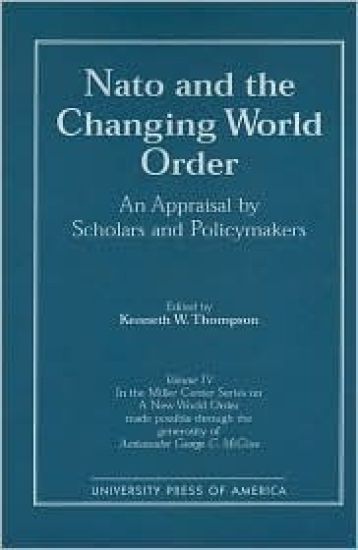
NATO and the Changing World Order

NATO and the Changing World Order

Kenneth W. Thompson

University Press of America
1996
nidottu
This book addresses the isssue of NATO's role in today's world. It explores how changes in international political structures have influenced NATO's position and policies, as well as our view of its capacities. The essays in this book look at a variety of controversial issues, paying particular attention to debates over seeing NATO as a modern structure or as an obsolete organization. Contents: Foreword: A New NATO for a New Era, Manfred W'mer; Preface, Kenneth W. Thompson; Introduction, Kenneth W. Thompson; THE UNITED STATES, NATO, AND EUROPE: Post-Cold War American Leadership in NATO, S. Nelson Drew; Partnership for Peace and the Future of European Security, Joseph J. Kruzel; Structure for Security in Europe, John R. Galvin; IS NATO OBSOLETE?: Is NATO Obsolete?, James Chace; Is NATO Obsolete?, Richard L. Kugler; Why NATO Persists, John S. Duffield; THE ENLARGEMENT OF NATO: CHANGING FACES: The Changing Faces of Nato; Partnership for Peace and the Combined Joint Task Force, Doug K. Bereuter; Russia in NATO: The Fourth Generation of the Atlantic Alliance, Ira L. Straus; NATO, East Asia, and Japan, Alan Tonelson; THE FUTURE OF NATO: The Future of NATO, David C. Acheson; NATO's Prospects, John Woodworth; The Future of NATO, Andrew J. Pierre.
Virginia Papers on the Presidency

Virginia Papers on the Presidency

Kenneth W. Thompson

University Press of America
1996
nidottu
This text continues the themes of the previous volumes of the "Virginia Papers Series" including the president as political leader, the president and congress, organizing approaches to policy making, the president, communications and the public, the international setting, and the public philosophy.
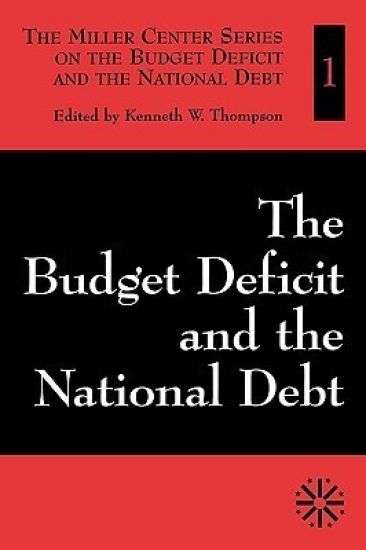
The Budget Deficit and the National Debt

The Budget Deficit and the National Debt

Kenneth W. Thompson

University Press of America
1997
nidottu
The Budget Deficit and National Debt analyzes and attempts to better understand the problems associated with the debt and deficit. The theme of this book parallels the Miller Center's primary focus on governance and the presidency. The president is a key actor in submitting, approving, and administrating the budget. Therefore, the study of debt and deficit is in keeping with the Miller Center's focus on governance and the presidency. The book is divided into four sections. The first section discusses the debt and deficit from a variety of political perspectives and ideological approaches. Three contributors, representing different schools of thought and professional backgrounds, provide separate frameworks for considering the budget and deficit. The first section contrasts liberal, conservative, and independent views and compares the effects of the deficit on federal and local governments. The second section provides an overview of the origins and growth of the deficit and its effect on the U.S. economy. The authors outline interaction among and competition between economic and political forces operating in the United States, and they debate the merits of deficit reduction proposals. The third section examines the economic and political ramifications of the deficit, reviewing tactical and strategic errors and their consequences. The book concludes with a discussion of the political struggle over controlling the deficit and chronicles the ambitions and rivalries of two key political figures—Bill Clinton and Newt Gingrich. Their dispute over the seven year balanced-budget plan had significant influence on the policies of debt and deficit.
The Reagan Presidency

The Reagan Presidency

Kenneth W. Thompson

University Press of America
1997
nidottu
The Reagan Presidency: Ten Intimate Perspectives of Ronald Reagan is part of a continuing Miller Center series of presidential portraits. This volume of the series examines the political forces and personal characteristics that shaped the Reagan presidency. Cabinet members, a counsel to the president, scholars, journalists, a chief of staff, and other professionals in the administration attended Miller Center forums to discuss important domestic and international issues from the Reagan presidency. Their vast professional and political experience and firsthand accounts provide an intimate perspective on Reagan's presidency and serve as a source of information and reference for historians of the administration. As it did with previous oral histories, the Miller Center hosted representatives from the press, public service, and academia. The forum audiences included supporters and critics of the administration and scholars of presidential politics. Their participation not only sparked debate on important aspects of the Reagan presidency but also broadened and enhanced this discussion of governance. This book addresses the essential themes of the Reagan presidency: governance, the role of communication, domestic policy, international trade, international policy, and post-Cold War strategy. The book examines Reagan's leadership style, analyzes the role of the media in presidential politics, explores the Reagan administration's unique policy challenges, and reviews the effects of their policy choices. The volume concludes with an assessment of Reagan's administration and its place in the history of contemporary presidents.
The Virginia Papers on the Presidency

The Virginia Papers on the Presidency

Kenneth W. Thompson

University Press of America
1997
nidottu
This volume explores the dual role of the president—leader of the American people and leader and spokesman for the United States. Part I examines the roles of the president through discussions of presidential leadership at summits, relations between Congress and the president, and the organization of policy-making. In Part II the focus shifts to the role of presidential communication in the international arena. American intervention is analyzed and the role of the U.N. executive committee is considered. The experiences of presidents on crucial domestic issues—education and science—is the theme of Part III. Contributors discuss how presidential policy on these issues influences the nation's future, both domestically and internationally. Part IV is a case study of the Cuban Missle Crisis that typifies the executive's role in the international setting, and Part V focuses on public philosophy and how it relates to urgent political problems. The book concludes with observations by the Miller Center's director on the history of the Center, the Miller Center series, and the contribution of public forums to a free and constructive exchange of ideas.
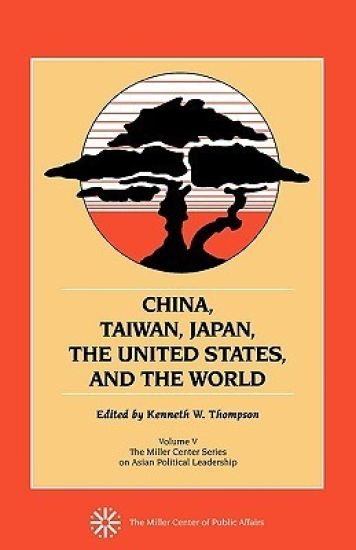
China, Taiwan, Japan, the United States and the World

China, Taiwan, Japan, the United States and the World

Kenneth W. Thompson

University Press of America
1998
sidottu
China, Taiwan, Japan, the United States and the World is the fifth volume in the Miller Center's series on Asian political leadership. As part of the Center's ongoing research program, recognized authorities participate in forums, colloquia, and conferences. China, Taiwan, Japan, the United States and the World provides valuable information on the economics, politics, and culture of Asian countries from theoretical and historical perspectives. In addition, the book predicts the future of these nations, their relations with the United States, and their role in the international arena.
China, Taiwan, Japan, the United States and the World

China, Taiwan, Japan, the United States and the World

Kenneth W. Thompson

University Press of America
1998
nidottu
China, Taiwan, Japan, the United States and the World is the fifth volume in the Miller Center's series on Asian political leadership. As part of the Center's ongoing research program, recognized authorities participate in forums, colloquia, and conferences. The contributors are a unique mix of scholars, administrators, and diplomats whose expertise serves as a rich resource for students of government and foreign policy. Their efforts provide a comparative dimension to the Center's programs. The book is divided into four sections. Part I focuses on China, Taiwan, and Southeast Asia after the Cold War. Part II focuses on Japan and its role in the future of international politics. Part III addresses the patterns and principles that dictate Asian culture and development. Part IV provides a theoretical and structural analysis of the future of Asian politics and economics. China, Taiwan, Japan, the United States and the World provides valuable information on the economics, politics, and culture of Asian countries from theoretical and historical perspectives. In addition, the book predicts the future of these nations, their relations with the United States, and their role in the international arena.
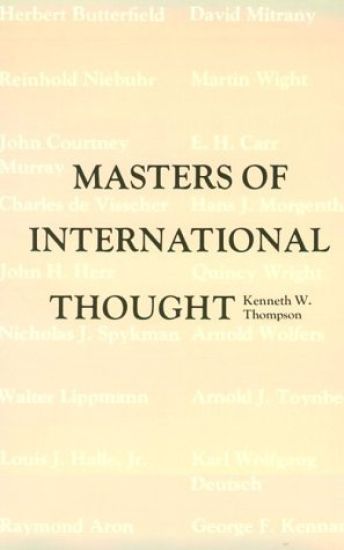
Masters of International Thought

Masters of International Thought

Kenneth W. Thompson

Louisiana State University Press
1982
nidottu
The complexities of modern politics and international relationships sometimes overwhelm us. Kenneth W. Thompson here offers clarity to replace obscurity, personal warmth and human values to replace abstractions. He states the aim of Masters of International Thought early: to introduce the ideas of eighteen ""men of large and capacious thought"" about twentieth-century international relations.He presents thinkers who assimilate practical ethics and religion (Butterfield, Niebuhr, Murray, Wight); who eschew utopia for the reality of power politics (Carr, Morgenthau, Spykman, Wolfers, Herz, Deutsch); who regard the Cold War as a mirror of the human condition (Lippman, Kennan, Halle, Aron); and who speculate about the possibilities of world order (Wright, Mitrany, de Visscher, and Toynbee). Thompson was guided in his selections by the enduring value of these men's thought. Even those works that are fifty years old are still read by policy makers and scholars, Thompson points out. He also acknowledges his personal approach to these masters, for not only has he known their works, he has known many of the writers. He admits that they are ""intellectual giants, but they are human beings, not gods."" In Masters of International Thought, he clearly fulfills his aim to share the wisdom and knowledge of these twentieth-century thinkers.
Morality and Foreign Policy

Morality and Foreign Policy

Kenneth W. Thompson

Louisiana State University Press
1982
nidottu
Kenneth W. Thompson admits that moral pronouncements and human conduct are often widely separated, particularly in international events. In order to balance harmony and disharmony, world and self-interests, nations observe moral principles less rigidly than do smaller communities. To understand how the separation between pronouncements and conduct widens in matters of foreign policy, Thompson candidly faces such issues as the harsh decisions that countries must make, the need for hypocrisy, and the resulting self-righteousness.Morality and Foreign Policy looks at the assumptions and principles that underlie historic debates about the ethics of foreign policy. Tracing decisions in policy from the 1800s to the present, Thompson views his subject from an American perspective but also concentrates on diverse international contexts in which decisions are made.Thompson cautiously maintains his balance on the fine wire between speaking up for America and embarking on an ideological crusade. He provides such examples from current events as the Bay of Pigs in Cuba and the East-West Cold War to show how easily one can fall on one side or the other. He contrasts the problem of order in America and the Third World and shows how the latter's is weighted by a special urgency, protest, and antithesis to the democratic process. For Kenneth Thompson, American moral reasoning is ""a practical alternative to abstract moralism or hopeless cynicism,"" and he holds up this principle as a challenge, not only to other countries but also to America itself.
Winston Churchill's World View

Winston Churchill's World View

Kenneth W. Thompson

Louisiana State University Press
1987
nidottu
Winston Churchill's place in modern history is assured. As a statesman and world leader, he towers above his contemporaries. As a historian, his reputation is equally secure. But little attention has been given to Churchill's stature as a political theorist, to the ideas and principles that he developed, tested, and followed throughout his long career as a soldier, military correspondent, politician, world leader, and author.Winston Churchill's World View is a study of the underlying principles and goals that shaped the actions of one of the most influential men of our time. Kenneth Thompson traces the genesis and elaboration of Churchill's views from his youth at the fringes of the British Empire through his rise as a politician, his years of determined struggle and final triumph as the prime minister of England in its darkest hour, and the time of reflection that followed his departure from his active political life. Thompson works closely with Churchill's writing to identify and assess his concepts of power, authority, politics, and diplomacy, as well as his thoughts on international organisation and law, collective security, and practical morality.Churchill firmed believed that an effective foreign policy must be based on a set of well-defined but flexible organizing principles. ""Those who are possessed of a definite body of doctrine and of deeply rooted convictions,"" he wrote in the first volume of his history of World War II, ""will be in a much better position to deal with the shifts and surprises of daily affairs."" It was the lack of such a set of principle, Churchill contended, that led the Allies into the conflagration of World War II and that in the postwar era threatened to bring about an even more destructive conflict between the West and the Soviet Union. Churchill's own plan to avert that peril, Thompson shows, was based on the twin pillars of diplomacy and strength. He insisted that peace must be negotiated. But only could a lasting settlement be concluded, a settlement that was not based on weakness and fear.Churchill's political philosophy was rooted in his own experience and in an awareness of the course of man's history. It is a perspective at odds with prevailing viewpoints, based not in history, but in a shifting tide of facts and statistics, and with the current perception of a world with problems too complex and numerous to be solved through the simple application of doctrine and conviction. But this complex age, Thompson argues, is one sorely in need of the lessons of history and the wisdom of experienced statesmen. With this study, Thompson demonstrates the relevance of Winston Churchill's views to the present world situation, and shows the current need for a steady, principled, pragmatic approach to maintaining world peace.
Cold War Theories

Cold War Theories

Kenneth W. Thompson

Louisiana State University Press
1991
nidottu
In this first of a two-volume examination of the Cold War, Kenneth Thompson offers a broad and, at the same time, specific account of its history and its historians. Thompson's aim is to find the best framework for understanding how the Cold War originated, what forces and factors produced it, how Soviet and American policies intensified the conflict, and what alternatives were open to the rivals. He evenhandedly sets forth three competing theories of the Cold War, the orthodox, revisionist, and critical/interpretative views, and reveals how the ideological confines of certain interpretations have made for incomplete understanding. Calling upon some of the great thinkers of our century, Thompson shows that orthodox and revisionist historians alike are misled by their exaggerated estimates of national capacity and interests.Volume I follows the course of the Cold War from the end of World War II and America demobilization through the war in Korea. Tracing the influence of the theories on policy makers, Thompson finds missed opportunities and unintentional acts of belligerence during such tense times as the debates over Poland, Iran, the Truman Doctrine, the Marshall Plan, NATO, and the Berlin Blockade.By joining political history with the theoretical approaches, the author seeks to show that theory and history ought to be conjoined in a study of the Cold War without minimizing the value of each separate outlook. In its widest sense Cold War Theories is about the nature of history, that intricate tapestry that stretches past out limits to see. In discussing the early period in the Cold War, Thompson keeps his eye on possible parallels and differences with the present era marked by the conflicts in Iran and Afghanistan. Throughout his presentation, Thompson keeps in mind that we are entering a new era of intense conflict in the Cold War wherein we can ill afford any form of dogmatism: ""Not only is reality more complex than ideology, but change is the first law of the political universe.
Traditions and Values in Politics and Diplomacy

Traditions and Values in Politics and Diplomacy

Kenneth W. Thompson

Louisiana State University Press
1992
nidottu
In this informed and comprehensive assessment of current issues in international policies, Kenneth W. Thompson addresses the role that traditions and values play in shaping change and in helping us to understand its implications. He challenges the idea that the enormous changes in contemporary national and international life have rendered the consideration of traditions and values obsolete. Thompson's purpose is to illuminate the problems we face and to set forth general principles directed toward an informing theory on traditions and values as they affect politics and diplomacy, while at the same time warning of the pitfalls and limitations of theory.In the first section of this book, Thompson draws on classical and Judaeo-Christian traditions in defining the relationship between philosophy, religion, and politics. He then examines the application of abstract values to such political realities as national interest, and goes on to consider the question of moral values in international diplomacy and politics.In a series of case studies, Thompson reflects on human rights, disarmament and arms control, and human survival. Maintaining that the implementation of traditions and values is sometimes uniquely the task of the American presidency, he studies the administrations of four postwar presidents, Dwight D. Eisenhower, John F. Kennedy, Lyndon B. Johnson, and Richard M. Nixon, in the light of the executives' attitudes toward ethics and politics. Finally, Thompson considers the implications of national decline and the breakdown of international order for the future of the United States. The vast knowledge of international affairs and the literature of politics that Kenneth W. Thompson brings to this timely and reflective books makes it exceptionally readable as well as intellectually challenging.
Fathers of International Thought

Fathers of International Thought

Kenneth W. Thompson

Louisiana State University Press
1994
nidottu
In Fathers of International Thought, renowned foreign affairs scholar Kenneth W. Thompson returns to the writings of sixteen thinkers in order better to understand the issues and problems that recurrently beset global politics. A companion volume to Masters of International Thought, in which Thompson analysed the thinking of eighteen leading twentieth-century political theorists, Fathers of International Thought traces the ideas of earlier philosophers, theologians, and legal and political theorists who provided the foundations for the present century's master thinkers.Thompson begins by discussing the relevance of classical political philosophy to the field of modern international relations theory. He then presents lucid essays on sixteen of the most brilliant minds from Plato through the nineteenth century, focusing on the importance of their thought in contemporary international affairs. Besides Plato, the classical thinkers, whom Thompson refers to as the fathers, include Aristotle, Augustine, Thomas Aquinas, Niccolò Machiavelli, Grotius, David Hume, Jean-Jacques Rousseau, Montesquieu, Edmund Burke, Immanuel Kant, Georg Wilhelm Friedrich Hegel, and Karl Marx.According to Thompson, the interrelatedness of earlier and recent thought is undeniable for such concepts as authority, justice, community, regimes, and power. He shows how the ideas of the fathers have application to the current international scene, as with events in Eastern Europe and the Persian Gulf area, and political upheaval on the African continent. The lesson for policy makers, students of politics and international relations, and, indeed, all citizens is that a comprehensive philosophical approach to world politics can lead to the rediscovery of enduring political principles and our place in history. By considering the insights of earlier thinkers, decision makers may come to recognise most present-day problems as perennial issues, however changing the context. Understanding the classics may help them avoid unsuccessful patterns in foreign policy. An introductory survey of early political philosophers and their relevance to our times is sorely needed by students and practitioners of international politics. Fathers of International Thought, by a man Foreign Affairs described as ""one of the best teachers still active from the postwar generation of scholars that developed the discipline of international relations,"" will be of lasting value in meeting that need.
The Virginia Papers on the Presidency

The Virginia Papers on the Presidency

Kenneth W. Thompson

University Press of America
1980
sidottu
An investigation of the many sides of presidential leadership: the role as chief executive and the nation's political leader, as head of his own party, and as leader of a free people in world affairs. Table of Contents: Preface, Kenneth W. Thompson, Director, White Burkett Miller Center; Introduction, Kenneth W. Thompson; The President and Political Leadership, former President Gerald R. Ford; The President and Congress, former President Gerald R. Ford; The President and the Cabinet, Clifford M. Hardin, former Secretary of Agriculture in the Nixon Administration; The President and Policymaking: The Middle East, Najeeb E. Halaby, FAA Administrator; The President and Communications: The Media and the Political Process, Sander Vanocur, ABC diplomatic correspondent; Concluding Observations, Kenneth W. Thompson. Co-published with the Miller Center of Public Affairs.
The Virginia Papers on the Presidency

The Virginia Papers on the Presidency

Kenneth W. Thompson

University Press of America
1983
sidottu
Table of Contents: Preface, Kenneth W. Thompson; ^IIntroduction, Kenneth W. Thompson; The President: Leadership in National Defense, Roswell Gilpatric; The President: Organizing Approaches to the World Economy, Philip Klutznick; Presidents and Civil Rights: Public Philosophy of Pragmatism, Harry Ashmore; The President and Defense: Science and Priorities, Rear Admiral K.S. Masterson, Jr.; The President, the People and a Strategy for National Defense, Admiral Harry D. Train, II; Concluding Observations, Kenneth W. Thompson.