Kirjojen hintavertailu. Mukana 11 244 527 kirjaa ja 12 kauppaa.

Kirjahaku

Etsi kirjoja tekijän nimen, kirjan nimen tai ISBN:n perusteella.

8 kirjaa tekijältä Kerry McSweeney

Supreme Attachments

Supreme Attachments

Kerry McSweeney

Routledge
2019
nidottu
The Victorian poetry of sexual love between men and women has not been as fully studied as other components of the imaginative literature of the period, and some of the attention it has received has been more concerned with the society and ideology of the age than with the poetry or the love. This study attempts an integrated account of the three elements, with particular emphasis on the close reading of poems. Chapters are devoted to the distinguishing features of Victorian love poetry; Browning’s dramatic lyrics; Tennyson’s Maud and the lyrics from Princess; women poets (Barrett Browning, Christina Rossetti and Emily Dickinson); Clough’s three long poems of contemporary life, Meredith’s Modern Love; the lyrics written by Morris and Dante Rossetti during the late 1860s and early 1870s, when the latter was conducting an affair with Morris’ wife; and two elegiac sequences, the bereavement odes from Patmore’s Unknown Eros and Hardy’s Poems of 1912-13. A final chapter uses the love poetry of D H Lawrence to point up continuities between Victorian and later love poetry.
Four Contemporary Novelists

Four Contemporary Novelists

Kerry McSweeney

McGill-Queen's University Press
1983
sidottu
Four Contemporary Novelists offer accounts of the fiction of Angus Wilson, Brian Moore, John Fowles, and V. S. Naipaul. The author has charted the development of each writer; identified dominant themes, controlling techniques, and informing sensibility; explained what each has tried to accomplish and compare theory to practice; provided an appropriate context for appreciation and evaluation of all parts of each canon; and made qualitative discriminations.
Middlemarch

Middlemarch

Kerry McSweeney

Routledge
2015
sidottu
First published in 1984. Although Middlemarch was extravagantly praised by Henry James, Emily Dickinson and Virginia Woolf, it is only in the last few decades that the novel has been widely recognised as George Eliot’s finest work, one of the greatest English novels, and one of the classic texts of nineteenth-century fiction. The intellectual, religious and aesthetic background to Middlemarch are fully examined, with particular attention paid to Eliot’s key doctrines of fellow-feeling and the humanistic economy of salvation. Professor McSweeney also provides fresh and thought-provoking discussions of the role of the omniscient narrator, and of character and characterisation. This title will be of interest to students of literature.
Middlemarch

Middlemarch

Kerry McSweeney

Routledge
2017
nidottu
First published in 1984. Although Middlemarch was extravagantly praised by Henry James, Emily Dickinson and Virginia Woolf, it is only in the last few decades that the novel has been widely recognised as George Eliot’s finest work, one of the greatest English novels, and one of the classic texts of nineteenth-century fiction. The intellectual, religious and aesthetic background to Middlemarch are fully examined, with particular attention paid to Eliot’s key doctrines of fellow-feeling and the humanistic economy of salvation. Professor McSweeney also provides fresh and thought-provoking discussions of the role of the omniscient narrator, and of character and characterisation. This title will be of interest to students of literature.
Tennyson and Swinburne As Romantic Naturalists

Tennyson and Swinburne As Romantic Naturalists

Kerry McSweeney

UNIVERSITY OF TORONTO PRESS
1987
pokkari
The central importance of naturalistic vision – of a sense of man’s life as part of nature – is emphasized in this study of the poetry of Tennyson and Swinburne. In tracing this vision, Professor McSweeney makes a series of qualitative distinctions leading to a revaluation of the achievements of both poets. McSweeney begins with an examination of Swinburne’s critical and creative response to Tennyson, revealing Swinburne’s perception of the effect that Tennyson’s suppression of naturalistic vision and his consequent overemphasis on morality and metaphysical speculation had on his poetry. A brief discussion of Tennyson’s response to Swinburne is followed by an analysis of the literary climate of the 1820s and 1830s, necessary for an understanding of the central feature of Tennyson’s artistic development: the complex mutation which transformed him from a wholly Romantic poet into a largely Victorian one. Tracing the development of Tennyson’s poetry, McSweeney examines some of the best-known works, including ‘The Lady of Shalott,’ ‘The Hesperides,’ ‘The Two Voices,’ and ‘The Lotos Eaters,’ and supplies analyses of In Memoriam and Idylls of the King. A thematic overview of Swinburne’s canon generates an examination which substantiates the argument that his poetry, contrary to George Meredith’s opinion, possesses an ‘internal centre.’ Close readings o four of the most important poems of the second half of Swinburne’s career, By the North Sea, Tristram of Lynesse, A Nympholept, and The Lake of Guabe, are included. This book places the two poets in the central tradition of Romantic naturalism and will be of interest to specialists in nineteenth-century literature as well as those interested in English literature in general.
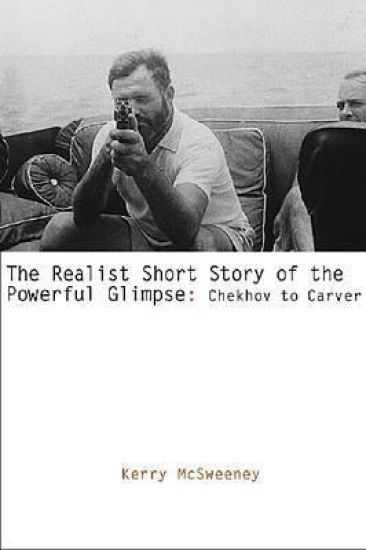
The Realist Short Story of the Powerful Glimpse

The Realist Short Story of the Powerful Glimpse

Kerry McSweeney

University of South Carolina Press
2007
sidottu
Taking a distinctively aesthetic approach to the genre of realist short fiction, Kerry McSweeney clusters the work of five masters - Anton Chekhov, James Joyce, Ernest Hemingway, Flannery O'Connor, and Raymond Carver - to offer a poetics of the form for students and scholars. At the center of this argument is the notion that the realist short story is a glimpse - powerful and tightly focused - into a world that the writer must precisely craft and in which the reader must fully invest. Selecting writers from different generational, national, and cultural backgrounds, McSweeney chooses writers based on their commitment to the realist representation of experience and their shared belief in the importance and efficacy of the short story form. By considering their efforts in tandem, he develops a means to assess the strategies and claims of realist short fiction. McSweeney demonstrates that when the comments these writers have made about their work are assembled and critically scrutinized, the result is an aesthetic critical model - as opposed to more interpretative models that focus attention on the determination (or indetermination) of meanings. He suggests that a fully adequate reading of a realist short story involves the integration of three components: the enjoyment and contemplation of the story in and of itself; affective receptivity, or a response to the story's emotional content; and cognitive activity, or the reflective consideration of the story's conceptual implications. In individual chapters on Chekov, Joyce, Hemingway, O'Connor, and Carver, this presentational model is applied to widely known and often anthologized readings from each writer. McSweeney brings into sharp focus the distinctive features of each piece, makes qualitative discriminations, and assesses the profitability of other critical models. He concludes with an invitation to test the mettle of his approach in reading other realist short story writers.
Supreme Attachments

Supreme Attachments

Kerry McSweeney

Ashgate Publishing Limited
1998
sidottu
The Victorian poetry of sexual love between men and women has not been as fully studied as other components of the imaginative literature of the period, and some of the attention it has received has been more concerned with the society and ideology of the age than with the poetry or the love. This study attempts an integrated account of the three elements, with particular emphasis on the close reading of poems. Chapters are devoted to the distinguishing features of Victorian love poetry; Browning’s dramatic lyrics; Tennyson’s Maud and the lyrics from Princess; women poets (Barrett Browning, Christina Rossetti and Emily Dickinson); Clough’s three long poems of contemporary life, Meredith’s Modern Love; the lyrics written by Morris and Dante Rossetti during the late 1860s and early 1870s, when the latter was conducting an affair with Morris’ wife; and two elegiac sequences, the bereavement odes from Patmore’s Unknown Eros and Hardy’s Poems of 1912-13. A final chapter uses the love poetry of D H Lawrence to point up continuities between Victorian and later love poetry.