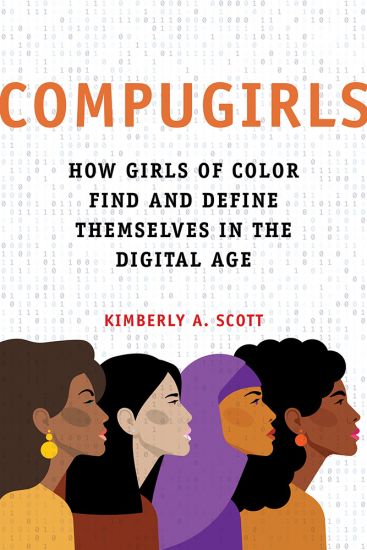
What does is it mean for girls of color to become techno-social change agents--individuals who fuse technological savvy with a deep understanding of society in order to analyze and confront inequality? Kimberly A. Scott explores this question and others as she details the National Science Foundation-funded enrichment project COMPUGIRLS. This groundbreaking initiative teaches tech skills to adolescent girls of color but, as importantly, offers a setting that emphasizes empowerment, community advancement, and self-discovery. Scott draws on her experience as an architect of COMPUGIRLS to detail the difficulties of translating participants' lives into a digital context while tracing how the program evolved. The dramatic stories of the participants show them blending newly developed technical and communication skills in ways designed to spark effective action and bring about important change. A compelling merger of theory and storytelling, COMPUGIRLS provides a much-needed roadmap for understanding how girls of color can find and define their selves in today's digital age.
What does is it mean for girls of color to become techno-social change agents--individuals who fuse technological savvy with a deep understanding of society in order to analyze and confront inequality? Kimberly A. Scott explores this question and others as she details the National Science Foundation-funded enrichment project COMPUGIRLS. This groundbreaking initiative teaches tech skills to adolescent girls of color but, as importantly, offers a setting that emphasizes empowerment, community advancement, and self-discovery. Scott draws on her experience as an architect of COMPUGIRLS to detail the difficulties of translating participants' lives into a digital context while tracing how the program evolved. The dramatic stories of the participants show them blending newly developed technical and communication skills in ways designed to spark effective action and bring about important change. A compelling merger of theory and storytelling, COMPUGIRLS provides a much-needed roadmap for understanding how girls of color can find and define their selves in today's digital age.
Results from quantitative and qualitative research studies have painted countless images of the unique features shaping urban schools including students' experiences and how the surrounding communities affect the entire system. Race, ethnicity, social class, language, power, politics, and public image operate as intersecting elements shaping the contours of urban school life therefore its documentation. Little has been written about how researchers of urban schools and their constituencies effectively navigate these complex elements, design a culturally sensitive and responsive project, and acquire meaningful data. What are some of the critically important issues a researcher should consider when working with urban schools? What should be a researcher's commitment to the urban communities in which they conduct research? How can a researcher develop a trusting relationship in an environment justifiably distrustful of outsiders? These and other inquiries shape the contours of this edited volume.As educators and policy makers take a closer examination at urban schools and their successes, research of these unique settings assumes a more prominent role. For academics, both novice and experienced, establishing and maintaining rapport within these environments often require greater attention than qualitative or quantitative research books accord. Authors in this compilation share lessons learned about power, privilege, and their meanings as they pertain to conducting research in and with urban settings. To this end, four primary objectives guide this manuscript: 1) To expand the conversation of urban school research to include multiple voices of culturally responsible, caring scholars with a professed commitment to using research as an empowering tool for urban educational contexts; 2) To provide practical accounts of what has and has not worked for individuals conducting both short-term and longitudinal research in urban educational institutions and communities; 3) To demonstrate the (dis)connect between classroom discussions of urban education and real-life field experiences of researchers working in urban settings; and 4) To broaden discussions of reflexivity by analyzing the complex journey qualitative and quantitative sociologists, anthropologists, teacher educators, urban educators, and special educators experience while negotiating and creating collaborative relationships with urban educators, administrators, students, parents, and community members.
Results from quantitative and qualitative research studies have painted countless images of the unique features shaping urban schools including students' experiences and how the surrounding communities affect the entire system. Race, ethnicity, social class, language, power, politics, and public image operate as intersecting elements shaping the contours of urban school life therefore its documentation. Little has been written about how researchers of urban schools and their constituencies effectively navigate these complex elements, design a culturally sensitive and responsive project, and acquire meaningful data. What are some of the critically important issues a researcher should consider when working with urban schools? What should be a researcher's commitment to the urban communities in which they conduct research? How can a researcher develop a trusting relationship in an environment justifiably distrustful of outsiders? These and other inquiries shape the contours of this edited volume.As educators and policy makers take a closer examination at urban schools and their successes, research of these unique settings assumes a more prominent role. For academics, both novice and experienced, establishing and maintaining rapport within these environments often require greater attention than qualitative or quantitative research books accord. Authors in this compilation share lessons learned about power, privilege, and their meanings as they pertain to conducting research in and with urban settings. To this end, four primary objectives guide this manuscript: 1) To expand the conversation of urban school research to include multiple voices of culturally responsible, caring scholars with a professed commitment to using research as an empowering tool for urban educational contexts; 2) To provide practical accounts of what has and has not worked for individuals conducting both short-term and longitudinal research in urban educational institutions and communities; 3) To demonstrate the (dis)connect between classroom discussions of urban education and real-life field experiences of researchers working in urban settings; and 4) To broaden discussions of reflexivity by analyzing the complex journey qualitative and quantitative sociologists, anthropologists, teacher educators, urban educators, and special educators experience while negotiating and creating collaborative relationships with urban educators, administrators, students, parents, and community members.