Kirjojen hintavertailu. Mukana 11 717 486 kirjaa ja 12 kauppaa.

Kirjahaku

Etsi kirjoja tekijän nimen, kirjan nimen tai ISBN:n perusteella.

3 kirjaa tekijältä Kirby Olson

Andrei Codrescu and the Myth of America

Andrei Codrescu and the Myth of America

Kirby Olson

McFarland Co Inc
2005
pokkari
"This is one of those times, a time choked in the weeds of academic and civilian formalism. To put it mildly, most of what we see in print in North America is unbearably trivial and singularly devoid of courage."--Andrei Codrescu, The Disappearance of the Outside. Known to the general public as a radio commentator on National Public Radio, Romanian-born essayist and poet Andrei Codrescu has developed a variety of voices throughout his career: Transylvanian humorist on NPR, surrealist poet in his many volumes of poetry, academic essayist in his philosophical writings and historical novelist. Taking seemingly everyday events in seemingly mundane places, Codrescu is able to link the random details into a larger whole, leading his readers and listeners to conclusions very different from those they first imagined. This work explores Codrescu's writings and how they are a part of the surrealist tradition. It examines the ways in which his poetry, essays and novels are influenced by his upbringing in Communist Romania and the liberal attitudes he encountered upon moving to the United States, and draws comparisons between Codrescu and other surrealists. An interview with the author is also included.
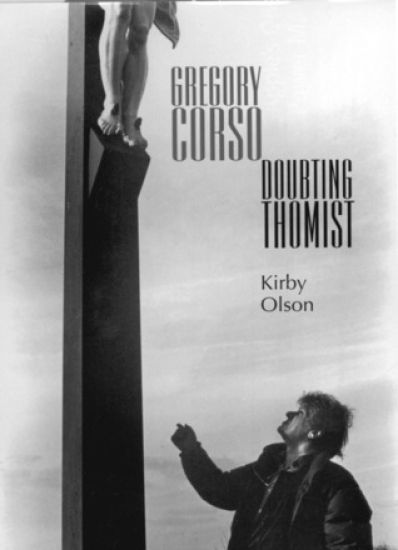
Gregory Corso

Gregory Corso

Kirby Olson

Southern Illinois University Press
2002
sidottu
Gregory Corso is the most intensely spiritual of the Beat generation poets and still by far the least explored. The virtue of Kirby Olson's Gregory Corso: Doubting Thomist is that it is the first book to place all of Corso's work in a philosophical perspective, concentrating on Corso as a poet torn between a static Catholic Thomist viewpoint and that of a progressive surrealist. While Corso is a subject of great controversy - his work often being seen as nihilistic and wildly comic - Olson argues that Corso's poetry, in fact, maintains an insistent theme of doubt and faith with regard to his early Catholicism. Although many critics have attempted to read his poetry, and some have done so brilliantly, Olson - in his approach and focus - is the first to attempt to give a holistic understanding of the oeuvre as essentially one not of entertainment or hilarity but of a deep spiritual and philosophical quest by an important and profound mind. In nine chapters, Olson addresses Corso from a broad philosophical perspective and shows how Corso takes on particular philosophical issues and contributes to new understandings. Corso's concerns, like his influence, extend beyond the Beat generation as he speaks about concerns that have troubled thinkers from the beginning of the Western tradition, and his answers offer provocative new openings for thought. Corso may very well be the most important Catholic poet in the American literary canon, a visionary like Burroughs and Ginsberg, whose work illuminated a generation. Written in a lively and engaging style, Gregory Corso: Doubting Thomist seeks to keep Corso's memory alive and at last delve fully into Corso's poetry.
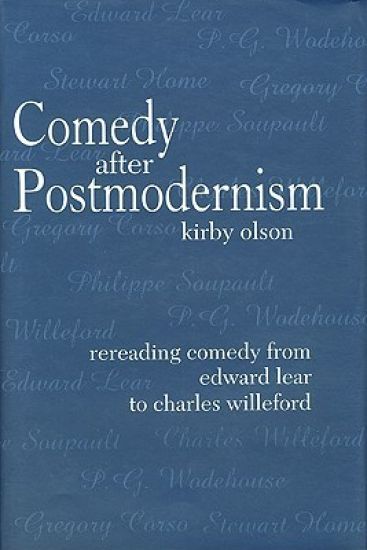
Comedy after Postmodernism

Comedy after Postmodernism

Kirby Olson

Texas Tech Press,U.S.
2001
sidottu
Is comedy postmodern? Kirby Olson posits that no one has been more marginalized than the comic writer, whose irreverent truths have always made others uncomfortable. In a literary age that purports to champion diversity, comic writers remain an underclass huddling at the fringes of the canon. Olson challenges the status quo by inviting the comic writer into the center of literary debate. In the growing discipline of humor studies, Olson is the first to create a substantial link between the fields of comedy and postmodernism, discovering in comic writers a philosophy of oddness and paradox that parallels and extends the work of the major postmodern thinkers. With elegant clarity, ""Comedy After Post-modernism"" examines: Edward Lear as he invents a comic picturesque to challenge the sublime of Kant and Ruskin Gregory Corso as he explodes the ""Great Chain of Being"" of his early Catholicism; Philippe Soupault as a comic surrealist undoing the sacrificial aesthetics of Andr Breton; P.G. Wodehouse as a social thinker with surprisingly deep affinities to anarchist Peter Kropotkin and radical social theorist Charles Fourier; Stewart Home, the infamously violent punk author, as a pacifist whose narrative questions Marxist-anarchist terrorism in favor of patience and tolerance; and, Charles Willeford, the maestro of the black humor police procedural, as a postmodern philosopher who deepens the problems of ethical and aesthetic judgment after postmodernism. 'An original, splendidly researched, and necessary book. By pointing to the vast excluded literature of comic writers, Dr. Olson opens the door to a postmodern scholarship capable of greater flexibility. ""Comedy After Postmodernism"" evinces a lucid, passionate, and engaging style' - Andrei Codrescu. 'There was an old man on the Border, Who lived in the utmost disorder; He danced with the cat, and made tea in his hat, Which vexed all the folks on the Border' - From ""The Complete Nonsense"" of Edward Lear.