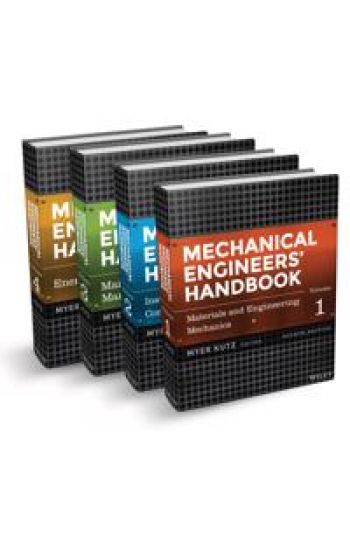
More and more engineers increasingly find themselves in a diverse set of industries covering a wide range of functions. No one engineer can be a specialist in every discipline. The Kutz Mechanical Engineer's Handbook: 4th Edition offers engineers a thorough, detailed, ready reference on topics that may fall outside their scope of expertise. The four volume set provides a quick guide to specialized areas in the engineering field. The accessible information offers discussions, examples and analyses of each of the topics covered. The handbook gives access to the basics of each and points you toward trusted resources for further reading. Everything a mechanical engineering student, researcher or practitioner needs to know Provides quick guidance to all the specialized areas in the mechanical engineering discipline, giving students, researchers and practitioners access to the information they need to quickly and confidently complete any task. The accessible information offers discussions, examples, and analyses of the topics covered. 4 Thematic Volumes: Volume One of the Mechanical Engineer's Handbook, Materials and Engineering Mechanics gives you accessible and in-depth access to the most common topics you'll encounter in the discipline: carbon and alloy steels, stainless steels, aluminum alloys, copper and copper alloys, titanium alloys for design, nickel and its alloys, magnesium and its alloys, superalloys for design, composite materials, smart materials, electronic materials, viscosity measurement, and much more.Volume Two: Design, Instrumentation, and Controls covers electronics, MEMS, and instrumentation and control, giving you accessible and in-depth access to the topics you'll encounter in the discipline: computer-aided design, product design for manufacturing and assembly, design optimization, total quality management in mechanical system design, reliability in the mechanical design process for sustainability, life-cycle design, design for remanufacturing processes, signal processing, data acquisition and display systems, and much more.Volume Three: Manufacturing and Management covers environmentally benign manufacturing, production planning, production processes and equipment, manufacturing systems evaluation, coatings and surface engineering, physical vapor deposition, mechanical fasteners, seal technology, statistical quality control, nondestructive inspection, intelligent control of material handling systems, and much more are covered in volume three of Mechanical Engineer's Handbook.Volume 4: Energy and Power covers the essentials of fluids, thermodynamics, entropy, and heat, with chapters dedicated to individual applications such as air heating, cryogenic engineering, indoor environmental control, and more. Readers will find detailed guidance toward fuel sources and their technologies, as well as a general overview of the mechanics of combustion.www.wiley.com/go/mehandbook

![Handbook of Measurement in Science and Engineering ^HMSE]](/covers/9781118436707.jpg)