Kirjojen hintavertailu. Mukana 11 244 527 kirjaa ja 12 kauppaa.

Kirjahaku

Etsi kirjoja tekijän nimen, kirjan nimen tai ISBN:n perusteella.

4 kirjaa tekijältä Kyle McGee

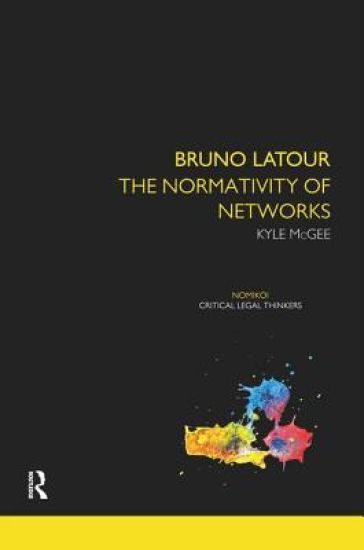
Bruno Latour

Bruno Latour

Kyle McGee

Routledge
2013
sidottu
The first extended study of Bruno Latour’s legal theory, this book presents a critical reconstruction of the whole of Latour’s oeuvre to date, from Laboratory Life to An Inquiry into the Modes of Existence. Based on the powerful insights into normative effects that actor-network theory makes possible, the book advances a new theory of legal normativity and the force of law, rethinking Latour’s work on technology, the image, and referential scientific inscriptions, among others, and placing them within the ambit of legality. The book also captures and deepens the contrast between the modern legal institution and the value of law as a mode of existence, and provides a fulsome theoretical account of legal veridiction. Throughout, Latour’s thought is put into dialogue with important progenitors and adversaries as well as historical and contemporary strands of legal and political philosophy. But the thread of legality is not confined to Latour's reflections on the making of law; rather, it cuts through the whole of his highly diverse body of work. The empire of mononaturalism augured by modern philosophies of science is thoroughly juridical; as such, the actor-network theory that promises to undo that empire by freeing the value of the sciences from its epistemological clutches is unthinkable without the device of the trial and the descriptive semiotics of normativity that sustain ANT. The democratization of the sciences and the vibrancy of ecologized politics that become possible once the bifurcation of nature into essential primary and disposable secondary qualities is disabled, and once the ‘modern Constitution’ is called into doubt, also have important legal dimensions that have gone largely unexamined. Bruno Latour: The Normativity of Networks remedies this and other omissions, evaluating Latour’s thought about law while carrying it in striking new directions. This book introduces legal scholars and students to the thought of the philosopher and sociologist Bruno Latour, whilst also presenting a critical analysis of his work in and around law. This interdisciplinary study will be of interest to those researching in Law, Philosophy, and Sociology.
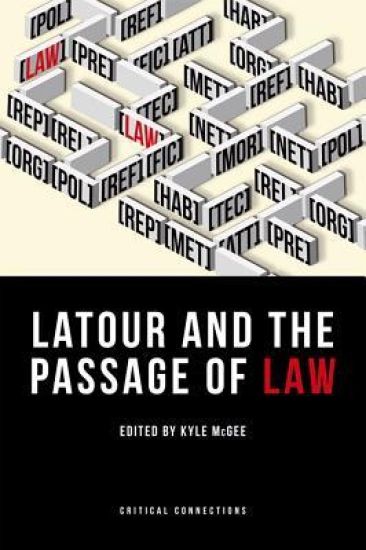
Latour and the Passage of Law

Latour and the Passage of Law

Kyle McGee

Edinburgh University Press
2017
sidottu
These 13 essays explore Bruno Latour's legal theory from a variety of disciplinary perspectives. They combine analytical tools drawn from Latour's actor-network theory developed in Science in Action, Reassembling the Social and The Making of Law with the philosophical anthropology of the Moderns in An Inquiry into Modes of Existence to blaze a new trail in legal epistemology.
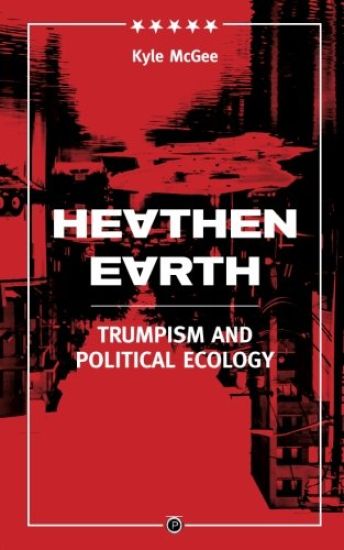
Heathen Earth: Trumpism and Political Ecology
Heathen Earth: Trumpism and Political Ecology looks beyond the rising fortunes of authoritarian nationalism in a fossil-fueled late capitalist world to encounter its conditions. Trumpism represents an alternative to the forces undermining the very cosmology of the modern West from two opposing directions. The global economy, pinnacle of modernization, has brought along a dark side of massive inequality, corrupt institutions, colonial violence, and environmental destruction, while global warming, nadir of modernity, threatens to undo the foundations of all states and all markets. To the vertigo of placelessness symptomatic of globalization is added the ecological vertigo of landlessness. With reality slowly fragmenting, it is only too obvious in this light that Trumpism and other nationalist movements would attract massive hordes of supporters. Promising to expel foreigners and to restore unity and equality by taking power back from the global elites, while utterly denying the climate science that calls ordinary means of subsistence and consumption radically into question, Trumpism can be seen as an antidote to the toxic combination of global markets and global warming. The irony, of course, is that Trumpism only responds to these dangers by doubling down on the reckless expansionist logic that gave rise to them in the first place.This book, composed entirely between November 8, 2016 and January 20, 2017, examines Trumpism according to its regime of political representation (despotism), its political ontology (nativism), and its political ecology (geocide), while laying the groundwork for an alternative politics and a resistant, responsive ecology of the incompossible.
Bruno Latour

Bruno Latour

Kyle McGee

Routledge
2015
nidottu
The first extended study of Bruno Latour’s legal theory, this book presents a critical reconstruction of the whole of Latour’s oeuvre to date, from Laboratory Life to An Inquiry into the Modes of Existence. Based on the powerful insights into normative effects that actor-network theory makes possible, the book advances a new theory of legal normativity and the force of law, rethinking Latour’s work on technology, the image, and referential scientific inscriptions, among others, and placing them within the ambit of legality. The book also captures and deepens the contrast between the modern legal institution and the value of law as a mode of existence, and provides a fulsome theoretical account of legal veridiction. Throughout, Latour’s thought is put into dialogue with important progenitors and adversaries as well as historical and contemporary strands of legal and political philosophy. But the thread of legality is not confined to Latour's reflections on the making of law; rather, it cuts through the whole of his highly diverse body of work. The empire of mononaturalism augured by modern philosophies of science is thoroughly juridical; as such, the actor-network theory that promises to undo that empire by freeing the value of the sciences from its epistemological clutches is unthinkable without the device of the trial and the descriptive semiotics of normativity that sustain ANT. The democratization of the sciences and the vibrancy of ecologized politics that become possible once the bifurcation of nature into essential primary and disposable secondary qualities is disabled, and once the ‘modern Constitution’ is called into doubt, also have important legal dimensions that have gone largely unexamined. Bruno Latour: The Normativity of Networks remedies this and other omissions, evaluating Latour’s thought about law while carrying it in striking new directions. This book introduces legal scholars and students to the thought of the philosopher and sociologist Bruno Latour, whilst also presenting a critical analysis of his work in and around law. This interdisciplinary study will be of interest to those researching in Law, Philosophy, and Sociology.