
Kirjahaku
Etsi kirjoja tekijän nimen, kirjan nimen tai ISBN:n perusteella.
10 kirjaa tekijältä Lance Strate
On the Binding Biases of Time and Other Essays on General Semantics and Media Ecology
Lance Strate
Institute of General Semantics
2011
pokkari
Neil Postman’s most popular work, Amusing Ourselves to Death (1985), provided an insightful critique of the effects of television on public discourse in America, arguing that television’s bias towards entertaining content trivializes serious issues and undermines the basis of democratic culture. Lance Strate, who earned his doctorate under Neil Postman and is one of the leading media ecology scholars of our time, re-examines Postman’s arguments, updating his analysis and critique for the twenty-first-century media environment that includes the expansion of television programming via cable and satellite as well as the Internet, the web, social media, and mobile technologies. Integrating Postman’s arguments about television with his critique of technology in general, Strate considers the current state of journalism, politics, religion, and education in American culture. Strate also contextualizes Amusing Ourselves to Death through an examination of Postman’s life and career and the field of media ecology that Postman introduced. This is a book about our prospects for the future, which can only be based on the ways in which we think and talk about the present.
Neil Postman’s most popular work, Amusing Ourselves to Death (1985), provided an insightful critique of the effects of television on public discourse in America, arguing that television’s bias towards entertaining content trivializes serious issues and undermines the basis of democratic culture. Lance Strate, who earned his doctorate under Neil Postman and is one of the leading media ecology scholars of our time, re-examines Postman’s arguments, updating his analysis and critique for the twenty-first-century media environment that includes the expansion of television programming via cable and satellite as well as the Internet, the web, social media, and mobile technologies. Integrating Postman’s arguments about television with his critique of technology in general, Strate considers the current state of journalism, politics, religion, and education in American culture. Strate also contextualizes Amusing Ourselves to Death through an examination of Postman’s life and career and the field of media ecology that Postman introduced. This is a book about our prospects for the future, which can only be based on the ways in which we think and talk about the present.
Media Ecology: An Approach to Understanding the Human Condition provides a long-awaited and much anticipated introduction to media ecology, a field of inquiry defined as the study of media as environments. Lance Strate presents a clear and concise explanation of an intellectual tradition concerned with much more than understanding media, but rather with understanding the conditions that shape us as human beings, drive human history, and determine the prospects for our survival as a species. Much more than a summary, this book represents a new synthesis that moves the field forward in a manner that is both unique and unprecedented, and simultaneously grounded in an unparalleled grasp of media ecology's intellectual foundations and its relation to other disciplines. Taking as its subject matter "life, the universe, and everything," Strate describes the field as interdisciplinary and communication-centered, provides a detailed explication of McLuhan's famous aphorism, "the medium is the message," and explains that the human condition can only be understood in the context of our biophysical, technological, and symbolic environments. Strate provides an in-depth examination of media ecology's four key terms: medium, which is defined in much broader terms than in other fields; bias, which refers to tendencies inherent in materials and methods; effects, which are best understood via the Aristotelian notion of formal causality and contemporary systems theory; and environment, which includes the distinctions between the oral, chirographic, typographic, and electronic media environments. A chapter on tools serves as a guide to further media ecological research and scholarship. This book is well suited for graduate and undergraduate courses on communication theory and philosophy.
Media Ecology: An Approach to Understanding the Human Condition provides a long-awaited and much anticipated introduction to media ecology, a field of inquiry defined as the study of media as environments. Lance Strate presents a clear and concise explanation of an intellectual tradition concerned with much more than understanding media, but rather with understanding the conditions that shape us as human beings, drive human history, and determine the prospects for our survival as a species. Much more than a summary, this book represents a new synthesis that moves the field forward in a manner that is both unique and unprecedented, and simultaneously grounded in an unparalleled grasp of media ecology's intellectual foundations and its relation to other disciplines. Taking as its subject matter "life, the universe, and everything," Strate describes the field as interdisciplinary and communication-centered, provides a detailed explication of McLuhan's famous aphorism, "the medium is the message," and explains that the human condition can only be understood in the context of our biophysical, technological, and symbolic environments. Strate provides an in-depth examination of media ecology's four key terms: medium, which is defined in much broader terms than in other fields; bias, which refers to tendencies inherent in materials and methods; effects, which are best understood via the Aristotelian notion of formal causality and contemporary systems theory; and environment, which includes the distinctions between the oral, chirographic, typographic, and electronic media environments. A chapter on tools serves as a guide to further media ecological research and scholarship. This book is well suited for graduate and undergraduate courses on communication theory and philosophy.
Diatribal Writes of Passage in a World of Wintertextuality
Lance Strate
Institute of General Semantics
2020
pokkari
The second poetry collection by Lance Strate, this volume brings together an eclectic mix of poems that address the themes of language, communication, media, technology, and poetry itself, etc.
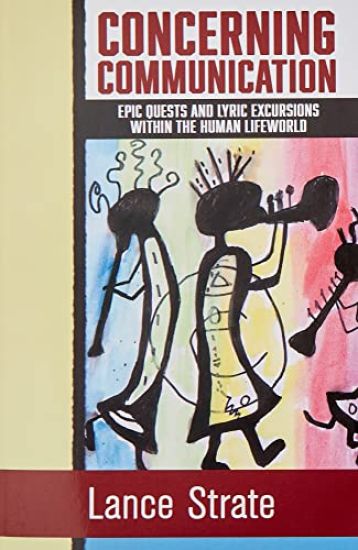
Concerning Communication: Epic Quests and Lyrical Excursions Within the Human Lifeworld is a collection of essays that range across a variety of topics, including models of communication, language and symbolic communication, sense perception, the self, disability and autism, listening, reading, science, media literacy, ethics, innovation, systems theory, information, communication history, isolation, solipsism, technology, education, media ecology, and general semantics. Lance Strate's unifying theme throughout this volume is the centrality of communication, as a phenomenon, to human life, and the importance of communication, as a field of study, to understanding ourselves and our place in the universe.
Not A, Not Be, &c is not just another collection of essays on general semantics. Not that it is not exactly that, a collection of essays on general semantics specifically, and on what Neil Postman described as general semantics writ large, aka media ecology. Or to use the designation adopted by the Balvant Parekh Centre in Baroda, India, this is a collection of essays on general semantics and other human sciences. Or, simply put, this is a colorful collection of six essays and an introduction, complete with illustrations and indexes, on human communication and the human condition.Alternately, this is a book devoted to essays in a non-aristotelian vein, which is what the first not in the title, Not A, refers to. Non-aristotelian is Alfred Korzybski's neologism, providing a name for a category of perspectives, and approaches that would include human sciences such as media ecology, information theory, cybernetics, systems theory, semiotics and, of course, general semantics. And the second not in the title, Not Be, refers specifically to the general semantics critique regarding our use of the verb to be, which also relates to linguistics and orality-literacy studies. Following the two nots, &c, an abbreviation of etc., itself an abbreviation of the Latin phrase, et cetera, represents one of the three main extensional devices recommended by Korzybski, the intent being to counter the illusion that any statement can ever be complete or final and to instill a sense of humility in all of us by reminding us of the limits of our knowledge, and our ability to communicate.The title, Not A, Not Be, &c, also alludes to the ABCs, and consequently to the alphabet, a reference to the field of media ecology, as scholars such as Marshall McLuhan, Walter Ong, Jack Goody, and Eric Havelock have discussed the pivotal role that alphabetic writing has played in the development of western culture. It follows that Not A, Not Be, &c is not not a book about media ecology. And Not A, Not Be, &c is most certainly not not a book about general semantics.Topics covered in the book include negation, the contrast between alphabetic and electronic cultures, a new tree of life model, understanding different types of symbolic form (i.e., words, images, and numbers), problems and possibilities regarding the copula and conjunctions, the nature of imagination, and coping with and changing the world we live in.