
Kirjahaku
Etsi kirjoja tekijän nimen, kirjan nimen tai ISBN:n perusteella.
10 kirjaa tekijältä Larry N. Gerston
Understanding federalism - the form of political organization that unites separate polities within an overarching political system so that all maintain their political integrity - is central to the study of democratic government in the United States. Yet, many political scientists treat federalism as a set of abstract principles or a maze of budgetary transfers with little connection to real political life. This concise and engaging book boils the discussion down to its essence: federalism is about power, specifically the tug for power among and within the various levels of government. Author Larry N. Gerston examines the historical and philosophical underpinnings of federalism; the various "change events" that have been involved in defining America's unique set of federal principles over time; and the vertical, horizontal, and international dimensions of federalism in the United States today. The result is a book examining the ways in which institutional political power is both diffused and concentrated in the United States.
Understanding federalism - the form of political organization that unites separate polities within an overarching political system so that all maintain their political integrity - is central to the study of democratic government in the United States. Yet, many political scientists treat federalism as a set of abstract principles or a maze of budgetary transfers with little connection to real political life. This concise and engaging book boils the discussion down to its essence: federalism is about power, specifically the tug for power among and within the various levels of government. Author Larry N. Gerston examines the historical and philosophical underpinnings of federalism; the various "change events" that have been involved in defining America's unique set of federal principles over time; and the vertical, horizontal, and international dimensions of federalism in the United States today. The result is a book examining the ways in which institutional political power is both diffused and concentrated in the United States.
This brief text identifies the issues, resources, actors, and institutions involved in public policy making and traces the dynamics of the policymaking process, including the triggering of issue awareness, the emergence of an issue on the public agenda, the formation of a policy commitment, and the implementation process that translates policy into practice. Throughout the text, which has been revised and updated, Gerston brings his analysis to life with abundant examples from the most recent and emblematic cases of public policy making. At the same time, with well-chosen references, he places policy analysis in the context of political science and deftly orients readers to the classics of public policy studies. Each chapter ends with discussion questions and suggestions for further reading.
This brief text identifies the issues, resources, actors, and institutions involved in public policy making and traces the dynamics of the policymaking process, including the triggering of issue awareness, the emergence of an issue on the public agenda, the formation of a policy commitment, and the implementation process that translates policy into practice. Throughout the text, which has been revised and updated, Gerston brings his analysis to life with abundant examples from the most recent and emblematic cases of public policy making. At the same time, with well-chosen references, he places policy analysis in the context of political science and deftly orients readers to the classics of public policy studies. Each chapter ends with discussion questions and suggestions for further reading.
While some people profess a disdain for politics, in a democracy politics is the primary vehicle for citizens to influence the decisions and decision makers that shape public policy at every level. This widely acclaimed book provides a clear and concise overview of public policymaking, designed to equip citizens to participate more effectively in the policymaking process. It gently introduces the reader to the players and institutions that comprise the public policymaking process of American society, and it demonstrates the many access points in the public policymaking process where one can participate. This fully updated third edition includes: A discussion of growing modes of public policymaking participation, including social media and voting by mail. An evaluation of the impediments to participation, including voter suppression. An examination of the role of whistleblowers as part of bureaucratic responsibility. All new case studies throughout the book on topics of interest to students and citizens alike, such as the policy response to COVID-19, George Floyd and police reform, homelessness, and the Affordable Care Act. Student projects throughout the text, along with a glossary, and extensive coverage on Project Citizen, a format that provides students with hands-on tools for participating in the policymaking process. Public Policymaking in a Democratic Society, Third Edition may be used in introductory courses on public policy, internships, or service-learning programs. It equally serves as an invaluable resource for any organized effort to involve citizens in community service and the exercise of civic responsibility.
While some people profess a disdain for politics, in a democracy politics is the primary vehicle for citizens to influence the decisions and decision makers that shape public policy at every level. This widely acclaimed book provides a clear and concise overview of public policymaking, designed to equip citizens to participate more effectively in the policymaking process. It gently introduces the reader to the players and institutions that comprise the public policymaking process of American society, and it demonstrates the many access points in the public policymaking process where one can participate. This fully updated third edition includes: A discussion of growing modes of public policymaking participation, including social media and voting by mail. An evaluation of the impediments to participation, including voter suppression. An examination of the role of whistleblowers as part of bureaucratic responsibility. All new case studies throughout the book on topics of interest to students and citizens alike, such as the policy response to COVID-19, George Floyd and police reform, homelessness, and the Affordable Care Act. Student projects throughout the text, along with a glossary, and extensive coverage on Project Citizen, a format that provides students with hands-on tools for participating in the policymaking process. Public Policymaking in a Democratic Society, Third Edition may be used in introductory courses on public policy, internships, or service-learning programs. It equally serves as an invaluable resource for any organized effort to involve citizens in community service and the exercise of civic responsibility.
Not So Golden After All
Larry N. Gerston
Routledge Member of the Taylor and Francis Group
2012
sidottu
Quality public education, modern highway systems, and reasonably priced housing—these are just some of the qualities that once made California one of the most desirable places to live. Just a few decades later, the state finds itself with an education system that is failing its citizens, one of the highest unemployment rates in the nation, and a quickly evaporating dream of home ownership. Illustrating each step of the breakdown that led to its current state of dysfunction, Not So Golden After All: The Rise and Fall of California provides insight into a system gone amuck. It addresses complicated topics in an engaging manner to help the public and leaders alike understand how to make policies that balance expectations with outcomes. Key political themes covered include disconnected institutions, perpetually unbalanced budgets, immigration, voter ignorance, interest group influence, and dysfunctional institutions. Investigating the gridlock that has become all too common within the state’s legislature, the book: Demonstrates the impact of the state’s inability to generate sufficient revenue, particularly for public education and an under-trained workforceHighlights the problems created by poor land use planning —from suburban sprawl and government waste to inefficient use of agricultural landExamines how interest groups have been able to wrest control of the processes that were created to keep them in lineIdentifies the duplication of efforts and other inefficiencies at the state and local levelsAuthor Larry Gerston leaves no stone unturned in his discussion of California's economy, position on the Pacific Rim, cultural diversity, land and water issues, and its relationship with the federal government. He examines the state’s infrastructure, natural resources, immigration issues, education, finance, healthcare, civil rights, planning and development, security, laws, political parties, and power structures to provide civic leaders and policy makers with the understanding required to restore the sheen to this once glistening paradise.The Contra Costa Times discussed Larry Gerston's recent Commonwealth Club lecture in a May 17, 2012 article. Read an interview with Larry Gerston in The Mercury News.
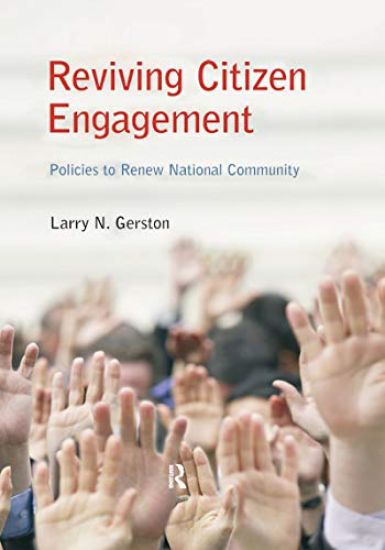
Whereas our nation was once united in purpose, today it is bitterly divided. Why? Racial discrimination, diminishing educational opportunities, poor economic mobility, greedy corporations, and an unresponsive federal government have combined to create two Americas. Presented in Gerston’s characteristic, no-holds-barred style of wit and candor, Reviving Citizen Engagement: Policies to Renew National Community casts a harsh light on the current state of American public policy. It then offers approaches to healing some of the country’s most pressing problems.The book begins with an assessment of the extent to which America has become a fractured society and the residual damage from the social implosion. It then examines the fragile condition of the 21st century electorate and a political system where private power too often has overcome values intended to protect the public good. The author argues it isn’t American entitlement run amok, but suggests there really is a powerful disconnect. The large number of Americans who have been left out of the system are no longer engaged citizens. This development represents a monumental threat to American democracy, for our democracy can succeed only if its people believe they have the opportunity to succeed. This book not only provides evidence of our frayed society but also includes recommendations for strengthening America’s social fabric. It details the steps we can—and must—take to repair, rebuild, and renew American society. Gerston contends they are within our reach if we are willing to make the sacrifices long overdue in what historically has been recognized as the world’s most powerful and successful nation.
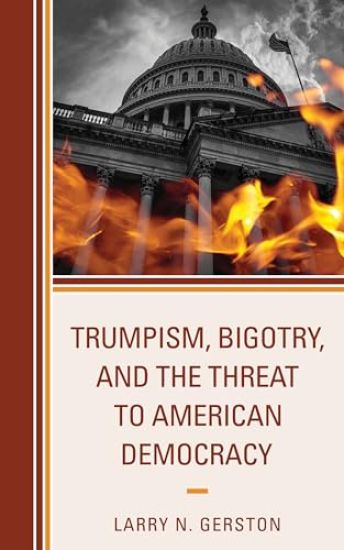
Trumpism, Bigotry, and the Threat to American Democracy
Larry N. Gerston
BLOOMSBURY PUBLISHING PLC
2023
sidottu
In Trumpism, Bigotry, and the Threat to American Democracy, Larry N. Gerston examines the near-lethal combination of American bigotry and the ability of Donald Trump to take advantage of this scourge to satisfy his own political objective. The result is an individual who won election to the American presidency by adroitly pitting members of American society against one another, while presenting himself as the only person in the position to save America from itself. Having succeeded to the nation’s most important political office, Trump proceeded to use the position for his own benefit, irrespective of laws, norms, and, most important, the Constitution. So powerful was Trump that he and his minions came close to overturning the 2020 presidential election with the January 6, 2021 insurrection against the nation’s Capitol. While Trump failed in his attempt to remain in office, the threat to the wellbeing of the United States remains real.