Kirjojen hintavertailu. Mukana 11 473 597 kirjaa ja 12 kauppaa.

Kirjahaku

Etsi kirjoja tekijän nimen, kirjan nimen tai ISBN:n perusteella.

6 kirjaa tekijältä Laura Emmery

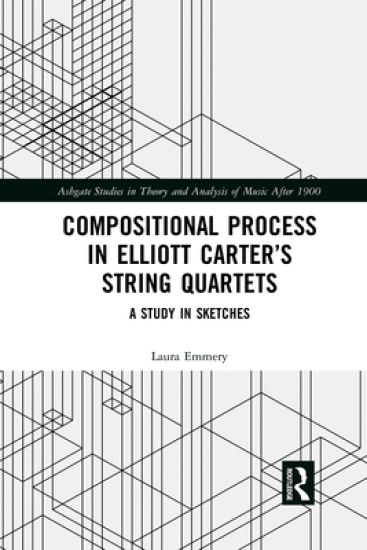
Compositional Process in Elliott Carter’s String Quartets
Compositional Process in Elliott Carter’s String Quartets is an interdisciplinary study examining the evolution and compositional process in Elliott Carter’s five string quartets. Offering a systematic and logical way of unpacking concepts and processes in these quartets that would otherwise remain opaque, the book’s narrative reveals new aspects of understanding these works and draws novel conclusions on their collective meaning and Carter’s place as the leading American modernist. Each of Carter’s five string quartets is driven by a new idea that Carter was exploring during a particular period, which allows for each quartet to be examined under a unique lens and a deeper understanding of his oeuvre at large. Drawing on key ideas from a variety of subjects including performance studies, philosophy, music cognition, musical meaning and semantics, literary criticism, and critical theory, this is an informative volume for scholars and researchers in the areas of music theory and musicology. Analyses are supplemented with sketch study, correspondence, text manuscripts, and other archival sources from the Paul Sacher Stiftung, the Library of Congress, and the New York Public Library.

Elliott Carter's String Quartet No. 1

Elliott Carter's String Quartet No. 1

Laura Emmery

Cambridge University Press
2025
sidottu
This Element offers a critical analysis of the history of Elliott Carter's String Quartet No. 1 and the composer's rise to public acclaim, not through the study of the work itself but through intriguing and captivating narratives that surround this quartet and their socio-cultural-political context, which led Carter to become one of the most dominant voices in the post-1945 American music scene. Carter's road to success was meticulously paved by powerful institutions and individuals, including critics, scholars, festival and radio programming directors, and the US government, for whom, in the context of the Cold War, Carter was chosen to represent an exemplary American triumphant story. The author argues that it is not the quartet itself that contributed to Carter's reception and legacy, but the inextricable narratives that we associate with this work.
Elliott Carter's String Quartet No. 1

Elliott Carter's String Quartet No. 1

Laura Emmery

Cambridge University Press
2025
pokkari
This Element offers a critical analysis of the history of Elliott Carter's String Quartet No. 1 and the composer's rise to public acclaim, not through the study of the work itself but through intriguing and captivating narratives that surround this quartet and their socio-cultural-political context, which led Carter to become one of the most dominant voices in the post-1945 American music scene. Carter's road to success was meticulously paved by powerful institutions and individuals, including critics, scholars, festival and radio programming directors, and the US government, for whom, in the context of the Cold War, Carter was chosen to represent an exemplary American triumphant story. The author argues that it is not the quartet itself that contributed to Carter's reception and legacy, but the inextricable narratives that we associate with this work.
Compositional Process in Elliott Carter’s String Quartets
Compositional Process in Elliott Carter’s String Quartets is an interdisciplinary study examining the evolution and compositional process in Elliott Carter’s five string quartets. Offering a systematic and logical way of unpacking concepts and processes in these quartets that would otherwise remain opaque, the book’s narrative reveals new aspects of understanding these works and draws novel conclusions on their collective meaning and Carter’s place as the leading American modernist. Each of Carter’s five string quartets is driven by a new idea that Carter was exploring during a particular period, which allows for each quartet to be examined under a unique lens and a deeper understanding of his oeuvre at large. Drawing on key ideas from a variety of subjects including performance studies, philosophy, music cognition, musical meaning and semantics, literary criticism, and critical theory, this is an informative volume for scholars and researchers in the areas of music theory and musicology. Analyses are supplemented with sketch study, correspondence, text manuscripts, and other archival sources from the Paul Sacher Stiftung, the Library of Congress, and the New York Public Library.

Yugoslav Avant-Garde Music, 1945–1991

Yugoslav Avant-Garde Music, 1945–1991

Laura Emmery

Cambridge University Press
2026
pokkari
Informed by fascinating interviews, photographs, and previously unexamined archival materials, this book reveals a compelling story of Yugoslav avant-garde and experimental music from 1945 until 1991, ending with the year when all artistic activities came to a sudden halt with the start of the Yugoslav wars. It examines the political, social, and cultural events that gave rise to the flourishing avant-garde scene in the country and follows the emergence and development of Yugoslav cultural programs in the postwar period that made the republic a magnet for cultural exchange, through to the sudden and violent dissolution of those programs with the collapse of the political state. The book is the first full-length book in English on the subject, and provides an indispensable, interdisciplinary resource that will contribute to the preservation of this legacy. This title is also available as Open Access on Cambridge Core.
Yugoslav Avant-Garde Music, 1945–1991

Yugoslav Avant-Garde Music, 1945–1991

Laura Emmery

Cambridge University Press
2026
sidottu
Informed by fascinating interviews, photographs, and previously unexamined archival materials, this book reveals a compelling story of Yugoslav avant-garde and experimental music from 1945 until 1991, ending with the year when all artistic activities came to a sudden halt with the start of the Yugoslav wars. It examines the political, social, and cultural events that gave rise to the flourishing avant-garde scene in the country and follows the emergence and development of Yugoslav cultural programs in the postwar period that made the republic a magnet for cultural exchange, through to the sudden and violent dissolution of those programs with the collapse of the political state. The book is the first full-length book in English on the subject, and provides an indispensable, interdisciplinary resource that will contribute to the preservation of this legacy. This title is also available as Open Access on Cambridge Core.