Kirjojen hintavertailu. Mukana 11 244 527 kirjaa ja 12 kauppaa.

Kirjahaku

Etsi kirjoja tekijän nimen, kirjan nimen tai ISBN:n perusteella.

8 kirjaa tekijältä Laura Kalman

The Long Reach of the Sixties

The Long Reach of the Sixties

Laura Kalman

Oxford University Press Inc
2019
nidottu
The Warren Court of the 1950s and 1960s was the most liberal in American history. Yet within a few short years, new appointments redirected the Court in a more conservative direction, a trend that continued for decades. However, even after Warren retired and the makeup of the court changed, his Court cast a shadow that extends to our own era. In The Long Reach of the Sixties, Laura Kalman focuses on the late 1960s and early 1970s, when Presidents Johnson and Nixon attempted to dominate the Court and alter its course. Using newly released--and consistently entertaining--recordings of Lyndon Johnson's and Richard Nixon's telephone conversations, she roots their efforts to mold the Court in their desire to protect their Presidencies. The fierce ideological battles--between the executive, legislative, and judicial branches--that ensued transformed the meaning of the Warren Court in American memory. Despite the fact that the Court's decisions generally reflected public opinion, the surrounding debate calcified the image of the Warren Court as activist and liberal. Abe Fortas's embarrassing fall and Nixon's campaign against liberal justices helped make the term "activist Warren Court" totemic for liberals and conservatives alike. The fear of a liberal court has changed the appointment process forever, Kalman argues. Drawing from sources in the Ford, Reagan, Bush I, and Clinton presidential libraries, as well as the justices' papers, she shows how the desire to avoid another Warren Court has politicized appointments by an order of magnitude. Among other things, presidents now almost never nominate politicians as Supreme Court justices (another response to Warren, who had been the governor of California). Sophisticated, lively, and attuned to the ironies of history, The Long Reach of the Sixties is essential reading for all students of the modern Court and U.S. political history.
FDR's Gambit

FDR's Gambit

Laura Kalman

OXFORD UNIVERSITY PRESS INC
2022
sidottu
A comprehensive, engaging, and revisionist account of the Court fight that ties it to contemporary policy debates. In the last past few years, liberals concerned about the prospect of long-term conservative dominance of the federal courts have revived an idea that famously crashed and burned in the 1930s: court packing. Not surprisingly, today's court packing advocates have run into a wall of opposition, with most citing the 1930s episode as one FDR's greatest failures. In early 1937, Roosevelt-fresh off a landslide victory-stunned the country when he proposed a plan to expand the size of the court by up to six justices. Today, that scheme is generally seen as an act of hubris-an instance where FDR failed to read Congress and the public properly. In FDR's Gambit, the eminent legal historian Laura Kalman challenges the conventional wisdom by telling the story as it unfolded, without the distortions of hindsight. Indeed, while scholars have portrayed the Court Bill as the ill-fated brainchild of a hubristic President made overbold by victory, Kalman argues to the contrary that acumen, not arrogance, accounted for Roosevelt's actions. Far from erring tragically from the beginning, FDR came very close to getting additional justices, and the Court itself changed course. As Kalman shows, the episode suggests that proposing a change in the Court might give the justices reason to consider whether their present course is endangering the institution and its vital role in a liberal democracy. Based on extensive archival research, FDR's Gambit offers a novel perspective on the long-term effects of court packing's failure, as a legacy that remains with us today. Whether or not it is the right remedy for today's troubles, Kalman argues that court packing does not deserve to be recalled as one fated for failure in 1937.
The Long Reach of the Sixties

The Long Reach of the Sixties

Laura Kalman

Oxford University Press Inc
2017
sidottu
The Warren Court of the 1950s and 1960s was the most liberal in American history. Yet within a few short years, new appointments redirected the Court in a more conservative direction, a trend that continued for decades. However, even after Warren retired and the makeup of the court changed, his Court cast a shadow that extends to our own era. In The Long Reach of the Sixties, Laura Kalman focuses on the late 1960s and early 1970s, when Presidents Johnson and Nixon attempted to dominate the Court and alter its course. Using newly released--and consistently entertaining--recordings of Lyndon Johnson's and Richard Nixon's telephone conversations, she roots their efforts to mold the Court in their desire to protect their Presidencies. The fierce ideological battles--between the executive, legislative, and judicial branches--that ensued transformed the meaning of the Warren Court in American memory. Despite the fact that the Court's decisions generally reflected public opinion, the surrounding debate calcified the image of the Warren Court as activist and liberal. Abe Fortas's embarrassing fall and Nixon's campaign against liberal justices helped make the term "activist Warren Court" totemic for liberals and conservatives alike. The fear of a liberal court has changed the appointment process forever, Kalman argues. Drawing from sources in the Ford, Reagan, Bush I, and Clinton presidential libraries, as well as the justices' papers, she shows how the desire to avoid another Warren Court has politicized appointments by an order of magnitude. Among other things, presidents now almost never nominate politicians as Supreme Court justices (another response to Warren, who had been the governor of California). Sophisticated, lively, and attuned to the ironies of history, The Long Reach of the Sixties is essential reading for all students of the modern Court and U.S. political history.
Abe Fortas

Abe Fortas

Laura Kalman

Yale University Press
1992
pokkari
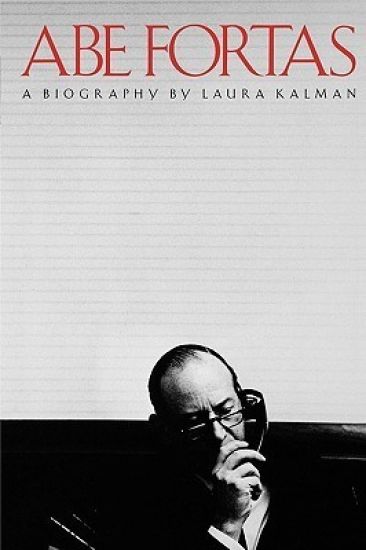
Abe Fortas was a New Dealer, a sub-cabinet official, the founder of an eminent Washington law firm, a lose adviser to Lyndon Johnson, and a Supreme Court justice. Nominated by Johnson to be Chief Justice, he was rejected by Congress and resigned from the Court early in the Nixon administration under a cloud of impending scandal. This engrossing book—the first full biography of Abe Fortas—tells his dramatic story. Drawing on Fortas’s previously unavailable personal papers, on numerous archives, and on extensive interviews with his family and associates, Laura Kalman, a historian and lawyer illuminates Fortas’s evolution from New Dealer to Washington lawyer to Great Society liberal, and in so doing also provides a unique view of American liberalism from the 1930s through the 1960s. “There was no single Abe Fortas,” writes Kalman. “There was a variety of personae, and Fortas moved comfortably from one to another.” Kalman describes Fortas’s various personae:•The boy who as “Fiddlin’ Abe” played the violin in dance bands to earn spending money and who grew to consider chamber music the love of his life; •The Jew who cared more about Israel than Judaism; •The civil libertarian who worked for irascible Harold Ickes as Under Secretary of the Interior during the New Deal, who defended those charged with disloyalty by Joseph McCarthy, and who promoted social justice on the Court; •The urbane corporate lawyer whose friends became clients and whose clients became friends; •The brilliant legal tactician who secured Lyndon Johnson’s Senate seat in 1948 and whose successful defense of the Gideon case was described by William O. Douglas as “the best single argument” he heard in all his years on the Supreme Court; •The Supreme Court justice who willingly risked compromising his judicial integrity to advise President Johnson; •The man who hobnobbed with the powerful yet was powerless to combat the attacks against him when he was a Supreme Court justice, and whose resignation from the Court contributed to the destruction of the liberal agenda for social reform.Reflecting on the various aspects of Fortas’s enigmatic personality and the events of his life, Kalman creates a new portrait of the man that is more insightful and complete than any yet published. Engagingly written and superbly researched, this is the authoritative account of Fortas and the legal and political history he helped to shape.
The Strange Career of Legal Liberalism

The Strange Career of Legal Liberalism

Laura Kalman

Yale University Press
1998
pokkari
Legal scholarship is in a state of crisis, Laura Kalman argues in this history of the most prestigious field in law studies: constitutional theory. Since the time of the New Deal, says Kalman, most law scholars have identified themselves as liberals who believe in the power of the Supreme Court to effect progressive social change. In recent years, however, new political and interdisciplinary perspectives have undermined the tenets of legal liberalism, and liberal law professors have enlisted other disciplines in the attempt to legitimize their beliefs. Such prominent legal thinkers as Cass Sunstein, Bruce Ackerman, and Frank Michelman have incorporated the work of historians into their legal theories and arguments, turning to eighteenth-century republicanism—which stressed communal values and an active citizenry—to justify their goals.Kalman, a historian and a lawyer, suggests that reliance on history in legal thinking makes sense at a time when the Supreme Court repeatedly declares that it will protect only those liberties rooted in history and tradition. There are pitfalls in interdisciplinary argumentation, she cautions, for historians' reactions to this use of their work have been unenthusiastic and even hostile. Yet lawyers, law professors, and historians have cooperated in some recent Supreme Court cases, and Kalman concludes with a practical examination of the ways they can work together more effectively as social activists.
Right Star Rising

Right Star Rising

Laura Kalman

WW NORTON CO
2010
nidottu
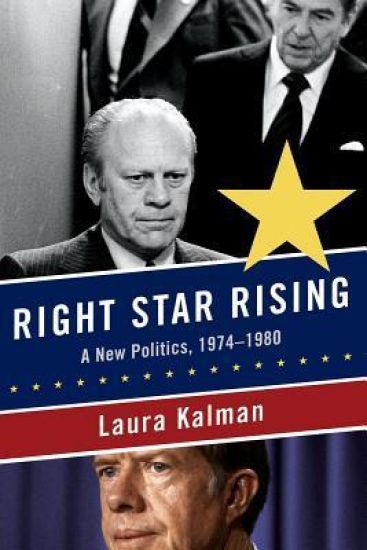
On the face of it, the Ford-Carter years seem completely forgettable. They were years of weak presidential leadership and national drift. Yet, as Laura Kalman shows in this absorbing narrative history, the contours of our contemporary politics took shape during these years. This was the incubation period for a powerful movement on the right that was to triumph with Ronald Reagan’s election in 1980. These years also marked the coming of age of the social movements of the 1960s, as their causes moved from the streets to the courts for mediation. Supreme Court decisions on affirmative action and the scope of privacy rights had immense social and political impact. The nation experienced an energy crisis, a sharp economic downturn, and a collision with fundamentalism in Iran that set the terms for coming crises. Kalman’s navigation of this eventful political and social terrain is expert and riveting.