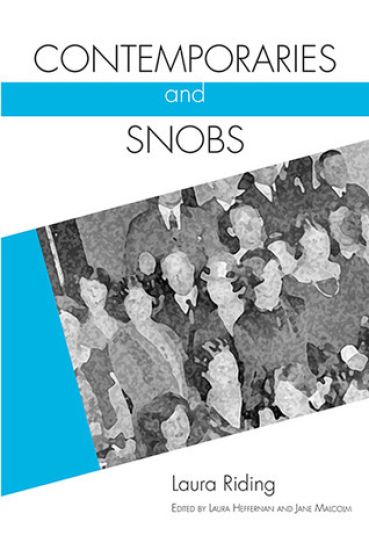
This new edition of Contemporaries and Snobs, a landmark collection of essays by Laura Riding, offers a counter-history of high modernist poetics. Laura Riding’s Contemporaries and Snobs (1928) was the first volume of essays to engage critically with high modernist poetics from the position of the outsider. For readers today, it offers a compelling account—by turns personal, by turns historical—of how the institutionalization of modernism denuded experimental poetry. Most importantly, Contemporaries and Snobs offers a counter-history of the idiosyncratic, of what the institution of modernism left (and leaves) behind. With Gertrude Stein as its figurehead, the book champions the noncanonical, the “barbaric,” and the undertheorized.Riding’s nuanced defense of a poetics of the person in Contemporaries and Snobs represents a forgotten but essential first attempt to identify and foster what is now a well-defined poetic lineage that leads from Stein to the contemporary experimental avant-garde. In these essays, Riding takes her readers on a remarkably thorough tour through the critical scene of the 1920s. Among other influential treatises, she considers T. S. Eliot’s The Sacred Wood and his editorial essays in The Criterion, Allen Tate’s “Poetry and the Absolute,” John Crowe Ransom’s essays on the modernist poet, Edgell Rickword’s essays in The Calendar of Modern Letters, and Herbert Read’s posthumous publication of T. E. Hulme’s essays. All of this criticism, Riding notes, gave modern poets a sheen of seriousness and professionalism, but was it good for poetry? Her decisive answer is “no.” This new edition includes an introduction by Laura Heffernan and Jane Malcolm that makes legible the many connections between Contemporaries and Snobs and the critical debates and poetic experiments of the 1920s, as well as explanatory notes, a chronological bibliography of Riding’s work, and an index of proper names.