Kirjojen hintavertailu. Mukana 11 936 547 kirjaa ja 12 kauppaa.

Kirjahaku

Etsi kirjoja tekijän nimen, kirjan nimen tai ISBN:n perusteella.

4 kirjaa tekijältä Laurel Brake

Walter Pater

Walter Pater

Laurel Brake

Liverpool University Press
1994
nidottu
Walter Pater (1839-94) was an active participant in the literary marketplace as an academic, journalist, critic, writer of short stories, and novelist at a time of the rise of English and of journalism, university reform, and the professionalisation and separating out of literature from journalism. He was also a classicist whose interest in Greek studies coincided with a commitment to explore in his writings the scope of male homosexual discourse. This critical study of a key figure in Victorian literary society examines Pater’s work on art history, literature and Greek studies, as well as analysing the roles of gender and journalism in shaping his writing. Laurel Brake approaches Pater’s writings from the prospective of cultural history – including publishing and the politics of literature and gender – and covers his key works, including Studies in the History of the Renaissance, Style, Imaginary Portraits, Marius the Epicurean, and Greek Studies.
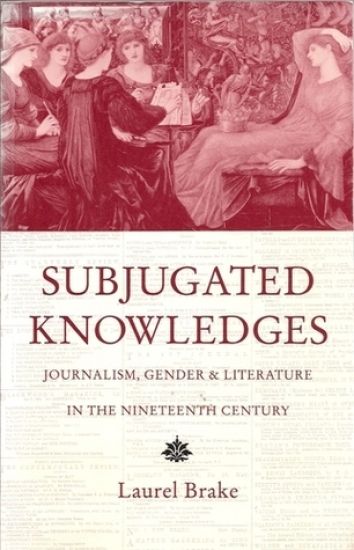
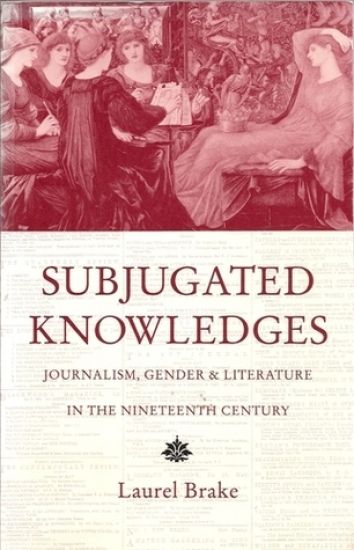
Subjugated Knowledges

Subjugated Knowledges

Laurel Brake

New York University Press
1994
sidottu
This book examines the connection between print and culture in the nineteenth century, identifying a neglected and important body of Victorian criticism. Subjugated Knowledges explores the relations of certain forms of nineteenth-century printed texts to their modes of production and to each other, in their own time period and in ours. Brake claims that there is a high degree of interdependence among literature, history, and journalism. She investigates the ways in which space is designated male or female as well as the way authorship is constructed in various forms of biography, including in such diverse forms as obituaries and dictionaries. The book moves from a general mapping of the relations between literature and journalism and their respective formations to studies of individual textssuch as Harper's New Monthly Magazine, Woman's World, and the Dictionary of National Biography and of relations between (the construction of) authorship and publishing history. The volume is comprised of three sections: Literature and Journalism, Gendered Space, and Biography and Authorship.The first section contains chapters on such diverse issues as the professionalization of critics, cultural formation of journals, new journalism, press censorship, and decadence. The second section discusses women's magazines of the 1880s and 90s, while the third examines debates in the press about biography.
Subjugated Knowledges

Subjugated Knowledges

Laurel Brake

New York University Press
1994
pokkari
This book examines the connection between print and culture in the nineteenth century, identifying a neglected and important body of Victorian criticism. Subjugated Knowledges explores the relations of certain forms of nineteenth-century printed texts to their modes of production and to each other, in their own time period and in ours. Brake claims that there is a high degree of interdependence among literature, history, and journalism. She investigates the ways in which space is designated male or female as well as the way authorship is constructed in various forms of biography, including in such diverse forms as obituaries and dictionaries. The book moves from a general mapping of the relations between literature and journalism and their respective formations to studies of individual textssuch as Harper's New Monthly Magazine, Woman's World, and the Dictionary of National Biography and of relations between (the construction of) authorship and publishing history. The volume is comprised of three sections: Literature and Journalism, Gendered Space, and Biography and Authorship.The first section contains chapters on such diverse issues as the professionalization of critics, cultural formation of journals, new journalism, press censorship, and decadence. The second section discusses women's magazines of the 1880s and 90s, while the third examines debates in the press about biography.