Kirjojen hintavertailu. Mukana 11 699 587 kirjaa ja 12 kauppaa.

Kirjahaku

Etsi kirjoja tekijän nimen, kirjan nimen tai ISBN:n perusteella.

6 kirjaa tekijältä Lawrence E. Harrison

The Pan-american Dream

The Pan-american Dream

Lawrence E. Harrison

Routledge
2019
sidottu
The initiative of Presidents George Bush and Bill Clinton to forge a Western Hemisphere community has been staggered by Mexico's economic and political crisis. Is this latest grand design for the hemisphere destined to follow John Kennedy's Alliance for Progress and Franklin Roosevelt's Good Neighbor Policy into the cemetery of frustrated Pan-American dreams? The United States and Canada are prosperous first-world countries with centuries-old democratic institutions; Latin America's countries are poor and, in most cases, experimenting with democratic capitalism for the first time. Can a coherent, durable community like the European Union be constructed with building blocks so different?Why are the United States and Canada so much more prosperous, so much more democratic than is Latin America? Why has it taken so long for Latin America to conclude that democratic capitalism and good relations with the United States are in its best interest? And what might be done to enhance the prospects for a dynamic community in the Western Hemisphere?These are the questions Lawrence Harrison addresses in The Pan-American Dream. Central to the contrasts between Latin America and the United States and Canada are the fundamental differences between the Ibero-Catholic and Anglo-Protestant cultures, reflected in contrasting views of work, education, merit, community, ethics, and authority, among others. But, as he stresses, cultural values and attitudes change, and Pan-Americanism can be more than a dream.A Pan-American community depends on shared values and institutions, as the community now embracing the United States and Canada demonstrates. Experiments with democracy and the free market in Latin America will help strengthen the values that lie behind the success of the United States and Canada, Western Europe, and East Asia. But if Latin America's political and intellectual leaders do not confront the traditional values and attitudes largely responsible for the region's underdevelo
Jews, Confucians, and Protestants

Jews, Confucians, and Protestants

Lawrence E. Harrison

Rowman Littlefield Publishers
2017
nidottu
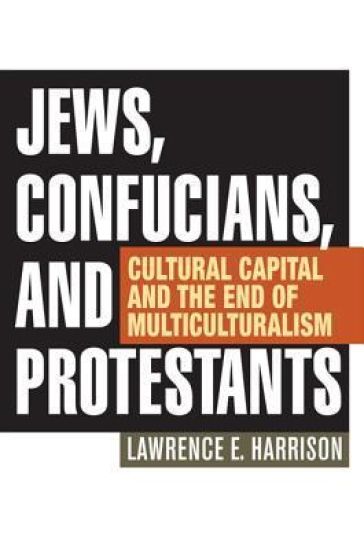
Multiculturalism—the belief that no culture is better or worse than any other; it is merely different—has come to dominate Western intellectual thought and to serve as a guide to domestic and foreign policy and development aid. But what if multiculturalism itself is flawed? What if some cultures are more prone to progress than others and more successful at creating the cultural capital that encourages democratic governance, social justice for all, and the elimination of poverty? In Jews, Confucians, and Protestants: Cultural Capital and the End of Multiculturalism, Lawrence E. Harrison takes the politically incorrect stand that all cultures are not created equal. Analyzing the performance of 117 countries, grouped by predominant religion, Harrison argues for the superiority of those cultures that emphasize Jewish, Confucian, and Protestant values. A concluding chapter outlines ways in which cultural change may substantially transform societies within a generation.
The Pan-american Dream

The Pan-american Dream

Lawrence E. Harrison

Westview Press Inc
1998
nidottu
The initiative of Presidents George Bush and Bill Clinton to forge a Western Hemisphere community has been staggered by Mexico's economic and political crisis. Is this latest grand design for the hemisphere destined to follow John Kennedy's Alliance for Progress and Franklin Roosevelt's Good Neighbor Policy into the cemetery of frustrated Pan-American dreams? The United States and Canada are prosperous first-world countries with centuries-old democratic institutions; Latin America's countries are poor and, in most cases, experimenting with democratic capitalism for the first time. Can a coherent, durable community like the European Union be constructed with building blocks so different?Why are the United States and Canada so much more prosperous, so much more democratic than is Latin America? Why has it taken so long for Latin America to conclude that democratic capitalism and good relations with the United States are in its best interest? And what might be done to enhance the prospects for a dynamic community in the Western Hemisphere?These are the questions Lawrence Harrison addresses in The Pan-American Dream. Central to the contrasts between Latin America and the United States and Canada are the fundamental differences between the Ibero-Catholic and Anglo-Protestant cultures, reflected in contrasting views of work, education, merit, community, ethics, and authority, among others. But, as he stresses, cultural values and attitudes change, and Pan-Americanism can be more than a dream.A Pan-American community depends on shared values and institutions, as the community now embracing the United States and Canada demonstrates. Experiments with democracy and the free market in Latin America will help strengthen the values that lie behind the success of the United States and Canada, Western Europe, and East Asia. But if Latin America's political and intellectual leaders do not confront the traditional values and attitudes largely responsible for the region's underdevelopment?with sweeping reforms in education and child-rearing practices, for example?realization of the Pan-American dream will be painfully slow and uncertain.
Jews, Confucians, and Protestants

Jews, Confucians, and Protestants

Lawrence E. Harrison

Rowman Littlefield
2012
sidottu
Multiculturalism—the belief that no culture is better or worse than any other; it is merely different—has come to dominate Western intellectual thought and to serve as a guide to domestic and foreign policy and development aid. But what if multiculturalism itself is flawed? What if some cultures are more prone to progress than others and more successful at creating the cultural capital that encourages democratic governance, social justice for all, and the elimination of poverty? In Jews, Confucians, and Protestants: Cultural Capital and the End of Multiculturalism, Lawrence E. Harrison takes the politically incorrect stand that all cultures are not created equal. Analyzing the performance of 117 countries, grouped by predominant religion, Harrison argues for the superiority of those cultures that emphasize Jewish, Confucian, and Protestant values. A concluding chapter outlines ways in which cultural change may substantially transform societies within a generation.