Kirjojen hintavertailu. Mukana 11 342 296 kirjaa ja 12 kauppaa.

Kirjahaku

Etsi kirjoja tekijän nimen, kirjan nimen tai ISBN:n perusteella.

7 kirjaa tekijältä Lawrence J. Vale

After the Projects

After the Projects

Lawrence J. Vale

Oxford University Press Inc
2019
sidottu
America is in the midst of a rental affordability crisis. More than a quarter of those that rent their homes spend more than half of their income for housing, even as city leaders across the United States have been busily dismantling the nation's urban public housing projects. In After the Projects, Lawrence Vale investigates the deeply-rooted spatial politics of public housing development and redevelopment at a time when lower-income Americans face a desperate struggle to find affordable rental housing in many cities. Drawing on more than 200 interviews with public housing residents, real estate developers, and community leaders, Vale analyzes the different ways in which four major American cities implemented the federal governments HOPE VI program for public housing transformation, while also providing a national picture of this program. Some cities attempted to minimize the presence of the poorest residents in their new mixed-income communities, but other cities tried to serve as many low-income households as possible. Through examining the social, political, and economic forces that underlie housing displacement, Vale develops the novel concept of governance constellations. He shows how the stars align differently in each city, depending on community pressures that have evolved in response to each citys past struggles with urban renewal. This allows disparate key players to gain prominence when implementing HOPE VI redevelopment. A much-needed comparative approach to the existing research on public housing, After the Projects shines a light on the broad variety of attitudes towards public housing redevelopment in American cities and identifies ways to achieve more equitable processes and outcomes for low-income Americans.
After the Projects

After the Projects

Lawrence J. Vale

Oxford University Press Inc
2020
nidottu
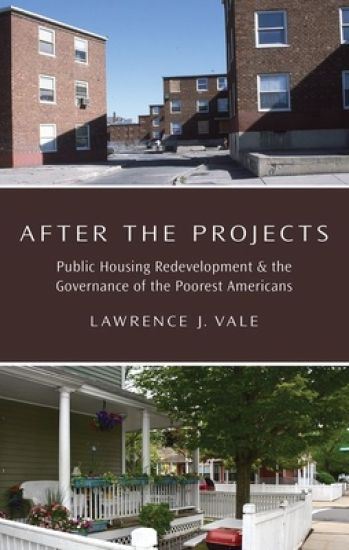
In After the Projects, Lawrence Vale investigates the deeply-rooted spatial politics of public housing development and redevelopment at a time when lower-income Americans face a desperate struggle to find affordable rental housing in many cities. Drawing on more than 200 interviews with public housing residents, real estate developers, and community leaders, Vale analyzes the different ways in which New Orleans, Boston, Tucson, and San Francisco implemented the federal government's HOPE VI program for public housing transformation, while also providing a national picture of this program. Through examining the social, political, and economic forces that underlie housing displacement, Vale develops the novel concept of governance constellations. He shows how the stars align differently in each city, depending on community pressures that have evolved in response to each city's past struggles with urban renewal. A much-needed comparative approach to the existing research on public housing, After the Projects shines a light on the broad variety of attitudes towards public housing redevelopment in American cities and identifies ways to achieve more equitable processes and outcomes for low-income Americans.
Purging the Poorest

Purging the Poorest

Lawrence J. Vale

University of Chicago Press
2013
sidottu
The building and management of public housing is often seen as a signal failure of American public policy, but this is a vastly oversimplified view. In "Purging the Poorest", Lawrence J. Vale offers a new narrative of the seventy-five-year struggle to house the "deserving poor." In the 1930s, two iconic American cities, Atlanta and Chicago, demolished their slums and established some of this country's first public housing. Six decades later, these same cities also led the way in clearing public housing itself. Vale's groundbreaking history of these "twice-cleared" communities provides unprecedented detail about the development, decline, and redevelopment of two of America's most famous housing projects: Chicago's Cabrini-Green and Atlanta's Techwood/Clark Howell Homes. Vale offers the novel concept of "design politics" to show how issues of architecture and urbanism are intimately bound up in thinking about policy. Drawing from extensive archival research and in-depth interviews, Vale recalibrates the larger cultural role of public housing, revalues the contributions of public housing residents, and reconsiders the role of design and designers.
Purging the Poorest

Purging the Poorest

Lawrence J. Vale

University of Chicago Press
2013
nidottu
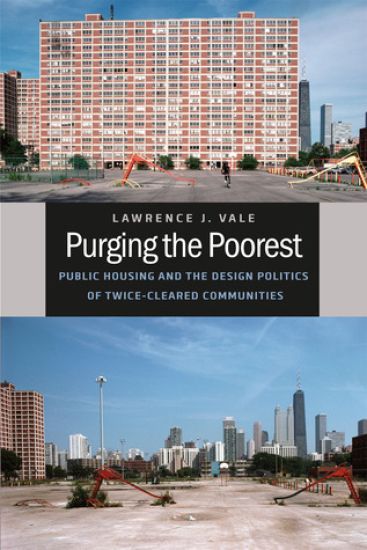
The building and management of public housing is often seen as a signal failure of American public policy, but this is a vastly oversimplified view. In "Purging the Poorest", Lawrence J. Vale offers a new narrative of the seventy-five-year struggle to house the "deserving poor." In the 1930s, two iconic American cities, Atlanta and Chicago, demolished their slums and established some of this country's first public housing. Six decades later, these same cities also led the way in clearing public housing itself. Vale's ground breaking history of these "twice-cleared" communities provides unprecedented detail about the development, decline, and redevelopment of two of America's most famous housing projects: Chicago's Cabrini-Green and Atlanta's Techwood/Clark Howell Homes. Vale offers the novel concept of "design politics" to show how issues of architecture and urbanism are intimately bound up in thinking about policy. Drawing from extensive archival research and in-depth interviews, Vale recalibrates the larger cultural role of public housing, revalues the contributions of public housing residents, and reconsiders the role of design and designers.
Reclaiming Public Housing

Reclaiming Public Housing

Lawrence J. Vale

Harvard University Press
2002
sidottu
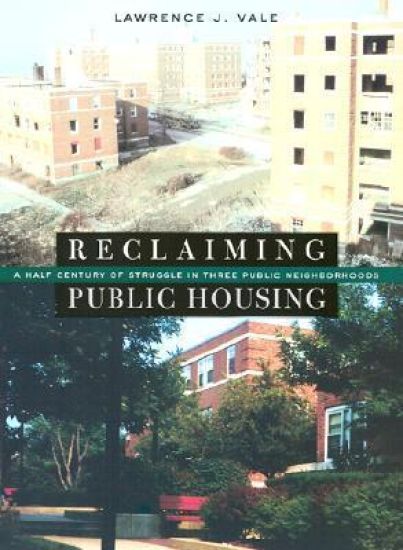
In Reclaiming Public Housing, Lawrence Vale explores the rise, fall, and redevelopment of three public housing projects in Boston. Vale looks at these projects from the perspectives of their low-income residents and assesses the contributions of the design professionals who helped to transform these once devastated places during the 1980s and 1990s. The three similarly designed projects were built at the same time under the same government program and experienced similar declines. Each received comparable funding for redevelopment, and each design team consisted of first-rate professionals who responded with similar "defensible space" redesign plans. Why, then, was one redevelopment effort a nationally touted success story, another only a mixed success, and the third a widely acknowledged failure? The book answers this key question by situating each effort in the context of specific neighborhood struggles. In each case, battles over race and poverty played out somewhat differently, yielding wildly different results.At a moment when local city officials throughout America are demolishing more than 100,000 units of low-income housing, this crucial book questions the conventional wisdom that all large public housing projects must be demolished and rebuilt as mixed-income neighborhoods.
From the Puritans to the Projects

From the Puritans to the Projects

Lawrence J. Vale

Harvard University Press
2007
nidottu
From the almshouses of seventeenth-century Puritans to the massive housing projects of the mid-twentieth century, the struggle over housing assistance in the United States has exposed a deep-seated ambivalence about the place of the urban poor. Lawrence J. Vale's groundbreaking book is both a comprehensive institutional history of public housing in Boston and a broader examination of the nature and extent of public obligation to house socially and economically marginal Americans during the past 350 years. First, Vale highlights startling continuities both in the way housing assistance has been delivered to the American poor and in the policies used to reward the nonpoor. He traces the stormy history of the Boston Housing Authority, a saga of entrenched patronage and virulent racism tempered, and partially overcome, by the efforts of unyielding reformers. He explores the birth of public housing as a program intended to reward the upwardly mobile working poor, details its painful transformation into a system designed to cope with society's least advantaged, and questions current policy efforts aimed at returning to a system of rewards for responsible members of the working class. The troubled story of Boston public housing exposes the mixed motives and ideological complexity that have long characterized housing in America, from the Puritans to the projects.