Kirjojen hintavertailu. Mukana 12 016 292 kirjaa ja 12 kauppaa.

Kirjahaku

Etsi kirjoja tekijän nimen, kirjan nimen tai ISBN:n perusteella.

17 kirjaa tekijältä Lawrence M. Friedman

A History of American Law

A History of American Law

Lawrence M. Friedman

Oxford University Press Inc
2019
sidottu
Renowned legal historian Lawrence Friedman presents an accessible and authoritative history of American law from the colonial era to the present day. This fully revised fourth edition incorporates the latest research to bring this classic work into the twenty-first century. In addition to looking closely at timely issues like race relations, the book covers the changing configurations of commercial law, criminal law, family law, and the law of property. Friedman furthermore interrogates the vicissitudes of the legal profession and legal education. The underlying theory of this eminently readable book is that the law is the product of society. In this way, we can view the history of the legal system through a sociological prism as it has evolved over the years.
A History of American Law

A History of American Law

Lawrence M. Friedman

Oxford University Press Inc
2019
nidottu
Renowned legal historian Lawrence Friedman presents an accessible and authoritative history of American law from the colonial era to the present day. This fully revised fourth edition incorporates the latest research to bring this classic work into the twenty-first century. In addition to looking closely at timely issues like race relations, the book covers the changing configurations of commercial law, criminal law, family law, and the law of property. Friedman furthermore interrogates the vicissitudes of the legal profession and legal education. The underlying theory of this eminently readable book is that the law is the product of society. In this way, we can view the history of the legal system through a sociological prism as it has evolved over the years.
American Law in the Twentieth Century

American Law in the Twentieth Century

Lawrence M. Friedman

Yale University Press
2004
nidottu
In this long-awaited successor to his landmark work A History of American Law, Lawrence M. Friedman offers a monumental history of American law in the twentieth century.The first general history of its kind, American Law in the Twentieth Century describes the explosion of law over the past century into almost every aspect of American life. Since 1900 the center of legal gravity in the United States has shifted from the state to the federal government, with the creation of agencies and programs ranging from Social Security to the Securities Exchange Commission to the Food and Drug Administration. Major demographic changes have spurred legal developments in such areas as family law and immigration law. Dramatic advances in technology have placed new demands on the legal system in fields ranging from automobile regulation to intellectual property.Throughout the book, Friedman focuses on the social context of American law. He explores the extent to which transformations in the legal order have resulted from the social upheavals of the twentieth century--including two world wars, the Great Depression, the civil rights movement, and the sexual revolution. Friedman also discusses the international context of American law: what has the American legal system drawn from other countries? And in an age of global dominance, what impact has the American legal system had abroad?Written by one of our most eminent legal historians, this engrossing book chronicles a century of revolutionary change within a legal system that has come to affect us all.
The Horizontal Society

The Horizontal Society

Lawrence M. Friedman

Yale University Press
2014
pokkari
Modern technology has radically and irretrievably altered our sense of identity and hence our social, political, and legal life, argues Lawrence M. Friedman in this bold new book. In traditional societies, he explains, relationships and identities were strongly vertical: there was a clear line of authority from top to bottom, and identity was fixed by one’s birth or social position. But in modern society, identity and authority have become much more horizontal: people feel freer to choose who they are and to form relationships on a plane of equality.Friedman examines how modern life centers on human identity seen in terms of race, gender, ethnicity, and religion, and how this new way of defining oneself affects politics, social structure, and the law. Our horizontal society, he says, is the product of the mass media—in particular, television—which break down the isolation of traditional life and allow individuals to connect with like-minded others across barriers of space and time. As horizontal groups blossom, loyalties and allegiances to smaller groups fragment what seemed to be the unity of the larger nation. In addition, the media’s ability to spread a global mass culture causes a breakdown of cultural isolation that leads to more immigration and heavy pressure on the laws and institutions of citizenship and immigration.
The Republic of Choice

The Republic of Choice

Lawrence M. Friedman

Harvard University Press
1998
nidottu
In this imaginative exploration of modern legal culture, Lawrence Friedman addresses how the contemporary idea of individual rights has altered the legal systems and authority structures of Western societies. Every aspect of law, he argues--from civil rights to personal-injury litigation to divorce law--has been profoundly reshaped, reflecting the power of this concept.The new individualism is quite different from that of the nineteenth century, which stressed self-control, discipline, and traditional group values. Modern individualism focuses on the individual as the starting and ending point of life and assumes a wide zone of choice. Choice is vital, fundamental: the right to develop oneself, to build up a life uniquely suited to oneself through free, open selection among forms, models, and lifestyles. With striking clarity and force, Friedman demonstrates how the new individualism results from changes in the technological and social framework of society. Loose, unconnected, free-floating, mobile: this is the modern individual, at least in comparison with the immediate past.Written for the general reader as well as lawyers and legal scholars, The Republic of Choice offers keen and original observations about legal culture and the public consciousness that informs and expresses it.
Impact

Impact

Lawrence M. Friedman

Harvard University Press
2016
sidottu
Laws and regulations are ubiquitous, touching on many aspects of individual and corporate behavior. But under what conditions are laws and rules actually effective? A huge amount of recent work in political science, sociology, economics, criminology, law, and psychology, among other disciplines, deals with this question. But these fields rarely inform one another, leaving the state of research disjointed and disorganized. Lawrence M. Friedman finds order in this cacophony. Impact gathers recent findings into one overarching analysis and lays the groundwork for a cohesive body of work in what Friedman labels “impact studies.”The first important factor that has a bearing on impact is communication. A rule or law has no effect if it never reaches its intended audience. The public’s fund of legal knowledge, the clarity of the law, and the presence of information brokers all influence the flow of information from lawmakers to citizens. After a law is communicated, subjects sometimes comply, sometimes resist, and sometimes adjust or evade. Three clusters of motives help shape which reaction will prevail: first, rewards and punishments; second, peer group influences; and third, issues of conscience, legitimacy, and morality. When all of these factors move in the same direction, law can have a powerful impact; when they conflict, the outcome is sometimes unpredictable.
The Big Trial

The Big Trial

Lawrence M. Friedman

University Press of Kansas
2015
sidottu
The trial of O. J. Simpson was a sensation, avidly followed by millions of people, but it was also, in a sense, nothing new. One hundred years earlier the Lizzie Borden trial had held the nation in thrall. The names (and the crimes) may change, but the appeal is enduring—and why this is, how it works, and what it means are what Lawrence Friedman investigates in The Big Trial.What is it about these cases that captures the public imagination? Are the “headline trials” of our period different from those of a century or two ago? And what do we learn from them, about the nature of our society, past and present? To get a clearer picture, Friedman first identifies what certain headline trials have in common, then considers particular cases within each grouping. The political trialz, for instance, embraces treason and spying, dissenters and radicals, and, to varying degrees, corruption and fraud. Celebrity trials involve the famous—whether victims, as in the case of Charles Manson, or defendants as disparate as Fatty Arbuckle and William Kennedy Smith—but certain high-profile cases, such as those Friedman categorizes as tabloid trials, can also create celebrities. The fascination of whodunit trials can be found in the mystery surrounding the case: Are we sure about O. J. Simpson? What about Claus von Bulow—tried, in another sensational case, for sending his wife into a coma? An especially interesting type of case Friedman groups under the rubric worm in the bud. These are cases, such as that of Lizzie Borden, that seem to put society itself on trial; they raise fundamental social questions and often suggest hidden and secret pathologies. And finally, a small but important group of cases proceed from moral panic, the Salem witchcraft trials being the classic instance, though Friedman also considers recent examples.Though they might differ in significant ways, these types of trials also have important similarities. Most notably, they invariably raise questions about identity (Who is this defendant? A villain? An innocent unfairly accused?). And in this respect, The Big Trial shows us, the headline trial reflects a critical aspect of modern society. Reaching across the nineteenth and twentieth centuries to the latest outrage, from congressional hearings to lynching and vigilante justice to public punishment, from Dr. Sam Sheppard (the “fugitive”) to Jeffrey Dahmer (the “cannibal”), The Rosenbergs to Timothy McVeigh, the book presents a complex picture of headline trials as displays of power—moments of “didactic theater” that demonstrate in one way or another whether a society is fair, whom it protects, and whose interest it serves.
Guarding Life's Dark Secrets

Guarding Life's Dark Secrets

Lawrence M. Friedman

Stanford University Press
2007
sidottu
Guarding Life's Dark Secrets tells the story of an intriguing aspect of the social and legal culture in the United States, the construction and destruction of a network of doctrines designed to protect reputation. The strict and unbending rules of decency and propriety of the nineteenth century, especially concerning sexual behavior, paradoxically provided ways to protect and shield respectable men and women who deviated from the official norms. This "Victorian compromise," which created an important zone of privacy, first came under attack from moralists for its tolerance of sin. During the second half of the twentieth century, the old structure was largely dismantled by an increasingly permissive society. Rich with anecdotes, Friedman's account draws us into the present. The Supreme Court has interpreted the Constitution to include a right of privacy, which has given ordinary people increased freedom, especially in matters of sex, reproduction, and choice of intimate partners. The elite, however, no longer have the freedom they once had to violate decency rules with impunity. Although public figures may have lost some of their privacy rights, ordinary people have gained more privacy, greater leeway, and broader choices. These gains, however, are now under threat as technology transforms the modern world into a world of surveillance.
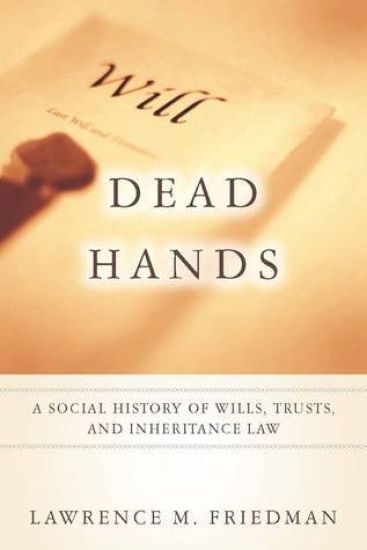
Dead Hands

Dead Hands

Lawrence M. Friedman

Stanford University Press
2009
pokkari
The law of succession rests on a single brute fact: you can't take it with you. The stock of wealth that turns over as people die is staggeringly large. In the United States alone, some $41 trillion will pass from the dead to the living in the first half of the 21st century. But the social impact of inheritance is more than a matter of money; it is also a matter of what money buys and brings about. Law and custom allow people many ways to pass on their property. As Friedman's enlightening social history reveals, a decline in formal rules, the ascendancy of will substitutes over classic wills, social changes like the rise of the family of affection, changing ideas of acceptable heirs, and the potential disappearance of the estate tax all play a large role in the balance of wealth. Dead Hands uncovers the tremendous social and legal importance of this rite of passage, and how it reflects changing values and priorities in American families and society.
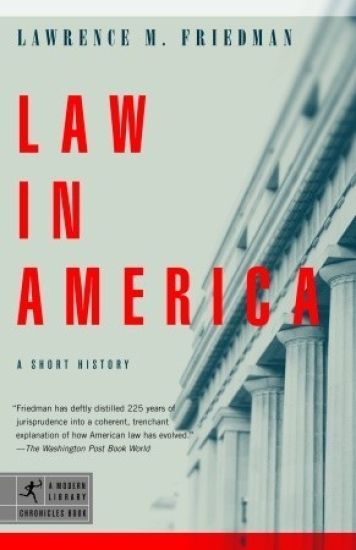
Law in America

Law in America

Lawrence M. Friedman

Modern Library Inc
2004
pokkari
Throughout America's history, our laws have been a reflection of who we are, of what we value, of who has control. They embody our society's genetic code. In the masterful hands of the subject's greatest living historian, the story of the evolution of our laws serves to lay bare the deciding struggles over power and justice that have shaped this country from its birth pangs to the present. Law in America is a supreme example of the historian's art, its brevity a testament to the great elegance and wit of its composition. From the Hardcover edition.
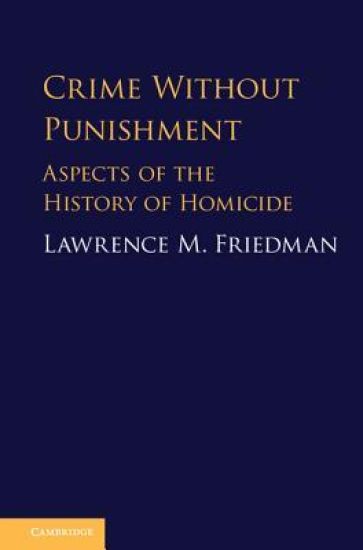
Crime without Punishment

Crime without Punishment

Lawrence M. Friedman

Cambridge University Press
2018
sidottu
In this compelling book, Lawrence M. Friedman looks at situations where killing is condemned by law but not by social norms and, therefore, is rarely punished. He shows how penal codes categorize homicides by degree of intent, which are in turn based on society's sense of moral outrage. Despite being officially defined as murder, many homicides have historically gone unpunished. Friedman looks at early vigilante justice, crimes of passion, murder of necessity, mercy killings, and assisted suicides. In his explorations of these unpunished homicides, Friedman probes what these circumstances tell us about conflicts in social and cultural norms, and the interaction of law and society.
Crime without Punishment

Crime without Punishment

Lawrence M. Friedman

Cambridge University Press
2019
pokkari
In this compelling book, Lawrence M. Friedman looks at situations where killing is condemned by law but not by social norms and, therefore, is rarely punished. He shows how penal codes categorize homicides by degree of intent, which are in turn based on society's sense of moral outrage. Despite being officially defined as murder, many homicides have historically gone unpunished. Friedman looks at early vigilante justice, crimes of passion, murder of necessity, mercy killings, and assisted suicides. In his explorations of these unpunished homicides, Friedman probes what these circumstances tell us about conflicts in social and cultural norms, and the interaction of law and society.
Personal Identity in the Modern World

Personal Identity in the Modern World

Lawrence M. Friedman

BLOOMSBURY PUBLISHING PLC
2022
sidottu
In a society of strangers, there develops what can be called crimes of mobility -- forms of criminality rare in traditional societies: bigamy, the confidence game, and blackmail, for example. What they have in common is a kind of fraudulent role-playing, which the new society makes possible. This book explores the social and legal consequences of social and geographical mobility in the United States and Great Britain from the beginning of the 19th century on. Personal identity became more fluid. Lines between classes blurred. Impostors abound.
Personal Identity in the Modern World

Personal Identity in the Modern World

Lawrence M. Friedman

ROWMAN LITTLEFIELD
2024
nidottu
In a society of strangers, there develops what can be called crimes of mobility -- forms of criminality rare in traditional societies: bigamy, the confidence game, and blackmail, for example. What they have in common is a kind of fraudulent role-playing, which the new society makes possible. This book explores the social and legal consequences of social and geographical mobility in the United States and Great Britain from the beginning of the 19th century on. Personal identity became more fluid. Lines between classes blurred. Impostors abound.
Law, Science, and Technology

Law, Science, and Technology

Lawrence M. Friedman

ROWMAN LITTLEFIELD
2023
sidottu
Through a series of historical analyses, Friedman explores the relationship between the legal system and the development of modern science and technology. The scientific revolution produced major changes in culture; and these in turn led to changes in government and law. The book covers, among other topics, the transportation revolution; the camera and the entertainment industry; the “germ theory” and its influence on modern society; and the role of culture and technology in the sexual revolution.
Contract Law in America: A Social and Economic Case Study
A classic study of the social and economic realities of trade law, told through case studies and rich historical analysis. Comparing contract cases and legislation over three discrete historical periods, Lawrence Friedman shows that social context matters, that law is more flexible and adaptive than traditional doctrinal studies would suggest, and that the framing of contract law can use a fresh reexamination in light of the historical realities he exposes. A recognized study in law & society, this volume previously hid out as a rare book or was completely unavailable. Now readily accessible worldwide, it also features a new preface by the author as well as a new, analytical foreword by Stewart Macaulay, a senior professor of law at the University of Wisconsin. As Macaulay notes, Friedman's Contract Law in America "still challenges those who research, write and teach in the field of contracts. His findings and arguments still call for a serious response today." Has contracts doctrine become "the law of leftovers"? In any event, Macaulay sums up, "Friedman combines scholarship that takes him into dusty archives with insight into the broader effect of both public culture and legal culture. I am continually and pleasantly surprised when I read him." As with all the quality contributions to Quid Pro's Classics of Law & Society Series, this book features modern formatting, legible tables, and hyperaccurate proofreading from the original text. Moreover, it embeds page numbers from the first edition (in both print and digital formats), for continuity of references. Praise for this anniversary edition of the book abounds: "Contract Law in America is one of the most important works in the entire scholarly literature on American legal history. Friedman took a subject that had been treated by researchers in exclusively doctrinal terms, bringing an entirely new perspective that revealed how contract law has been at the very center of how we need to understand 'law in action' in key periods of American development. In the methodology that Friedman applied, in the brilliance of the analysis, and in the new light his book cast on the full dimensions of governance and law in the United States, this book broke new ground. It remains today, still, required reading for any student of legal history." - Harry N. Scheiber Stefan A. Riesenfeld Professor of Law and History, University of California at Berkeley "The republishing of Contract Law in America is a very welcome event. For years this has been one of the neglected classics of legal literature. Friedman did what the Legal Realists only dreamed of doing-he studied in depth what kinds of contracts cases state courts had decided over time, and found grand patterns in the decisions. As real-world contracts dropped out of common law litigation and into private ordering and specialized regulation, courts abandoned abstract formal rule-making for particularized equitable resolutions. In the present moment, more receptive to social and empirical studies of law than was 1965, Friedman's book should finally find the audience it deserves." - Robert W. Gordon Chancellor Kent Professor of Law and Legal History, Emeritus, Yale University; and Professor of Law, Stanford University "Contract Law in America remains a classic examination of the relationships among legal doctrine, legal culture, and the shifting frameworks of American business enterprise. Amid the current academic re-engagement with questions of political economy, we can only hope that more historians, social scientists, and legal scholars acquaint themselves with Friedman's probing analysis of how law did, and did not, influence American commerce, and how commerce did, and did not, influence American law." - Edward J. Balleisen Associate Professor of History, Duke University