Kirjojen hintavertailu. Mukana 11 627 491 kirjaa ja 12 kauppaa.

Kirjahaku

Etsi kirjoja tekijän nimen, kirjan nimen tai ISBN:n perusteella.

9 kirjaa tekijältä Lawrence S. Wrightsman

The Psychology of the Supreme Court

The Psychology of the Supreme Court

Lawrence S. Wrightsman

Oxford University Press Inc
2006
sidottu
With the media spotlight on the recent developments concerning the Supreme Court, more and more people have become increasingly interested in the highest court in the land. Who are the justices that run it and how do they make their decisions? The Psychology of the Supreme Court by Lawrence S. Wrightsman is the first book to thoroughly examine the psychology of Supreme Court decision-making. Dr. Wrightsman's book seeks to help us understand all aspects of the Supreme Court's functioning from a psychological perspective. This timely and comprehensive work addresses many factors of influence, including the background of the justices, how they are nominated and appointed, the role of their law clerks, the power of the Chief Justice, and the day-to-day life in the Court. Dr. Wrightsman uses psychological concepts and research findings from the social sciences to examine the steps of the decision-making process, as well as the ways in which the justices seek to remain collegial in the face of conflict and the degree of predictability in their votes.
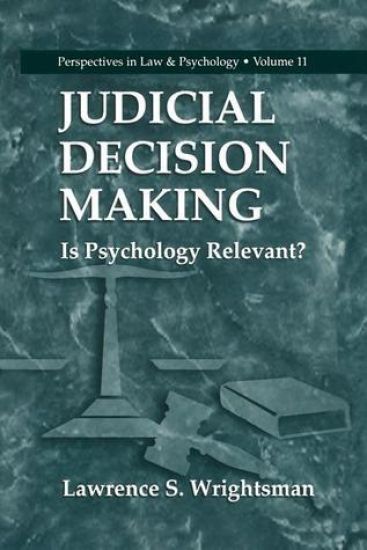
Judicial Decision Making

Judicial Decision Making

Lawrence S. Wrightsman

Kluwer Academic/Plenum Publishers
1999
sidottu
In the mid-1970s, as a social psychologist dedicated to the application of knowl­ edge, I welcomed our field's emerging interest in the legal system. I have al­ ways been fascinated by jury trials-something about the idea that two con­ ceptions of the truth were in irrevocable conflict and jurors could choose only one of them. More important, the criminal justice system is a major social force that has been ignored by social psychologists for most of the twentieth century. As I systematically began to explore the applications of social psycho­ logical concepts to the law 20 years ago, I experienced the delight of discovery similar to that of a child under a Christmas tree. It has been satisfying to be among the cohort of researchers who have studied the legal system, especially trial juries, from a psychological perspective. I believe we have learned much that would be useful if the system were to be revised. Hlf the system were to be revised" . . . there's the rub. As I have stated, my original motivation was the application of knowledge. Like other social scien­ tists, I believed-perhaps arrogantly-that the results of our research efforts could be used to make trial juries operate with more efficiency, accuracy, and satisfaction. Qver the last two decades, much knowledge has accumulated. How can we put this knowledge to work? Judges are the gatekeepers of the legal system.
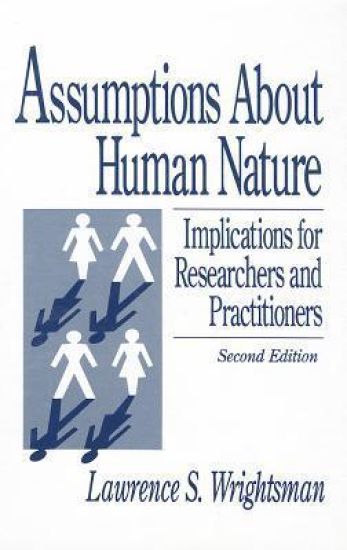
Assumptions about Human Nature

Assumptions about Human Nature

Lawrence S. Wrightsman

SAGE Publications Inc
1991
sidottu
This book, which is in its second edition, provides a provocative mirror from which to discern more clearly one's own assumptions about human nature. . . . I found myself reflecting on the subject matter and its impact on my own life, including relationships, teaching, research, and therapy. . . . The author has done a superb job of raising our consciousness about human nature in this book, an I strongly recommend it to academic and applied psychologists. If you need an invitation to examine your views about human nature, this book is it. --C. R. Snyder, University of Kansas, Lawrence In general, are people trustworthy or unreliable, altruistic or selfish? Are they simple and easy to understand or complex and beyond comprehension? Our assumptions about human nature color everything from the way we bargain with a used-car dealer to our expectations about further conflict in the Middle East. Because our assumptions about human nature underlie our reactions to specific events, Wrightsman designed this second edition to enhance our understanding of human nature--the relationship of attitudes to behavior, the unidimensionality of attitudes, and the influence of social movements on beliefs. Psychologists, social workers, researchers, and students will find Assumptions About Human Nature an illuminating exploration into the philosophies of human nature.
Assumptions about Human Nature

Assumptions about Human Nature

Lawrence S. Wrightsman

SAGE Publications Inc
1991
nidottu
This book, which is in its second edition, provides a provocative mirror from which to discern more clearly one's own assumptions about human nature. . . . I found myself reflecting on the subject matter and its impact on my own life, including relationships, teaching, research, and therapy. . . . The author has done a superb job of raising our consciousness about human nature in this book, an I strongly recommend it to academic and applied psychologists. If you need an invitation to examine your views about human nature, this book is it. --C. R. Snyder, University of Kansas, Lawrence In general, are people trustworthy or unreliable, altruistic or selfish? Are they simple and easy to understand or complex and beyond comprehension? Our assumptions about human nature color everything from the way we bargain with a used-car dealer to our expectations about further conflict in the Middle East. Because our assumptions about human nature underlie our reactions to specific events, Wrightsman designed this second edition to enhance our understanding of human nature--the relationship of attitudes to behavior, the unidimensionality of attitudes, and the influence of social movements on beliefs. Psychologists, social workers, researchers, and students will find Assumptions About Human Nature an illuminating exploration into the philosophies of human nature.
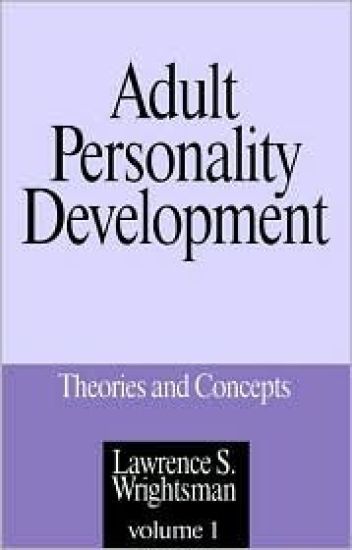
Adult Personality Development

Adult Personality Development

Lawrence S. Wrightsman

SAGE Publications Inc
1994
sidottu
Why do we, as adults, have the personality characteristics we do? No one explanation is accepted by all; however, in this greatly expanded version of his earlier book, Personality Development in Adulthood, Wrightsman helps us understand and organize the three broad theoretical approaches to explain psychological changes during the period from adolescence to the onset of late adulthood. Each of these approaches--early formation theories, stage theories, and the dialectical approach--are described and contrasted in order to help us more easily compare our experiences with those of others. Case histories, relevant current events, and boxed inserts are used throughout the book to illustrate important concepts in a thought-provoking, lively manner. Written in a compelling, non-technical style, the book is accessible to students and interested readers from all disciplines, especially psychology, clinical and developmental psychology, aging, family studies, sociology, gender studies and nursing.
Adult Personality Development

Adult Personality Development

Lawrence S. Wrightsman

SAGE Publications Inc
1994
nidottu
Why do we, as adults, have the personality characteristics we do? No one explanation is accepted by all; however, in this greatly expanded version of his earlier book, Personality Development in Adulthood, Wrightsman helps us understand and organize the three broad theoretical approaches to explain psychological changes during the period from adolescence to the onset of late adulthood. Each of these approaches--early formation theories, stage theories, and the dialectical approach--are described and contrasted in order to help us more easily compare our experiences with those of others. Case histories, relevant current events, and boxed inserts are used throughout the book to illustrate important concepts in a thought-provoking, lively manner. Written in a compelling, non-technical style, the book is accessible to students and interested readers from all disciplines, especially psychology, clinical and developmental psychology, aging, family studies, sociology, gender studies and nursing.
Adult Personality Development

Adult Personality Development

Lawrence S. Wrightsman

SAGE Publications Inc
1994
sidottu
This stimulating book and its companion volume, Adult Personality Development: Theories and Concepts, reflect an expansion of the coverage of Wrightsman's initial book, Personality Development in Adulthood. The luxury of greater length has permitted an exploration of new topics, including the use of a wider variety of sources including scholarly articles and books, biographies, and case studies. Increased attention is devoted to creativity in adulthood, to learning and memory, to marriage stability, and other topics. The book provides a focus for a Psychology of Adulthood course that encourages students to look at the evolving nature of their own lives. Particular attention is given to developing an extensive set of references (over 700 in this volume) as an aid to scholars. Adult Personality Development will attract a wide readership among students and professionals of Psychology, Developmental and Clinical Psychology, Aging, Family Studies, Social Psychology, Gender Studies and Nursing.
Adult Personality Development

Adult Personality Development

Lawrence S. Wrightsman

SAGE Publications Inc
1994
nidottu
This stimulating book and its companion volume, Adult Personality Development: Theories and Concepts, reflect an expansion of the coverage of Wrightsman's initial book, Personality Development in Adulthood. The luxury of greater length has permitted an exploration of new topics, including the use of a wider variety of sources including scholarly articles and books, biographies, and case studies. Increased attention is devoted to creativity in adulthood, to learning and memory, to marriage stability, and other topics. The book provides a focus for a Psychology of Adulthood course that encourages students to look at the evolving nature of their own lives. Particular attention is given to developing an extensive set of references (over 700 in this volume) as an aid to scholars. Adult Personality Development will attract a wide readership among students and professionals of Psychology, Developmental and Clinical Psychology, Aging, Family Studies, Social Psychology, Gender Studies and Nursing.
Judicial Decision Making

Judicial Decision Making

Lawrence S. Wrightsman

Springer-Verlag New York Inc.
2012
nidottu
In the mid-1970s, as a social psychologist dedicated to the application of knowl­ edge, I welcomed our field's emerging interest in the legal system. I have al­ ways been fascinated by jury trials-something about the idea that two con­ ceptions of the truth were in irrevocable conflict and jurors could choose only one of them. More important, the criminal justice system is a major social force that has been ignored by social psychologists for most of the twentieth century. As I systematically began to explore the applications of social psycho­ logical concepts to the law 20 years ago, I experienced the delight of discovery similar to that of a child under a Christmas tree. It has been satisfying to be among the cohort of researchers who have studied the legal system, especially trial juries, from a psychological perspective. I believe we have learned much that would be useful if the system were to be revised. Hlf the system were to be revised" . . . there's the rub. As I have stated, my original motivation was the application of knowledge. Like other social scien­ tists, I believed-perhaps arrogantly-that the results of our research efforts could be used to make trial juries operate with more efficiency, accuracy, and satisfaction. Qver the last two decades, much knowledge has accumulated. How can we put this knowledge to work? Judges are the gatekeepers of the legal system.