Kirjojen hintavertailu. Mukana 11 342 296 kirjaa ja 12 kauppaa.

Kirjahaku

Etsi kirjoja tekijän nimen, kirjan nimen tai ISBN:n perusteella.

5 kirjaa tekijältä Lee C. Bollinger

The Tolerant Society

The Tolerant Society

Lee C. Bollinger

Oxford University Press Inc
1988
nidottu
This book examines the consequences of the First Amendment to the United States Constitution. While Americans benefit from its broad protection of freedom of speech, they also suffer from the extremes which result from interpretation of the same amendment. Bollinger provides a masterly critique of the major theories of freedom of expression, finding them persuasive but inadequate. Buttressing his argument with references to many specific cases, as well as with careful analysis of the primary literature on free speech, he contends that the real value of toleration of extremist speech lies in the extraordinary self-control toward antisocial behaviour that it elicits: society is strenthened by the exercise of tolerance.
Uninhibited, Robust, and Wide-Open

Uninhibited, Robust, and Wide-Open

Lee C. Bollinger

Oxford University Press Inc
2010
sidottu
Lee Bollinger is one of our foremost experts on the First Amendment--both an erudite scholar and elegant advocate. In this sweeping account, he explores the troubled history of a free press in America and looks toward the challenges ahead. The first amendment guaranteed freedom of the press in seemingly clear terms. However, over the course of American history, Bollinger notes, the idea of press freedom has evolved, in response to social, political, technological, and legal changes. It was not until the twentieth century that freedom of the press came to be understood as guaranteeing an "uninhibited, robust and wide-open" public discourse. But even during the twentieth century, government continually tried to erect barriers: the sedition laws of World War One, the use of libel law, the Pentagon Papers case, and efforts to limit press access to information. Bollinger utilizes this history to explore the meaning of freedom of the press in our globalized, internet-dominated era. As he shows, we have now entered uncharted territory. What does press freedom mean when our news outlets can instantaneously disseminate information throughout the world? When foreign media have immediate access to the American market? Bollinger stresses that even though the law will surely evolve in the coming years, we must maintain our commitment to a press that is "uninhibited, robust, and wide-open," not only in America but everywhere. Given the new ability of foreign media to reach the United States via the Internet and vice versa, it is in America's national interest for press freedoms to expand overseas. While protecting the freedom of the press at home remains a crucial task, the next challenge is to help create a global public forum suitable for an increasingly interconnected world. Part of Oxford's landmark Inalienable Rights series, this book will set the agenda for how we think about the press in the twenty-first century.
Images of a Free Press

Images of a Free Press

Lee C. Bollinger

University of Chicago Press
1991
sidottu
Rich in historical detail, Images of a Free Press is an elegant, powerful guide to the evolution of our modern conception of freedom of the press, which finds expression in laws that protect print journalism and regulate broadcast media. Bollinger argues that this distinction remains meaningful but he advocates a more sophisticated approach to issues of privacy, access, and technology. Providing concrete guidelines for improving media laws, Images of a Free Press is a vital First Amendment primer for lawyers, media professionals, and critics, and all concerned citizens.
Images of a Free Press

Images of a Free Press

Lee C. Bollinger

University of Chicago Press
1994
nidottu
Rich in historical detail, Images of a Free Press is an elegant, powerful guide to the evolution of our modern conception of freedom of the press, which finds expression in laws that protect print journalism and regulate broadcast media. Bollinger argues that this distinction remains meaningful but he advocates a more sophisticated approach to issues of privacy, access, and technology. Providing concrete guidelines for improving media laws, Images of a Free Press is a vital First Amendment primer for lawyers, media professionals, and critics, and all concerned citizens."Images of a Free Press is the natural sequel to Lee Bollinger's first book, The Tolerant Society, and is destined to become a standard in first amendment scholarship."—Rodney A. Smolla, Constitutional Commentary"Revisiting themes he first explored some fifteen years ago, Bollinger now adds further to our understanding of the complex relationship among the First Amendment, the Supreme Court, the public, the press and the democratic process. This is a work of insight, sensitivity, and power. Bollinger has a profound knowledge of and a deep affection for his subject, and it shows."—Geoffrey R. Stone, Michigan Law Review"This thoughtful, understated book remains a call to come join the town meeting and hammer out some new rules of order. Scholars and citizens alike could do well to read Bollinger's book and accept his challenge."—Yale Law Review"For a number of years, Lee Bollinger has argued that the First Amendment has been applied differently to the print media than it has been to the broadcast media. In his new book, Images of a Free Press, Bollinger provides a concise, persuasive account of why this is so—and why it ought to be so."—Columbia Law Review
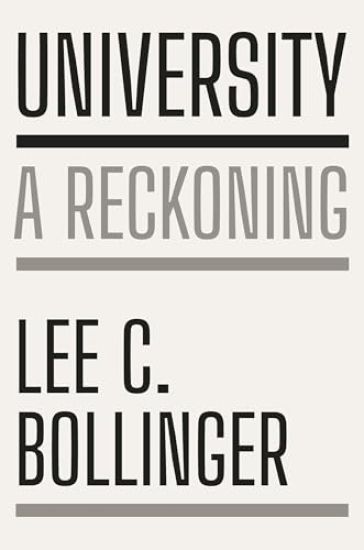
University

University

Lee C. Bollinger

WW NORTON CO
2026
sidottu
The American university is facing an unprecedented assault from the president of the United States. Defences of the university usually emphasise the practical benefits it offers to society such as highly skilled graduates, scientific research and technological breakthroughs. Bollinger offers a more original account, revealing how the structure of the university contributes to the success of the American system, and why that structure is both impossible to re-create and vulnerable to outside attack. The fundamental mission of the university is to enhance knowledge but this is not merely a high-minded idea. It is, as Bollinger demonstrates, a notion rooted deeply in the Constitution. Bollinger argues that, with the press diminished, the university remains the only source of truth-seeking for those who still believe in democracy. The stakes are self-evident: the university must be defended if the American experiment is to continue.