Kirjojen hintavertailu. Mukana 11 244 527 kirjaa ja 12 kauppaa.

Kirjahaku

Etsi kirjoja tekijän nimen, kirjan nimen tai ISBN:n perusteella.

7 kirjaa tekijältä Leela Fernandes

Governing Water in India

Governing Water in India

Leela Fernandes

UNIVERSITY OF WASHINGTON PRESS
2022
sidottu
Intensifying droughts and competing pressures on water resources foreground water scarcity as an urgent concern of the global climate change crisis. In India, individual, industrial, and agricultural water demands exacerbate inequities of access and expose the failures of state governance to regulate use. State policies and institutions influenced by global models of reform produce and magnify socio-economic injustice in this "water bureaucracy."Drawing on historical records, an analysis of post-liberalization developments, and fieldwork in the city of Chennai, Leela Fernandes traces the configuration of colonial historical legacies, developmental-state policies, and economic reforms that strain water resources and intensify inequality. While reforms of water governance promote privatization and decentralization, they strengthen the state centralized control over water through city-based development models. Understanding the political economy of water thus illuminates the consequent failures of the state within countries of the Global South.
Governing Water in India

Governing Water in India

Leela Fernandes

UNIVERSITY OF WASHINGTON PRESS
2022
pokkari
Intensifying droughts and competing pressures on water resources foreground water scarcity as an urgent concern of the global climate change crisis. In India, individual, industrial, and agricultural water demands exacerbate inequities of access and expose the failures of state governance to regulate use. State policies and institutions influenced by global models of reform produce and magnify socio-economic injustice in this "water bureaucracy."Drawing on historical records, an analysis of post-liberalization developments, and fieldwork in the city of Chennai, Leela Fernandes traces the configuration of colonial historical legacies, developmental-state policies, and economic reforms that strain water resources and intensify inequality. While reforms of water governance promote privatization and decentralization, they strengthen the state centralized control over water through city-based development models. Understanding the political economy of water thus illuminates the consequent failures of the state within countries of the Global South.

Producing Workers

Producing Workers

Leela Fernandes

University of Pennsylvania Press
1997
pokkari
As the politicization of cultural identities-based on religion, ethnicity, gender, race-has come to play a central role in shaping relations between and among peoples, issues of difference raise unsettling questions about how identities overlap and group interests are represented. Using the jute mills of Calcutta as a case study, Leela Fernandes reveals that these interconnections play a fundamental role in shaping both the political actions of workers and the representation of their interests.
Transnational Feminism in the United States

Transnational Feminism in the United States

Leela Fernandes

New York University Press
2013
sidottu
The acceleration of economic globalization and the rapid global flows of people, culture, and information have intensified the importance of developing transnational understandings of contemporary issues. Transnational feminist perspectives have provided a unique outlook on women's lives and have deepened our understanding of the gendered nature of global processes. Transnational Feminism in the United States examines how transnational perspectives shape the ways in which we create and disseminate knowledge about the world within the United States, and how the paradigm of transnational feminism is affected by national narratives and public discourses within the country itself. An innovative theoretical project that is both deconstructive and constructive, this bookinterrogates the limits of feminist thought, primarily through case studies that illustrate its power to create new fields of research out of traditionally interdisciplinary lines of inquiry. Leela Fernandes discusses ways to approach, analyze, and capture processes that exceed and unsettle the nation-state within the transnational feminist paradigm. Examining the links between power and knowledge that bind interdisciplinary theory and research, she shines new light on issues such as human rights as well as academic debates about transnational feminist perspectives on global issues. A thought-provoking analysis, Transnational Feminism in the United States powerfully contributes to the field of Women's Studies and related cross-disciplinary scholarship on feminist theory and gender from a global perspective.
Transnational Feminism in the United States

Transnational Feminism in the United States

Leela Fernandes

New York University Press
2013
pokkari
The acceleration of economic globalization and the rapid global flows of people, culture, and information have intensified the importance of developing transnational understandings of contemporary issues. Transnational feminist perspectives have provided a unique outlook on women's lives and have deepened our understanding of the gendered nature of global processes. Transnational Feminism in the United States examines how transnational perspectives shape the ways in which we create and disseminate knowledge about the world within the United States, and how the paradigm of transnational feminism is affected by national narratives and public discourses within the country itself. An innovative theoretical project that is both deconstructive and constructive, this bookinterrogates the limits of feminist thought, primarily through case studies that illustrate its power to create new fields of research out of traditionally interdisciplinary lines of inquiry. Leela Fernandes discusses ways to approach, analyze, and capture processes that exceed and unsettle the nation-state within the transnational feminist paradigm. Examining the links between power and knowledge that bind interdisciplinary theory and research, she shines new light on issues such as human rights as well as academic debates about transnational feminist perspectives on global issues. A thought-provoking analysis, Transnational Feminism in the United States powerfully contributes to the field of Women's Studies and related cross-disciplinary scholarship on feminist theory and gender from a global perspective.
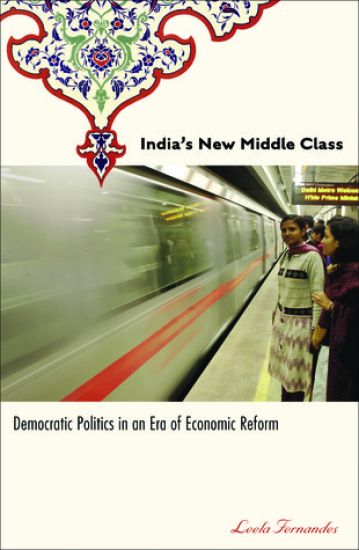
India's New Middle Class

India's New Middle Class

Leela Fernandes

University of Minnesota Press
2006
nidottu
Today India's middle class numbers more than 250 million people and is growing rapidly. Public reports have focused mainly on the emerging group's consumer potential, while global views of India's new economy range from excitement about market prospects to anxieties over outsourcing of service sector jobs. Yet the consequences of India's economic liberalization and the expansion of the middle class have transformed Indian culture and politics. In India's New Middle Class, Leela Fernandes digs into the implications of this growth and uncovers—in the media, in electoral politics, and on the streets of urban neighborhoods—the complex politics of caste, religion, and gender that shape this rising population. Using rich ethnographic data, she reveals how the middle class represents the political construction of a social group and how it operates as a proponent of economic democratization. Delineating the tension between consumer culture and outsourcing, Fernandes also examines the roots of India's middle class and its employment patterns, including shifting skill sets and labor market restructuring. Through this close look at the country's recent history and reforms, Fernandes develops an original theoretical approach to the nature of politics and class formation in an era of globalization.In this sophisticated analysis of the dynamics of an economic and political group in the making, Fernandes moves beyond reductionist images of India's new middle class to bring to light the group's social complexity and profound influence on politics in India and beyond.Leela Fernandes is associate professor of political science at Rutgers University, New Brunswick.