
Kirjojen hintavertailu. Mukana 12 016 292 kirjaa ja 12 kauppaa.

Kirjahaku

Etsi kirjoja tekijän nimen, kirjan nimen tai ISBN:n perusteella.

9 kirjaa tekijältä Len Pismen

Working with Dynamical Systems

Working with Dynamical Systems

Len Pismen

TAYLOR FRANCIS LTD
2023
nidottu
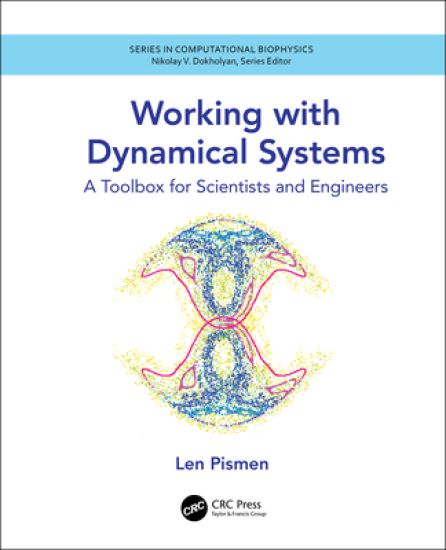
This book provides working tools for the study and design of nonlinear dynamical systems applicable in physics and engineering. It offers a broad-based introduction to this challenging area of study, taking an applications-oriented approach that emphasizes qualitative analysis and approximations rather than formal mathematics or simulation. The author, an internationally recognized authority in the field, makes extensive use of examples and includes executable Mathematica notebooks that may be used to generate new examples as hands-on exercises. The coverage includes discussion of mechanical models, chemical and ecological interactions, nonlinear oscillations and chaos, forcing and synchronization, spatial patterns and waves.Key Features:Written for a broad audience, avoiding dependence on mathematical formulations in favor of qualitative, constructive treatmentExtensive use of physical and engineering applicationsIncorporates Mathematica notebooks for simulations and hands-on self-studyProvides a gentle but rigorous introduction to real-world nonlinear problemsFeatures a final chapter dedicated to applications of dynamical systems to spatial patternsThe book is aimed at student and researchers in applied mathematics and mathematical modelling of physical and engineering problems. It teaches to see common features in systems of different origins, and to apply common methods of study without losing sight of complications and uncertainties related to their physical origin.
Working with Dynamical Systems
This book provides working tools for the study and design of nonlinear dynamical systems applicable in physics and engineering. It offers a broad-based introduction to this challenging area of study, taking an applications-oriented approach that emphasizes qualitative analysis and approximations rather than formal mathematics or simulation. The author, an internationally recognized authority in the field, makes extensive use of examples and includes executable Mathematica notebooks that may be used to generate new examples as hands-on exercises. The coverage includes discussion of mechanical models, chemical and ecological interactions, nonlinear oscillations and chaos, forcing and synchronization, spatial patterns and waves.Key Features:Written for a broad audience, avoiding dependence on mathematical formulations in favor of qualitative, constructive treatmentExtensive use of physical and engineering applicationsIncorporates Mathematica notebooks for simulations and hands-on self-studyProvides a gentle but rigorous introduction to real-world nonlinear problemsFeatures a final chapter dedicated to applications of dynamical systems to spatial patternsThe book is aimed at student and researchers in applied mathematics and mathematical modelling of physical and engineering problems. It teaches to see common features in systems of different origins, and to apply common methods of study without losing sight of complications and uncertainties related to their physical origin.

Morphogenesis Deconstructed

Morphogenesis Deconstructed

Len Pismen

Springer Nature Switzerland AG
2020
sidottu
This book is about morphogenesis as the genesis of forms. It is not restricted to plants growing from seed or animals developing from an embryo (although these do supply the most abundant examples) but also addresses kindred processes, from inorganic to social to biomorphic technology. It is about our morphogenetic universe: unplanned, unfair and frustratingly complicated but benevolent in allowing us to emerge, survive, and inquire into its laws.
Morphogenesis Deconstructed

Morphogenesis Deconstructed

Len Pismen

Springer Nature Switzerland AG
2021
nidottu
This book is about morphogenesis as the genesis of forms. It is not restricted to plants growing from seed or animals developing from an embryo (although these do supply the most abundant examples) but also addresses kindred processes, from inorganic to social to biomorphic technology. It is about our morphogenetic universe: unplanned, unfair and frustratingly complicated but benevolent in allowing us to emerge, survive, and inquire into its laws.
Active Matter Within and Around Us

Active Matter Within and Around Us

Len Pismen

Springer Nature Switzerland AG
2021
sidottu
This book presents a comprehensive review of various aspects of the novel and rapidly developing field of active matter, which encompasses a wide variety of self-organized self-driven energy-consuming media or agents. Most naturally occurring examples are of biological origin, spanning all scales from intracellular structures to swimming and crawling cells and microorganisms, to living tissues, bacterial colonies and flocks of birds. But the field also encompasses artificial systems, from colloids to soft robots. Intrinsically out of equilibrium and free of constraints of time-reversal symmetry, such systems display a range of surprising and unusual behaviors.? In this book, the author emphasizes connections between fluid-mechanical, material, biological and technological aspects of active matter. He employs a minimum of mathematical tools, ensuring that the presentation is accessible to a wider scientific community. Richly illustrated, it gives the reader a clear picture of this fascinating field, its diverse phenomena and its open questions.
Active Matter Within and Around Us

Active Matter Within and Around Us

Len Pismen

Springer Nature Switzerland AG
2022
nidottu
This book presents a comprehensive review of various aspects of the novel and rapidly developing field of active matter, which encompasses a wide variety of self-organized self-driven energy-consuming media or agents. Most naturally occurring examples are of biological origin, spanning all scales from intracellular structures to swimming and crawling cells and microorganisms, to living tissues, bacterial colonies and flocks of birds. But the field also encompasses artificial systems, from colloids to soft robots. Intrinsically out of equilibrium and free of constraints of time-reversal symmetry, such systems display a range of surprising and unusual behaviors.? In this book, the author emphasizes connections between fluid-mechanical, material, biological and technological aspects of active matter. He employs a minimum of mathematical tools, ensuring that the presentation is accessible to a wider scientific community. Richly illustrated, it gives the reader a clear picture of this fascinating field, its diverse phenomena and its open questions.
Patterns and Interfaces in Dissipative Dynamics

Patterns and Interfaces in Dissipative Dynamics

Len Pismen

Springer International Publishing AG
2023
sidottu
Spontaneous pattern formation in nonlinear dissipative systems far from equilibrium is a paradigmatic case of emergent behaviour associated with complex systems. It is encountered in a great variety of settings, both in nature and technology, and has numerous applications ranging from nonlinear optics through solid and fluid mechanics, physical chemistry and chemical engineering to biology.This book is a first-hand account by one of the leading players in this field, which gives in-depth descriptions of analytical methods elucidating the complex evolution of nonlinear dissipative systems, and brings the reader to the forefront of current research.Since the publication of the first edition, applications of the theory of nonlinear dynamics have been substantially extended to the novel area of active systems, largely motivated by problems of biophysics and biomorphic technology. These problems typically involve media with internal orientation. This new edition incorporates a chapter discussing dynamics of liquids and soft solids with internal orientation, including special features of their instabilities and motion of topological defects, which form the background for various applications to the motion of cells, tissues, and activated soft materials. The contents of the first edition have also been substantially reworked, improving graphics, emphasizing more complex secondary instabilities, and dropping some material pertaining to dynamical systems.This book caters for graduate students and young researchers from many pertinent areas including applied mathematics, physical chemistry, chemical engineering and biophysics, as well as the seasoned scientist in search of a modern source of reference.
Patterns and Interfaces in Dissipative Dynamics

Patterns and Interfaces in Dissipative Dynamics

Len Pismen

Springer International Publishing AG
2024
nidottu
Spontaneous pattern formation in nonlinear dissipative systems far from equilibrium is a paradigmatic case of emergent behaviour associated with complex systems. It is encountered in a great variety of settings, both in nature and technology, and has numerous applications ranging from nonlinear optics through solid and fluid mechanics, physical chemistry and chemical engineering to biology.This book is a first-hand account by one of the leading players in this field, which gives in-depth descriptions of analytical methods elucidating the complex evolution of nonlinear dissipative systems, and brings the reader to the forefront of current research.Since the publication of the first edition, applications of the theory of nonlinear dynamics have been substantially extended to the novel area of active systems, largely motivated by problems of biophysics and biomorphic technology. These problems typically involve media with internal orientation. This new edition incorporates a chapter discussing dynamics of liquids and soft solids with internal orientation, including special features of their instabilities and motion of topological defects, which form the background for various applications to the motion of cells, tissues, and activated soft materials. The contents of the first edition have also been substantially reworked, improving graphics, emphasizing more complex secondary instabilities, and dropping some material pertaining to dynamical systems.This book caters for graduate students and young researchers from many pertinent areas including applied mathematics, physical chemistry, chemical engineering and biophysics, as well as the seasoned scientist in search of a modern source of reference.
The Swings of Science

The Swings of Science

Len Pismen

Springer International Publishing AG
2018
nidottu
This book is a personal account of some aspects of the emergence of modern science, mostly from the viewpoint of those branches of physics which provided the much needed paradigm shift of "more is different" that heralded the advent of complexity science as an antidote to the purely reductionist approach in fundamental physics. It is also about the humans that have helped to shape these developments, including personal reminiscences and the realization that the so-called exact sciences are inevitably also a social endeavour with all its facets. Served by the razor-sharp wit of the author, this erudite ramble is meant to be neither comprehensive nor systematic, but its generous insights will give the inquisitive academically trained mind a better understanding of what science, and physics in particular, could or should be about.