Kirjojen hintavertailu. Mukana 12 390 323 kirjaa ja 12 kauppaa.

Kirjahaku

Etsi kirjoja tekijän nimen, kirjan nimen tai ISBN:n perusteella.

42 kirjaa tekijältä Leo Strauss

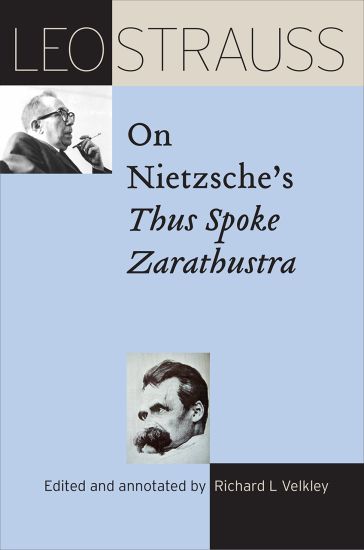
Leo Strauss on Nietzsche's Thus Spoke Zarathustra

Leo Strauss on Nietzsche's Thus Spoke Zarathustra

Leo Strauss

University of Chicago Press
2017
sidottu
Although Leo Strauss published little on Nietzsche, his lectures and correspondence demonstrate a deep critical engagement with Nietzsche's thought. One of the richest contributions is a seminar on Nietzsche's Thus Spoke Zarathustra, taught in 1959 during Strauss's tenure at the University of Chicago. In the lectures, Strauss draws important parallels between Nietzsche's most important project and his own ongoing efforts to restore classical political philosophy. With Leo Strauss on Nietzsche's "Thus Spoke Zarathustra," preeminent Strauss scholar Richard L. Velkley presents Strauss's lectures on Zarathustra with superb annotations that bring context and clarity to the critical role played by Nietzsche in shaping Strauss's thought. In addition to the broad relationship between Nietzsche and political philosophy, Strauss adeptly guides readers through Heidegger's confrontations with Nietzsche, laying out Heidegger's critique of Nietzsche's "will to power" while also showing how Heidegger can be read as a foil for his own reading of Nietzsche. The lectures also shed light on the relationship between Heidegger and Strauss, as both philosophers saw Nietzsche as a central figure for understanding the crisis of philosophy and Western civilization. Strauss's reading of Nietzsche is one of the important--yet little appreciated--philosophical inquiries of the past century, both an original interpretation of Nietzsche's thought and a deep engagement with the core problems that modernity posed for political philosophy. It will be welcomed by anyone interested in the work of either philosopher.
Leo Strauss on Political Philosophy

Leo Strauss on Political Philosophy

Leo Strauss

University of Chicago Press
2018
sidottu
Leo Strauss is known primarily for reviving classical political philosophy through careful analyses of works by ancient thinkers. As with his published writings, Strauss’s seminars devoted to specific philosophers were notoriously dense, accessible only to graduate students and scholars with a good command of the subject. In 1965, however, Strauss offered an introductory course on political philosophy at the University of Chicago. Using a conversational style, he sought to make political philosophy, as well as his own ideas and methods, understandable to those with little background on the subject. Leo Strauss on Political Philosophy brings together the lectures that comprise Strauss’s “Introduction to Political Philosophy.” Strauss begins by emphasizing the importance of political philosophy in determining the common good of society and critically examining the two most powerful contemporary challenges to the possibility of using political theory to learn about and develop the best political order: positivism and historicism. In seeking the common good, classical political philosophers like Plato and Aristotle did not distinguish between political philosophy and political science. Today, however, political philosophy must contend with the contemporary belief that it is impossible to know what the good society really is. Strauss emphasizes the need to study the history of political philosophy to see whether the changes in the understanding of nature and conceptions of justice that gradually led people to believe that it is not possible to determine what the best political society is are either necessary or valid. In doing so, he ranges across the entire history of political philosophy, providing a valuable, thematically coherent foundation, including explications of many canonical thinkers, such as Auguste Comte and Immanuel Kant, about whom Strauss did not write extensively in his published writings.
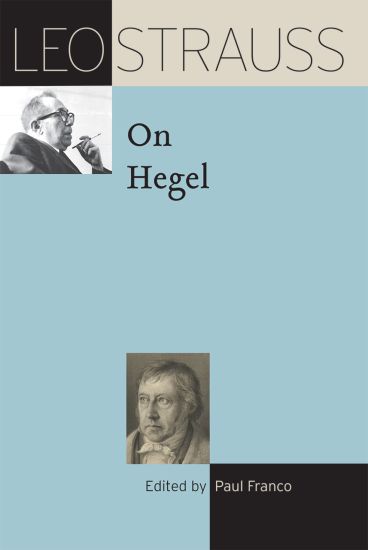
Leo Strauss on Hegel

Leo Strauss on Hegel

Leo Strauss

University of Chicago Press
2019
sidottu
In the winter of 1965, Leo Strauss taught a seminar on Hegel at the University of Chicago. While Strauss did not consider himself a Hegelian nor write about Hegel at any length, his writings contain intriguing references to the philosopher, particularly in connection with his studies of Hobbes, in his debate in On Tyranny with Alexandre Koje ve; and in his account of the "three waves" of modern political philosophy. Leo Strauss on Hegel reconstructs Strauss's seminar on Hegel, supplemented by passages from an earlier version of the seminar from which only fragments of a transcript remain. Strauss focused in his seminar on the lectures collected in The Philosophy of History, which he considered more accessible than Hegel's written works. In his own lectures on Hegel, Strauss continues his project of demonstrating how modern philosophers related to ancient thought and explores the development and weaknesses of modern political theory. Strauss is especially concerned with the relationship in Hegel between empirical history and his philosophy of history, and he argues for the primacy of religion in Hegel's understanding of history and society. In addition to a relatively complete transcript, Leo Strauss on Hegel also includes annotations, which bring context and clarity to the text.
Leo Strauss on Maimonides

Leo Strauss on Maimonides

Leo Strauss

University of Chicago Press
2013
sidottu
Leo Strauss is widely recognized as one of the foremost interpreters of Maimonides. His studies of the medieval Jewish philosopher led to his rediscovery of esotericism and deepened his sense that the tension between reason and revelation was central to modern political thought. His writings throughout the twentieth century were chiefly responsible for restoring Maimonides as a philosophical thinker of the first rank. Yet, to appreciate the extent of Strauss' contribution to the scholarship on Maimonides, one has traditionally had to seek out essays he published separately spanning almost fifty years. With "Leo Strauss on Maimonides", Kenneth Hart Green presents for the first time a comprehensive, annotated collection of Strauss' writings on Maimonides, comprising sixteen essays, three of which appear in English for the first time. Green has also provided careful translations of materials originally quoted in Hebrew, Arabic, Latin, German, and French; written an informative introduction highlighting the contributions found in each essay; and brought references to out-of-print editions fully up to date. The result will become the standard edition of Strauss' writings on Maimonides.
Leo Strauss On Plato's Symposium

Leo Strauss On Plato's Symposium

Leo Strauss

University of Chicago Press
2001
sidottu
In this volume Leo Strauss presents a coherent and complete interpretation of Plato's "Symposium", proceeding by meticulous reading, from beginning to end. Strauss, operating on the idea that commentary is an useful method of expounding the truth, sheds light on the meaning of the dialogue and its place in the Platonic corpus, and also on a host of other topics, including the nature of eros and its place in the overall economy of human life, the quarrel between poetry and philosophy, and the character of Socrates and the question of his trial.
Leo Strauss On Plato's Symposium

Leo Strauss On Plato's Symposium

Leo Strauss

University of Chicago Press
2003
nidottu
The first major piece of unpublished work by Leo Strauss to appear in more than 30 years, this volume offers the public the unprecedented experience of encountering this renowned scholar as his students did. Given as a course in autumn 1959 under the title "Plato's Political Philosophy" these provocative lectures - until now, never published, but instead passed down from one generation of students to the next - show Strauss at his subtle and insightful best.
Leo Strauss on Hegel

Leo Strauss on Hegel

Leo Strauss

University of Chicago Press
2021
nidottu
In the winter of 1965, Leo Strauss taught a seminar on Hegel at the University of Chicago. While Strauss neither considered himself a Hegelian nor wrote about Hegel at any length, his writings contain intriguing references to the philosopher, particularly in connection with his studies of Hobbes, in his debate in On Tyranny with Alexandre Koje`ve; and in his account of the “three waves” of modern political philosophy. Leo Strauss on Hegel reconstructs Strauss’s seminar on Hegel, supplemented by passages from an earlier version of the seminar from which only fragments of a transcript remain. Strauss focused his seminar on the lectures collected in The Philosophy of History, which he considered more accessible than Hegel’s written works. In his own lectures on Hegel, Strauss continues his project of demonstrating how modern philosophers related to ancient thought and explores the development and weaknesses of modern political theory. Strauss is especially concerned with the relationship in Hegel between empirical history and his philosophy of history, and he argues for the primacy of religion in Hegel’s understanding of history and society. In addition to a relatively complete transcript, Leo Strauss on Hegel also includes annotations, which bring context and clarity to the text.
Leo Strauss on Nietzsche's "Thus Spoke Zarathustra"

Leo Strauss on Nietzsche's "Thus Spoke Zarathustra"

Leo Strauss

University of Chicago Press
2021
nidottu
Although Leo Strauss published little on Nietzsche, his lectures and correspondence demonstrate a deep critical engagement with Nietzsche’s thought. One of the richest contributions is a seminar on Nietzsche’s Thus Spoke Zarathustra, taught in 1959 during Strauss’s tenure at the University of Chicago. In the lectures, Strauss draws important parallels between Nietzsche’s most important project and his own ongoing efforts to restore classical political philosophy. With Leo Strauss on Nietzsche’s “Thus Spoke Zarathustra,” eminent Strauss scholar Richard L. Velkley presents Strauss’s lectures on Zarathustra with superb annotations that bring context and clarity to the critical role played by Nietzsche in shaping Strauss’s thought. In addition to the broad relationship between Nietzsche and political philosophy, Strauss adeptly guides readers through Heidegger’s confrontations with Nietzsche, laying out Heidegger’s critique of Nietzsche’s “will to power” while also showing how Heidegger can be read as a foil for his own reading of Nietzsche. The lectures also shed light on the relationship between Heidegger and Strauss, as both philosophers saw Nietzsche as a central figure for understanding the crisis of philosophy and Western civilization. Strauss’s reading of Nietzsche is one of the important—yet little appreciated—philosophical inquiries of the past century, both an original interpretation of Nietzsche’s thought and a deep engagement with the core problems that modernity posed for political philosophy. It will be welcomed by anyone interested in the work of either philosopher.
Leo Strauss on Political Philosophy

Leo Strauss on Political Philosophy

Leo Strauss

University of Chicago Press
2021
nidottu
Leo Strauss is known primarily for reviving classical political philosophy through careful analyses of works by ancient thinkers. As with his published writings, Strauss’s seminars devoted to specific philosophers were notoriously dense, accessible only to graduate students and scholars with a good command of the subject. In 1965, however, Strauss offered an introductory course on political philosophy at the University of Chicago. Using a conversational style, he sought to make political philosophy, as well as his own ideas and methods, understandable to those with little background on the subject. Leo Strauss on Political Philosophy brings together the lectures that comprise Strauss’s “Introduction to Political Philosophy.” Strauss begins by emphasizing the importance of political philosophy in determining the common good of society and critically examining the two most powerful contemporary challenges to the possibility of using political theory to learn about and develop the best political order: positivism and historicism. In seeking the common good, classical political philosophers like Plato and Aristotle did not distinguish between political philosophy and political science. Today, however, political philosophy must contend with the contemporary belief that it is impossible to know what the good society really is. Strauss emphasizes the need to study the history of political philosophy to see whether the changes in the understanding of nature and conceptions of justice that gradually led people to believe that it is not possible to determine what the best political society is are either necessary or valid. In doing so, he ranges across the entire history of political philosophy, providing a valuable, thematically coherent foundation, including explications of many canonical thinkers, such as Auguste Comte and Immanuel Kant, about whom Strauss did not write extensively in his published writings.
Leo Strauss on Plato’s "Protagoras"

Leo Strauss on Plato’s "Protagoras"

Leo Strauss

THE UNIVERSITY OF CHICAGO PRESS
2022
sidottu
A transcript of Leo Strauss’s key seminars on Plato’s Protagoras. This book offers a transcript of Strauss’s seminar on Plato’s Protagoras taught at the University of Chicago in the spring quarter of 1965, edited and introduced by renowned scholar Robert C. Bartlett. These lectures have several important features. Unlike his published writings, they are less dense and more conversational. Additionally, while Strauss regarded himself as a Platonist and published some work on Plato, he published little on individual dialogues. In these lectures Strauss treats many of the great Platonic and Straussian themes: the difference between the Socratic political science or art and the Sophistic political science or art of Protagoras; the character and teachability of virtue, its relation to knowledge, and the relations among the virtues, courage, justice, moderation, and wisdom; the good and the pleasant; frankness and concealment; the role of myth; and the relation between freedom of thought and freedom of speech. In these lectures, Strauss examines Protagoras and the sophists, providing a detailed discussion of Protagoras as it relates to Plato’s other dialogues and the work of modern thinkers. This book should be of special interest to students both of Plato and of Strauss.
Leo Strauss on Moses Mendelssohn

Leo Strauss on Moses Mendelssohn

Leo Strauss

University of Chicago Press
2012
sidottu
Moses Mendelssohn (1729-86) was the leading Jewish thinker of the German Enlightenment and the founder of modern Jewish philosophy. His writings, especially his attempt during the Pantheism Controversy to defend the philosophical legacies of Spinoza and Leibniz against F. H. Jacobi's philosophy of faith, captured the attention of a young Leo Strauss and played a critical role in the development of his thought on one of the fundamental themes of his life's work: the conflicting demands of reason and revelation. "Leo Strauss on Moses Mendelssohn" is a superbly annotated translation of ten introductions written by Strauss to a multivolume critical edition of Mendelssohn's work. Commissioned in Weimar Germany in the 1920s, the project was suppressed and nearly destroyed during Nazi rule and was not revived until the 1960s. In addition to Strauss' introductions, Martin D. Yaffe has translated various editorial annotations Strauss makes on key passages in Mendelssohn's texts. Yaffe has also contributed an extensive interpretive essay that both analyzes the introductions on their own terms and discusses what Strauss writes elsewhere about the broader themes broached in his Mendelssohnian studies. "Strauss' critique of Mendelssohn" represents one of the largest bodies of work by the young Strauss on a single thinker to be made available in English. It illuminates not only a formerly obscure phase in the emergence of his thought but also a critical moment in the history of the German Enlightenment.
Leo Strauss` Published but Uncollected English Writings

Leo Strauss` Published but Uncollected English Writings

Leo Strauss; Steven J. Lenzner; Svetozar Minkov

ST AUGUSTINE'S PRESS
2024
nidottu
Any presentation of political philosophy in the 20th century is radically incomplete without Leo Strauss. The appearance of this collection is particularly important given the relentless but shifting interest in his influence and thought in recent years. Lenzner and Minkov contend that in order to evaluate Strauss’s achievement properly, one must do so chiefly with reference to the works by which Strauss sought to establish his legacy–i.e., those he chose to submit for the consideration of future readers. The most complete record of Strauss's thought includes his books together with his other published and unpublished writings and lectures. The achievement of this volume is to present in one collection every piece Strauss chose to publish in English that he did not himself include in a collection or a book. The material is arranged chronologically so as to avoid undue categorization by the editors. Among the highlights of these works published between 1937 and 1972 are striking formulations not to be found in his books on the relationship between philosophy and society, which is perhaps the most prominent theme in Strauss’s corpus taken as a whole; rare ‘personal’ statements that shed light on his self-understanding as a philosopher; his first writing devoted solely to a classical thinker (“The Spirit of Sparta or the Taste of Xenophon”); his first piece devoted to Plato, “On a New Interpretation of Plato’s Political Philosophy,” his most searching engagement with Jean-Jacques Rousseau; his first treatment of the thought of Niccolò Machiavelli and a wonderful, later treatment of Machiavelli’s relation to ancient writers; and a critical review of a book on Xenophon’s Hellenica. This complete collection of Strauss’s scattered work in English is invaluable for those interested in the political philosopher, to be sure. But it is also an important contribution to the field in general as well as the history of philosophy.
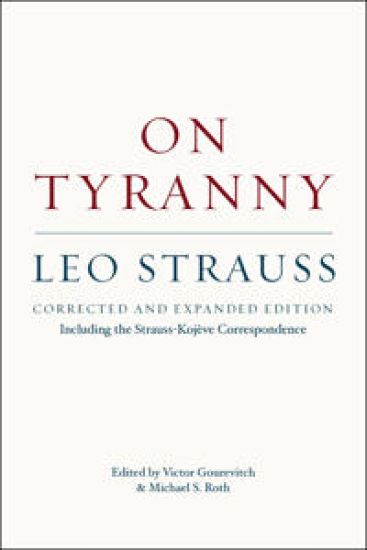
On Tyranny – Corrected and Expanded Edition, Including the Strauss–Kojève Correspondence

On Tyranny – Corrected and Expanded Edition, Including the Strauss–Kojève Correspondence

Leo Strauss; Victor Gourevitch; Michael S. Roth

University of Chicago Press
2013
nidottu
"On Tyranny" is Leo Strauss' classic reading of Xenophon's dialogue Hiero, or Tyrannicus, in which the tyrant Hiero and the poet Simonides discuss the advantages and disadvantages of exercising tyranny. Included are a translation of the dialogue from its original Greek, a critique of Strauss' commentary by the French philosopher Alexandre Kojeve, and the complete correspondence between the two. This corrected and expanded edition introduces important revisions throughout and expands Strauss' restatement of his position in light of Kojeve's commentary to bring it into conformity with the text as it was originally published in France.
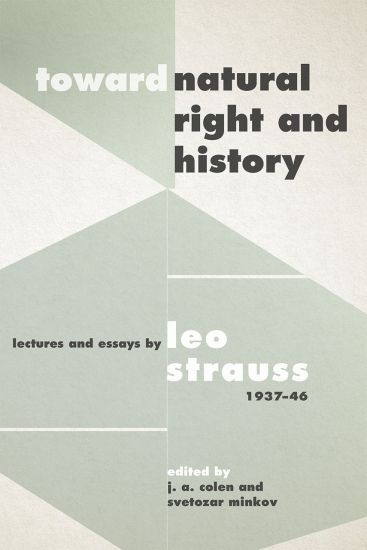
Toward "Natural Right and History"

Toward "Natural Right and History"

Leo Strauss

University of Chicago Press
2018
sidottu
Natural Right and History is widely recognized as Strauss's most influential work. The six lectures, written while Strauss was at the New School, and a full transcript of the 1949 Walgreen Lectures show Strauss working toward the ideas he would present in fully matured form in his landmark work. In them, he explores natural right and the relationship between modern philosophers and the thought of the ancient Greek philosophers, as well as the relation of political philosophy to contemporary political science and to major political and historical events, especially the Holocaust and World War II. Previously unpublished in book form, Strauss's lectures are presented here in a thematic order that mirrors Natural Right and History and with interpretive essays by J. A. Colen, Christopher Lynch, Svetozar Minkov, Daniel Tanguay, Nathan Tarcov, and Michael Zuckert that establish their relation to the work. Rounding out the book are copious annotations and notes to facilitate further study.
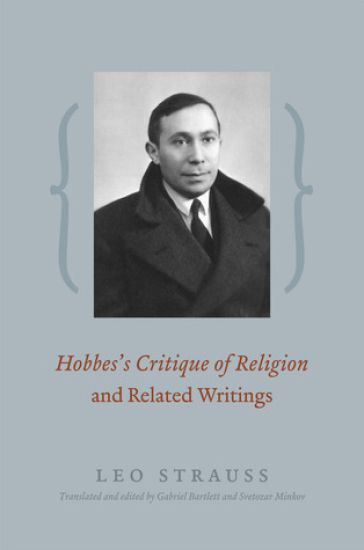
Hobbes's Critique of Religion and Related Writings

Hobbes's Critique of Religion and Related Writings

Leo Strauss

University of Chicago Press
2011
sidottu
Leo Strauss' "The Political Philosophy of Hobbes" deservedly ranks among his most widely acclaimed works. In it Strauss argues that the basis for Hobbes' natural and political science is his interest in 'self-knowledge of man as he really is.' The pieces collected in this book, each written prior to that classic volume, complement that account. Thus, at long last, this book allows us to have a complete picture of Strauss' interpretation of Hobbes, the thinker pivotal to the fundamental theme of his life's work: the conflicting demands of philosophy and revelation, or, as he termed it, 'the theologico-political problem.' It is no exaggeration to say that Strauss' work on Hobbes' critique of religion is essential to his analysis of Hobbes' political philosophy, and vice versa. This volume will spark new interest in Hobbes' explication of the Bible and in his understanding of religion by revealing previously neglected dimensions and motives of Hobbes' 'theology.' At the same time, scholars interested in the intellectual development of Leo Strauss will find in these writings the missing link, as it were, between his two early books, Spinoza's "Critique of Religion" and "The Political Philosophy of Hobbes". In addition, this volume makes avilable for the first time in English a letter, a book outline, an extended review, an engagement with legal positivism, and an account of Strauss' work on Hobbes by Heinrich Meier, all of which shed light on Strauss' concerns and his approach to Hobbes in particular, as well as to modern political thought and life.
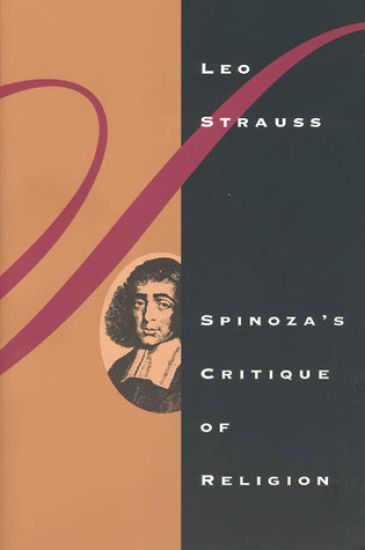
Spinoza's Critique of Religion

Spinoza's Critique of Religion

Leo Strauss

University of Chicago Press
1997
nidottu
In this text Leo Strauss articulates the conflict between reason and revelation as he explores Spinoza's scientific, comparative, and textual treatment of the Bible. He compares Spinoza's "Theologico-political Treatise" and the Epistles, showing their relation to critical controversy on religion from Epicurus and Lucretius through Uriel da Costa and Isaac Peyrere to Thomas Hobbes. An autobiographical preface to this book traces Strauss' dilemmas as a young liberal intellectual in Germany during the Weimar Republic, as a scholar in exile, and as a leader of American philosophical thought.
Natural Right and History

Natural Right and History

Leo Strauss

University of Chicago Press
1965
nidottu
In this classic work, Leo Strauss examines the problem of natural right and argues that there is a firm foundation in reality for the distinction between right and wrong in ethics and politics. On the centenary of Strauss's birth, and the fiftieth anniversary of the Walgreen Lectures which spawned the work, Natural Right and History remains as controversial and essential as ever. "Strauss ...makes a significant contribution towards an understanding of the intellectual crisis in which we find ourselves ...[and] brings to his task an admirable scholarship and a brilliant, incisive mind."--John H. Hallowell, American Political Science Review Leo Strauss (1899-1973) was the Robert Maynard Hutchins Distinguished Service Professor Emeritus in Political Science at the University of Chicago.
The Political Philosophy of Hobbes

The Political Philosophy of Hobbes

Leo Strauss

University of Chicago Press
1996
nidottu
In this classic analysis, Leo Strauss pinpoints what is original and innovative in the political philosophy of Thomas Hobbes. He argues that Hobbes's ideas arose not from tradition or science but from his own deep knowledge and experience of human nature. Tracing the development of Hobbes's moral doctrine from his early writings to his major work The Leviathan, Strauss explains contradictions in the body of Hobbes's work and discovers startling connections between Hobbes and the thought of Plato, Thucydides, Aristotle, Descartes, Spinoza, and Hegel. Leo Strauss (1899-1973) was Robert Maynard Hutchins Distinguished Service Professor Emeritus in political science at the University of Chicago. Among his works published by the University of Chicago Press are Thoughts on Machiavelli, The City and Man, and Natural Right and History.
The Argument and the Action of Plato's Laws

The Argument and the Action of Plato's Laws

Leo Strauss

University of Chicago Press
1998
nidottu
The posthumous publication of The Argument and the Action of Plato's "Laws" was compiled shortly before the death of Leo Strauss in 1973. Strauss offers an insightful and instructive reading through careful probing of Plato's classic text. "Strauss's The Argument and the Action of Plato's 'Laws' reflects his interest in political thought, his dogged method of following the argument of the Laws step by step, and his vigorous defense of this dialogue's integrity in respect to the ideals of the Republic."--Cross Currents "The unique characteristics of this commentary on the Laws reflect the care and precision which were the marks of Professor Strauss's efforts to understand the complex thoughts of other men."--Allan D. Nelson, Canadian Journal of Political Science "Thorough and provocative, an important addition to Plato scholarship."--Library Journal "The major purpose of the commentary is to provide a reading of the dialogue which displays its structural arrangement and the continuity of the argument."--J. W. Dy, Bibliographical Bulletin of Philosophy "The reader of Strauss's book is indeed guided closely through the whole text."-- M. J. Silverthorne, The Humanities Association Review Leo Strauss (1899-1973) was the Robert Maynard Hutchins Distinguished Service Professor Emeritus of political science at the University of Chicago.
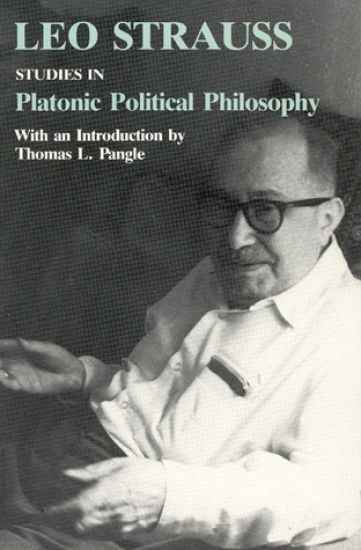
Studies in Platonic Political Philosophy

Studies in Platonic Political Philosophy

Leo Strauss

University of Chicago Press
1985
nidottu
One of the outstanding thinkers of our time offers in this book his final words to posterity. Studies in Platonic Political Philosophy was well underway at the time of Leo Strauss's death in 1973. Having chosen the title for the book, he selected the most important writings of his later years and arranged them to clarify the issues in political philosophy that occupied his attention throughout his life. As his choice of title indicates, the heart of Strauss's work is Platonism—a Platonism that is altogether unorthodox and highly controversial. These essays consider, among others, Heidegger, Husserl, Nietzsche, Marx, Moses Maimonides, Machiavelli, and of course Plato himself to test the Platonic understanding of the conflict between philosophy and political society. Strauss argues that an awesome spritual impoverishment has engulfed modernity because of our dimming awareness of that conflict. Thomas Pangle's Introduction places the work within the context of the entire Straussian corpus and focuses especially on Strauss's late Socratic writings as a key to his mature thought. For those already familiar with Strauss, Pangle's essay will provoke thought and debate; for beginning readers of Strauss, it provides a fine introduction. A complete bibliography of Strauss's writings if included.