Kirjojen hintavertailu. Mukana 11 627 362 kirjaa ja 12 kauppaa.

Kirjahaku

Etsi kirjoja tekijän nimen, kirjan nimen tai ISBN:n perusteella.

13 kirjaa tekijältä Leonard Smith

Chaos

Chaos

Leonard Smith

Oxford University Press
2007
nidottu
Chaos exists in systems all around us. Even the simplest system of cause and effect can be subject to chaos, denying us accurate predictions of its behaviour, and sometimes giving rise to astonishing structures of large-scale order. Our growing understanding of Chaos Theory is having fascinating applications in the real world - from technology to global warming, politics, human behaviour, and even gambling on the stock market. Leonard Smith shows that we all have an intuitive understanding of chaotic systems. He uses accessible maths and physics (replacing complex equations with simple examples like pendulums, railway lines, and tossing coins) to explain the theory, and points to numerous examples in philosophy and literature (Edgar Allen Poe, Chang-Tzu, Arthur Conan Doyle) that illuminate the problems. The beauty of fractal patterns and their relation to chaos, as well as the history of chaos, and its uses in the real world and implications for the philosophy of science are all discussed in this Very Short Introduction. ABOUT THE SERIES: The Very Short Introductions series from Oxford University Press contains hundreds of titles in almost every subject area. These pocket-sized books are the perfect way to get ahead in a new subject quickly. Our expert authors combine facts, analysis, perspective, new ideas, and enthusiasm to make interesting and challenging topics highly readable.

Lunatic Hospitals in Georgian England, 1750–1830
Lunatic Hospitals in Georgian England, 1750–1830 constitutes the first comprehensive study of the philanthropic asylum system in Georgian England. Using original research and drawing upon a wide range of expertise on the history of mental health this book demonstrates the crucial role of the lunatic hospitals in the early development of a national system of psychiatric institutions.These hospitals were to form an essential historical link in the emergence of a national system of institutional provision for mentally disordered people. They provided important prototypes for the subsequent development of a network of state-sponsored lunatic asylums during the nineteenth century. This is an impressive volume which covers various areas including:the provincial lunatic hospitalsmanaging the hospitalmanaging the insane.This book will interest specialist historians as well as mental health professionals and people interested in local and regional studies.
Lunatic Hospitals in Georgian England, 1750–1830
Lunatic Hospitals in Georgian England, 1750–1830 constitutes the first comprehensive study of the philanthropic asylum system in Georgian England. Using original research and drawing upon a wide range of expertise on the history of mental health this book demonstrates the crucial role of the lunatic hospitals in the early development of a national system of psychiatric institutions.These hospitals were to form an essential historical link in the emergence of a national system of institutional provision for mentally disordered people. They provided important prototypes for the subsequent development of a network of state-sponsored lunatic asylums during the nineteenth century. This is an impressive volume which covers various areas including:the provincial lunatic hospitalsmanaging the hospitalmanaging the insane.This book will interest specialist historians as well as mental health professionals and people interested in local and regional studies.
Power Politics

Power Politics

Leonard Smith

iUniverse
2005
pokkari
Throughout the ages, the immortal forces of good and evil have struggled for control over the human race. According to author Leonard Smith, the influences that have been exerted upon humankind for centuries have caused us to embrace delusional beliefs that have distorted our perception of history. Within its objective narrative, "Power Politics: Primeval, Medieval, and Constant Evil" illustrates the significant political impact of both God and Satan on historical events. Readers will discover powerful political forces not apparent to the senses, as well as the influence those forces have over our everyday lives. Using real-life examples that expose the eternal power struggle between good and evil, "Power Politics: Primeval, Medieval, and Constant Evil" offers a unique perspective that encourages us to look beyond society's conventional beliefs.
The Unitarians

The Unitarians

Leonard Smith

Blackstone Editions
2008
pokkari
This short history of Unitarianism concisely explores the origins and progress of a worldwide liberal religious tradition committed to principles of freedom, reason, and tolerance. Unitarians have exercised an influence out of proportion to their minority status. Through their agency, Poland and Transylvania enjoyed periods of religious toleration. In Great Britain, as pioneers of early modern higher education in Dissenting Academies, they applied Enlightenment reasoning to the study of religion, science, and the humanities. In the United States, they led the Transcendentalist movement, the first major flowering of American intellectual culture. This book traces the history of the separate but related Unitarian (and Unitarian Universalist) denominations in Europe, Great Britain, and the United States, and touches on the new groups that have arisen, or are in the process of emerging, elsewhere in the world.
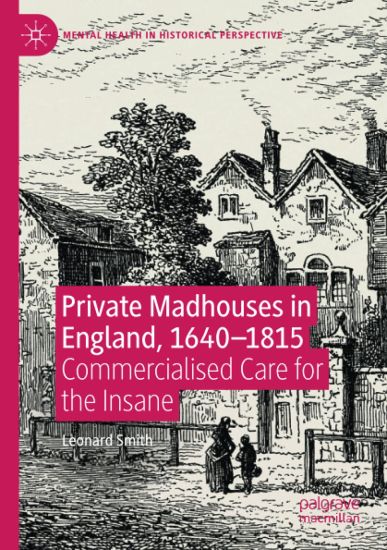
Private Madhouses in England, 1640–1815

Private Madhouses in England, 1640–1815

Leonard Smith

Springer Nature Switzerland AG
2020
sidottu
This book examines the origins and early development of private mental health-care in England, showing that the current spectacle of commercially-based participation in key elements of service provision is no new phenomenon. In 1815, about seventy per cent of people institutionalised because of insanity were being kept in private ‘madhouses’. The opening four chapters detail the emergence of these madhouses and demonstrate their increasing presence in London and across the country during the long eighteenth century. Subsequent chapters deal with specific aspects in greater depth - the insane patients themselves, their characteristics, and the circumstances surrounding admissions; the madhouse proprietors, their business activities, personal attributes and professional qualifications or lack of them; changing treatment practices and the principles that informed them. Finally, the book explores conditions within the madhouses, which ranged from the relatively enlightened to theseriously defective, and reveals the experiences, concerns and protests of their many critics.
Private Madhouses in England, 1640–1815

Private Madhouses in England, 1640–1815

Leonard Smith

Springer Nature Switzerland AG
2021
nidottu
This book examines the origins and early development of private mental health-care in England, showing that the current spectacle of commercially-based participation in key elements of service provision is no new phenomenon. In 1815, about seventy per cent of people institutionalised because of insanity were being kept in private ‘madhouses’. The opening four chapters detail the emergence of these madhouses and demonstrate their increasing presence in London and across the country during the long eighteenth century. Subsequent chapters deal with specific aspects in greater depth - the insane patients themselves, their characteristics, and the circumstances surrounding admissions; the madhouse proprietors, their business activities, personal attributes and professional qualifications or lack of them; changing treatment practices and the principles that informed them. Finally, the book explores conditions within the madhouses, which ranged from the relatively enlightened to theseriously defective, and reveals the experiences, concerns and protests of their many critics.