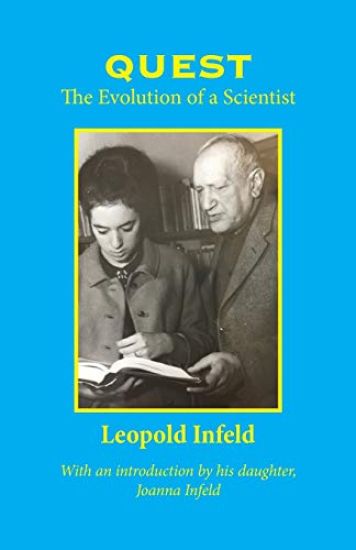
Leopold Infeld was one of the nine eminent scientists who, together with Albert Einstein, signed Bertrand Russell's famous letter warning that in this nuclear age, only a ban on war itself could save this planet (July, 1955). Infeld was born in the Jewish ghetto of Cracow, Poland in 1898, and this autobiography contains a vivid description of this long-since-vanished world. He was assistant to and then a scientific collaborator with Albert Einstein at the Institute for Advanced Study, Princeton, NJ (1936-1938), and this collaboration continued for twelve years while Infeld was at the University of Toronto. In 1938 he wrote a book together with Albert Einstein that became a number one bestseller, The Evolution of Physics. Infeld was lecturer and then Professor of Applied Mathematics at the University of Toronto from 1938--1950. From 1945-1950 he gave many lectures all over Canada on the elementary physics of the atom bomb, warning that Russia would soon have the bomb and urging that the short period of U.S. monopoly be used constructively, for peace. In 1950 he left Canada to become Professor of Theoretical Physics at the University of Warsaw as well as the founding director of the Institute of Theoretical Physics at that university, where he remained until 1967, the year before he died.