Kirjojen hintavertailu. Mukana 11 244 527 kirjaa ja 12 kauppaa.

Kirjahaku

Etsi kirjoja tekijän nimen, kirjan nimen tai ISBN:n perusteella.

4 kirjaa tekijältä Leora Batnitzky

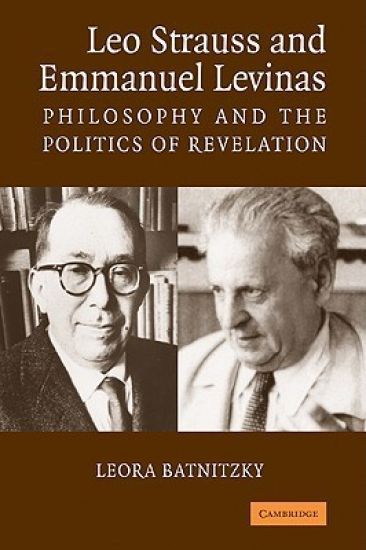
Leo Strauss and Emmanuel Levinas

Leo Strauss and Emmanuel Levinas

Leora Batnitzky

Cambridge University Press
2007
pokkari
Leo Strauss and Emmanuel Levinas, two twentieth-century Jewish philosophers and two extremely provocative thinkers whose reputations have grown considerably, are rarely studied together. This is due to the disparate interests of many of their intellectual heirs. Strauss has influenced political theorists and policy makers on the right while Levinas has been championed in the humanities by different cadres associated with postmodernist thought. In Leo Strauss and Emmanuel Levinas: Philosophy and the Politics of Revelation, first published in 2006, Leora Batnitzky brings together these two seemingly incongruous contemporaries, demonstrating that they often had the same philosophical sources and their projects had many formal parallels. While such a comparison is valuable in itself for better understanding each figure, it also raises profound questions in the debate on the definitions of 'religion', suggesting ways that religion makes claims on both philosophy and politics.
Leo Strauss and Emmanuel Levinas

Leo Strauss and Emmanuel Levinas

Leora Batnitzky

Cambridge University Press
2006
sidottu
Leo Strauss and Emmanuel Levinas, two twentieth-century Jewish philosophers and two extremely provocative thinkers whose reputations have grown considerably, are rarely studied together. This is due to the disparate interests of many of their intellectual heirs. Strauss has influenced political theorists and policy makers on the right while Levinas has been championed in the humanities by different cadres associated with postmodernist thought. In Leo Strauss and Emmanuel Levinas: Philosophy and the Politics of Revelation, first published in 2006, Leora Batnitzky brings together these two seemingly incongruous contemporaries, demonstrating that they often had the same philosophical sources and their projects had many formal parallels. While such a comparison is valuable in itself for better understanding each figure, it also raises profound questions in the debate on the definitions of 'religion', suggesting ways that religion makes claims on both philosophy and politics.
Idolatry and Representation

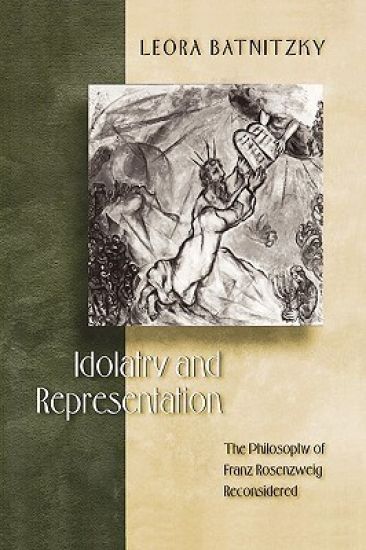
Idolatry and Representation

Leora Batnitzky

Princeton University Press
2009
pokkari
Although Franz Rosenzweig is arguably the most important Jewish philosopher of the twentieth century, his thought remains little understood. Here, Leora Batnitzky argues that Rosenzweig's redirection of German-Jewish ethical monotheism anticipates and challenges contemporary trends in religious studies, ethics, philosophy, anthropology, theology, and biblical studies. This text, which captures the hermeneutical movement of Rosenzweig's corpus, is the first to consider the full import of the cultural criticism articulated in his writings on the modern meanings of art, language, ethics, and national identity. In the process, the book solves significant conundrums about Rosenzweig's relation to German idealism, to other major Jewish thinkers, to Jewish political life, and to Christianity, and brings Rosenzweig into conversation with key contemporary thinkers. Drawing on Rosenzweig's view that Judaism's ban on idolatry is the crucial intellectual and spiritual resource available to respond to the social implications of human finitude, Batnitzky interrogates idolatry as a modern possibility. Her analysis speaks not only to the question of Judaism's relationship to modernity (and vice versa), but also to the generic question of the present's relationship to the past--a subject of great importance to anyone contemplating the modern statuses of religious tradition, reason, science, and historical inquiry. By way of Rosenzweig, Batnitzky argues that contemporary philosophers and ethicists must relearn their approaches to religious traditions and texts to address today's central ethical problems.
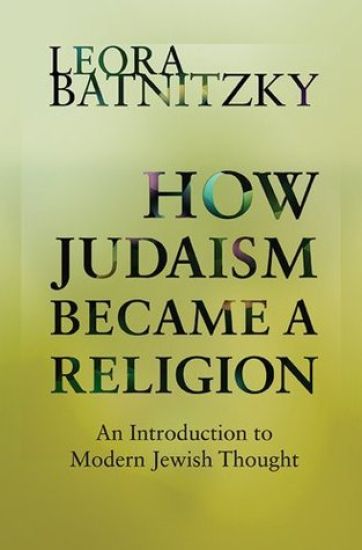
How Judaism Became a Religion

How Judaism Became a Religion

Leora Batnitzky

Princeton University Press
2013
pokkari
Is Judaism a religion, a culture, a nationality--or a mixture of all of these? In How Judaism Became a Religion, Leora Batnitzky boldly argues that this question more than any other has driven modern Jewish thought since the eighteenth century. This wide-ranging and lucid introduction tells the story of how Judaism came to be defined as a religion in the modern period--and why Jewish thinkers have fought as well as championed this idea. Ever since the Enlightenment, Jewish thinkers have debated whether and how Judaism--largely a religion of practice and public adherence to law--can fit into a modern, Protestant conception of religion as an individual and private matter of belief or faith. Batnitzky makes the novel argument that it is this clash between the modern category of religion and Judaism that is responsible for much of the creative tension in modern Jewish thought. Tracing how the idea of Jewish religion has been defended and resisted from the eighteenth century to today, the book discusses many of the major Jewish thinkers of the past three centuries, including Moses Mendelssohn, Abraham Geiger, Hermann Cohen, Martin Buber, Zvi Yehuda Kook, Theodor Herzl, and Mordecai Kaplan. At the same time, it tells the story of modern orthodoxy, the German-Jewish renaissance, Jewish religion after the Holocaust, the emergence of the Jewish individual, the birth of Jewish nationalism, and Jewish religion in America. More than an introduction, How Judaism Became a Religion presents a compelling new perspective on the history of modern Jewish thought.