Kirjojen hintavertailu. Mukana 11 244 527 kirjaa ja 12 kauppaa.

Kirjahaku

Etsi kirjoja tekijän nimen, kirjan nimen tai ISBN:n perusteella.

15 kirjaa tekijältä Lester R. Brown

The Twenty-Ninth Day

The Twenty-Ninth Day

Lester R. Brown

WW NORTON CO
1978
nidottu
The global lily pond in which four billion of us live may already be half full. Although UN projections show world population continuing to grow until it reaches ten to sixteen billion, Lester Brown believes this is unrealistic. In this fascinating analysis of the fisheries, forests, grasslands, and croplands—the author shows that the demands at current levels of population and per capita consumption often exceed the long-term carrying capacity. He documents the overfishing, deforestation, and overgrazing that are gradually undermining human life support systems. He also explains that with energy shortages anticipated in the early eighties and a projected downturn in world oil production in the early eighties and a projected downturn in world oil production in the early nineties, the world must quickly shift to renewable energy resources.
Full Planet, Empty Plates

Full Planet, Empty Plates

Lester R. Brown

WW Norton Co
2012
sidottu
What will the geopolitics of food look like in a new era dominated by scarcity and food nationalism? Brown outlines the political implications of land acquisitions by grain-importing countries in Africa and elsewhere as well as the world's shrinking buffers against poor harvests. With wisdom accumulated over decades of tracking agricultural issues, Brown exposes the increasingly volatile food situation the world is facing.
Breaking New Ground

Breaking New Ground

Lester R. Brown

WW Norton Co
2013
sidottu
Lester R. Brown, whom the Washington Post praised as “one of the world’s most influential thinkers,” built his understanding of global environmental issues from the ground up. Brown spent his childhood working on the family’s small farm. His entrepreneurial skills surfaced early. Even while excelling in school, he launched with his younger brother a tomato-growing operation that by 1958 was producing 1.5 million pounds of tomatoes. Later, at the U.S. Department of Agriculture, Brown emphasized the need for systemic thinking. In 1963 he did the first global food supply and demand projections to the end of the century. While on a brief assignment in India in 1965, he pieced together the clues that led him to sound the alarm on an impending famine there. His urgent warning to the U.S. and Indian governments set in motion the largest food rescue effort in history, helping to save millions of lives. This experience led India to adopt new agricultural practices, which he helped to shape. Brown went on to advise governments internationally and to found the Worldwatch and Earth Policy institutes, two major nonprofit environmental research organizations. Both brilliant and articulate, through his many books he has brought to the fore the interconnections among such issues as overpopulation, climate change, and water shortages and their effect on food security. His 1995 book, Who Will Feed China?, led to a broad restructuring of China’s agricultural policy. Never one to focus only on the problem, Brown always proposes pragmatic, employable solutions to stave off the unfolding ecological crises that endanger our future.
Eco-Economy

Eco-Economy

Lester R. Brown

WW Norton Co
2001
pokkari
In 1543, Polish astronomer Nicolaus Copernicus challenged the view that the Sun revolved around the Earth, arguing instead that the Earth revolved around the Sun. His paper led to a revolution in thinking to a new worldview. "Eco-Economy" discusses the need today for a similar shift in our worldview. The issue now is whether the environment is part of the economy or the economy is part of the environment. Lester R. Brown argues the latter, pointing out that treating the environment as part of the economy has produced an economy that is destroying its natural support systems. Brown notes that if China were to have a car in every garage, American style, it would need 80 million barrels of oil a day more than the world currently produces. If paper consumption per person in China were to reach the U.S. level, China would need more paper than the world produces. There go the world's forests. If the fossil fuel-based, automobile-centered, throwaway economic model will not work for China, it will not work for the other 3 billion people in the developing world and it will not work for the rest of the world. But Brown is optimistic as he describes how to restructure the global economy to make it compatible with the Earth's ecosystem so that economic progress can continue. In the new economy, wind farms replace coal mines, hydrogen-powered fuel cells replace internal combustion engines, and cities are designed for people, not cars. Glimpses of the new economy can be seen in the wind farms of Denmark, the solar rooftops of Japan, and the bicycle network of the Netherlands. "Eco-Economy" is a road map of how to get from here to there."
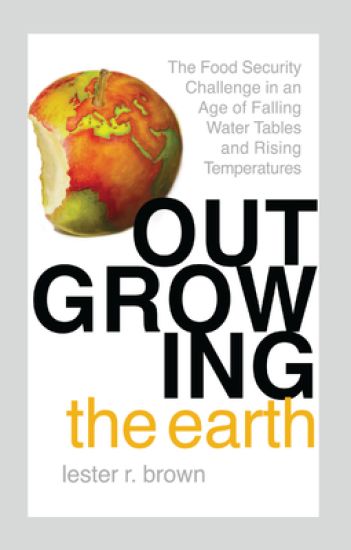
Outgrowing the Earth: The Food Security Challenge in an Age of Falling Water Tables and Rising Temperatures
Ever since 9/11, many have considered al Queda to be the leading threat to global security, but falling water tables in countries that contain more than half the world's people and rising temperatures worldwide pose a far more serious threat. Spreading water shortages and crop-withering heat waves are shrinking grain harvests in more and more countries, making it difficult for the world's farmers to feed 70 million more people each year. The risk is that tightening food supplies could drive up food prices, destabilizing governments in low-income grain-importing countries and disrupting global economic progress. Future security, Brown says, now depends on raising water productivity, stabilizing climate by moving beyond fossil fuels, and stabilizing population by filling the family planning gap and educating young people everywhere. If Osama bin Laden and his colleagues succeed in diverting our attention from the real threats to our future security, they may reach their goals for reasons that even they have not imagined.
Plan B 4.0

Plan B 4.0

Lester R. Brown

WW Norton Co
2009
nidottu
As fossil fuel prices rise, oil insecurity deepens, and concerns about climate change cast a shadow over the future of coal, a new energy economy is emerging. Wind, solar, and geothermal energy are replacing oil, coal, and natural gas, at a pace and on a scale we could not have imagined even a year ago. For the first time since the Industrial Revolution, we have begun investing in energy sources that can last forever. Plan B 4.0 explores both the nature of this transition to a new energy economy and how it will affect our daily lives.
World on the Edge

World on the Edge

Lester R. Brown

WW Norton Co
2011
pokkari
We are in a race between political and natural tipping points. Can we close coal-fired power plants fast enough to save the Greenland ice sheet and avoid catastrophic sea level rise? Can we raise water productivity fast enough to halt the depletion of aquifers and avoid water-driven food shortages? Can we cope with peak water and peak oil at the same time? These are some of the issues Lester R. Brown skillfully distills in World on the Edge. Bringing decades of research and analysis into play, he provides the responses needed to reclaim our future.
Full Planet, Empty Plates

Full Planet, Empty Plates

Lester R. Brown

WW Norton Co
2012
pokkari
With food scarcity driven by falling water tables, eroding soils and rising temperatures, control of arable land and water resources is moving to centre stage in the global struggle for food security. "In this era of tightening world food supplies, the ability to grow food is fast becoming a new form of geopolitical leverage. Food is the new oil.", Lester R. Brown writes. Here, Brown, "One of the world's most influential thinkers" (Washington Post), discusses what the geopolitics of food will look like in a new era dominated by scarcity and food nationalism. He outlines the political implications of land acquisitions by grain-importing countries in Africa and elsewhere as well as the world's shrinking buffers against poor harvests. With wisdom accumulated over decades of tracking agricultural issues, Brown exposes the increasingly volatile food situation the world is facing.
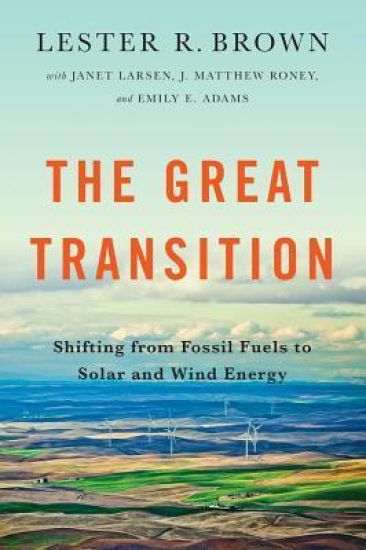
The Great Transition

The Great Transition

Lester R. Brown

WW Norton Co
2015
nidottu
As oil insecurity deepens, the extraction risks of fossil fuels rise and concerns about climate instability cast a shadow over the future of coal, a new world energy economy is emerging. The old economy, fuelled by oil, natural gas and coal is being replaced with one powered by wind, solar and geothermal energy.
Outgrowing the Earth

Outgrowing the Earth

Lester R. Brown

Routledge
2019
nidottu
Historically, food security was the responsibility of ministries of agriculture but today that has changed: decisions made in ministries of energy may instead have the greatest effect on the food situation. Recent research reporting that a one degree Celsius rise in temperature can reduce grain yields by 10 per cent means that energy policy is now directly affecting crop production. Agriculture is a water-intensive activity and, while public attention has focused on oil depletion, it is aquifer depletion that poses the more serious threat. There are substitutes for oil, but none for water and the link between our fossil fuel addiction, climate change and food security is now clear. While population growth has slowed over the past three decades, we are still adding 76 million people per year. In a world where the historical rise in land productivity has slowed by half since 1990, eradicating hunger may depend as much on family planners as on farmers. The bottom line is that future food security depends not only on efforts within agriculture but also on energy policies that stabilize climate, a worldwide effort to raise water productivity, the evolution of land-efficient transport systems, and population policies that seek a humane balance between population and food. Outgrowing the Earth advances our thinking on food security issues that the world will be wrestling with for years to come.
Outgrowing the Earth

Outgrowing the Earth

Lester R. Brown

Earthscan Ltd
2005
sidottu
Historically, food security was the responsibility of ministries of agriculture but today that has changed: decisions made in ministries of energy may instead have the greatest effect on the food situation. Recent research reporting that a one degree Celsius rise in temperature can reduce grain yields by 10 per cent means that energy policy is now directly affecting crop production. Agriculture is a water-intensive activity and, while public attention has focused on oil depletion, it is aquifer depletion that poses the more serious threat. There are substitutes for oil, but none for water and the link between our fossil fuel addiction, climate change and food security is now clear. While population growth has slowed over the past three decades, we are still adding 76 million people per year. In a world where the historical rise in land productivity has slowed by half since 1990, eradicating hunger may depend as much on family planners as on farmers. The bottom line is that future food security depends not only on efforts within agriculture but also on energy policies that stabilize climate, a worldwide effort to raise water productivity, the evolution of land-efficient transport systems, and population policies that seek a humane balance between population and food. Outgrowing the Earth advances our thinking on food security issues that the world will be wrestling with for years to come.
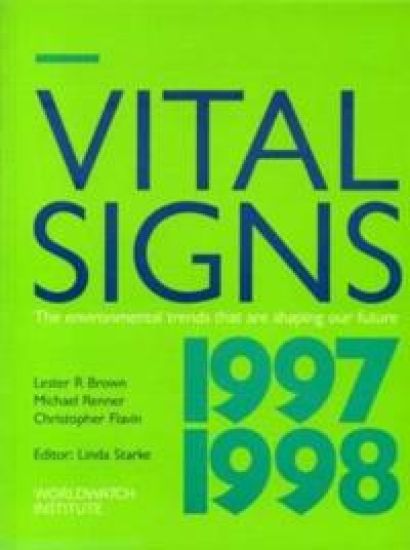
Vital Signs 1997-1998

Vital Signs 1997-1998

Lester R. Brown

Earthscan Ltd
1997
nidottu
The sixth annual guide to the environmental, economic and social trends which are shaping the future, this text presents the good news, the bad news, and a few surprises about the state of our planet. n Part One, facing pages of text and graphs provide information on 40 carefully selected indicators, mapping changes in food supplies; agriculture; the atmosphere, energy and transport; natural resources; the global economy; society and health; and the millitary. Part Two of the text contains special features on less celebrated trends, including ten new vital signs indicators such as violence against women, how the environment impacts on the insurance industry, and the proliferation of landmines.
Vital Signs 1998-1999

Vital Signs 1998-1999

Lester R. Brown

Earthscan Ltd
1998
nidottu
First Published in 1998. In this seventh annual edition of VITAL SIGNS the team at the Worldwatch Institute bring together an eclectic selection of disparate trends to offer a unique, multifaceted view of our rapidly changing world. This vital resource and reference guide traces the scientific, social, economic and environmental trends that have and continue to shape our world. Among the trends covered for the first time in VITAL SIGNS 1998-99, are frontier forests, plantation forestry, satellite launches, minerals exploration, small arms proliferation and female education. This year's edition points out that global emissions of carbon, the leading contributor to global climate change, hit another new high, while wind power has grown an amazing 26 per cent per year, and sales of solar cells jumped a phenomenal 43 per cent in 1997. VITAL SIGNS is the most comprehensive source of environmental and social information available.
Eco-Economy

Eco-Economy

Lester R. Brown

Earthscan Ltd
2003
sidottu
This study presents an account of how to rethink the industrial economy to work with, not against, the natural environment, exploring the vast economic potential and environmental gain that exists from eliminating the waste and destruction of current consumption.