Kirjojen hintavertailu. Mukana 12 016 292 kirjaa ja 12 kauppaa.

Kirjahaku

Etsi kirjoja tekijän nimen, kirjan nimen tai ISBN:n perusteella.

5 kirjaa tekijältä Lewis Gordon

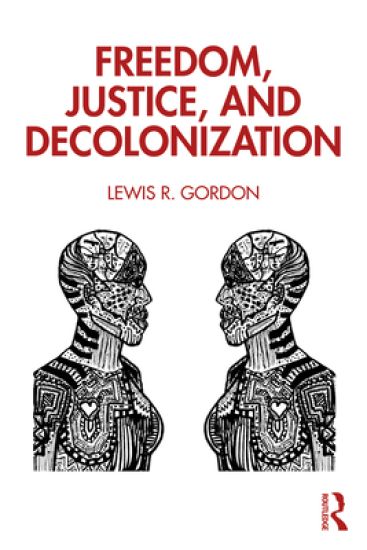
Freedom, Justice, and Decolonization
The eminent scholar Lewis R. Gordon offers a probing meditation on freedom, justice, and decolonization. What is there to be understood and done when it is evident that the search for justice, which dominates social and political philosophy of the North, is an insufficient approach for the achievements of dignity, freedom, liberation, and revolution? Gordon takes the reader on a journey as he interrogates a trail from colonized philosophy to re-imagining liberation and revolution to critical challenges raised by Afropessimism, theodicy, and looming catastrophe. He offers not forecast and foreclosure but instead an urgent call for dignifying and urgent acts of political commitment. Such movements take the form of examining what philosophy means in Africana philosophy, liberation in decolonial thought, and the decolonization of justice and normative life. Gordon issues a critique of the obstacles to cultivating emancipatory politics, challenging reductionist forms of thought that proffer harm and suffering as conditions of political appearance and the valorization of nonhuman being. He asserts instead emancipatory considerations for occluded forms of life and the irreplaceability of existence in the face of catastrophe and ruin, and he concludes, through a discussion with the Circassian philosopher and decolonial theorist, Madina Tlostanova, with the project of shifting the geography of reason.
Freedom, Justice, and Decolonization
The eminent scholar Lewis R. Gordon offers a probing meditation on freedom, justice, and decolonization. What is there to be understood and done when it is evident that the search for justice, which dominates social and political philosophy of the North, is an insufficient approach for the achievements of dignity, freedom, liberation, and revolution? Gordon takes the reader on a journey as he interrogates a trail from colonized philosophy to re-imagining liberation and revolution to critical challenges raised by Afropessimism, theodicy, and looming catastrophe. He offers not forecast and foreclosure but instead an urgent call for dignifying and urgent acts of political commitment. Such movements take the form of examining what philosophy means in Africana philosophy, liberation in decolonial thought, and the decolonization of justice and normative life. Gordon issues a critique of the obstacles to cultivating emancipatory politics, challenging reductionist forms of thought that proffer harm and suffering as conditions of political appearance and the valorization of nonhuman being. He asserts instead emancipatory considerations for occluded forms of life and the irreplaceability of existence in the face of catastrophe and ruin, and he concludes, through a discussion with the Circassian philosopher and decolonial theorist, Madina Tlostanova, with the project of shifting the geography of reason.

Fanon and the Crisis of European Man
As the first book to analyze the work of Fanon as an existential-phenomenological of human sciences and liberation philosopher, Gordon deploys Fanon's work to illuminate how the "bad faith" of European science and civilization have philosophically stymied the project of liberation. Fanon's body of work serves as a critique of European science and society, and shows the ways in which the project of "truth" is compromised by Eurocentric artificially narrowed scope of humanity--a circumstance to which he refers as the crisis of European Man. In his examination of the roots of this crisis, Gordon explores the problems of historical salvation and the dynamics of oppression, the motivation behind contemporary European obstruction of the advancement of a racially just world, the forms of anonymity that pervade racist theorizing and contribute to "seen invisibility," and the reasons behind the impossibility of a nonviolent transition from colonialism and neocolonialism to postcolonialism.
Sheep and Goats

Sheep and Goats

Lewis Gordon

Vagabond Voices
2014
nidottu
Nicky plays the drums. He plays at church - softly. Friday nights he goes to the youth club there. For the rest of the week he serves his time at school, quietly and anonymously. One Sunday morning he meets Sid. Fresh from an onstage tussle with an elderly music teacher, Sid needs a new drummer for his punk band. Nicky is the chosen one, but he has much to learn. Sid fills his ears with new sounds. Soon Nicky was caught up in Sid's rude schooling. Now part of a whole new scene of misfits and piss-artists, Nicky's past relationships start to fray. A playground attack causes animosity with his old pal Pete; enigmatic girls draw his attention away from Christian crush Ruth; youth leader Mack strains to shepherd him on the narrow path. Profane and often absurd, Sheep and Goats uses short, compressed sketches to recount the thrill and pain of teenage awakenings, the drudgery and slog of education and the frantic need to stand out and fit in all at once: the tale of a naive adolescent, struggling to make space for faith when all that matters is friendship, sex, drink and unholy music.
Vad Fanon sa

Vad Fanon sa

Lewis Gordon

Tankekraft Förlag
2016
nidottu
Frantz Fanon (1925-1961) var en av de centrala förgrundsgestalterna inom avkolonialiseringsrörelsen. Genom sitt deltagande i det väpnade motståndet mot kolonialmakterna och sina teoretiska bidrag till förståelsen av kolonialismens mekanismer har han förtjänat platsen som en av 1900-talets viktigaste antirasistiska figurer. I Vad Fanon sa inbjuder oss Lewis Gordon till en närläsning av Fanons skrifter för att visa på bredden och rikedomen i Fanons tänkande samt klargöra dess relevans för vår tids samhällskritik. Genom att återvända till Fanons faktiska ord tar sig Gordon an hela vidden av Fanons produktion – som spänner över områden som etik och existentialism, via psykiatri och psykoanalys till politisk teori – och återupptäcker en tänkare och aktivist som alltjämt har mycket att säga om dagens rasistiska strukturer.