Kirjojen hintavertailu. Mukana 11 717 486 kirjaa ja 12 kauppaa.

Kirjahaku

Etsi kirjoja tekijän nimen, kirjan nimen tai ISBN:n perusteella.

9 kirjaa tekijältä Lilian R. Furst

Counterparts

Counterparts

Lilian R. Furst

Routledge
2020
sidottu
Originally published in 1977, this volume gives a co-hesive overview of Franco-German literary relationships between 1770 and 1895. It discerns the dynamics and outlines the structure of the interrelationship. The two literatures develop in a broadly similar direction in the nineteenth century, but there is a puzzling time-lag which forms the focal point of enquiry. It looks back to the combination of literary, political and social factors that may explain how the time-lag came into being. The book serves both as an introduction and as a starting point for further detailed analysis of specific areas and offers a new approach to the comparative study of literature.
Counterparts

Counterparts

Lilian R. Furst

TAYLOR FRANCIS LTD
2021
nidottu
Originally published in 1977, this volume gives a co-hesive overview of Franco-German literary relationships between 1770 and 1895. It discerns the dynamics and outlines the structure of the interrelationship. The two literatures develop in a broadly similar direction in the nineteenth century, but there is a puzzling time-lag which forms the focal point of enquiry. It looks back to the combination of literary, political and social factors that may explain how the time-lag came into being. The book serves both as an introduction and as a starting point for further detailed analysis of specific areas and offers a new approach to the comparative study of literature.
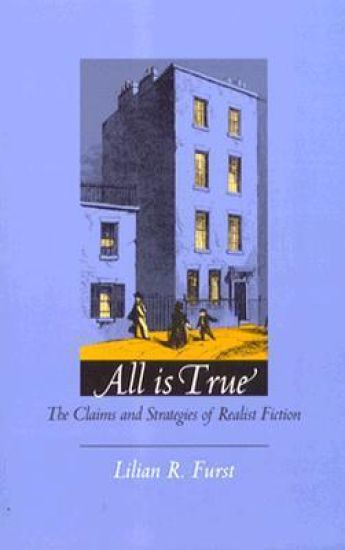
All Is True

All Is True

Lilian R. Furst

Duke University Press
1995
sidottu
"All is true," realist writers would say of their work, to which critics now respond: All is art and artifice. Offering a new approach to reading nineteenth-century realist fiction, Lilian R. Furst seeks to reconcile these contradictory claims. In doing so, she clarifies the deceptions, appropriations, intentions, and ultimately the power of literary realism.In close textual analyses of works ranging across European and American literature, including paradigmatic texts by Balzac, Flaubert, George Eliot, Zola, Henry James, and Thomas Mann, Furst shows how the handling of time, the presentation of place, and certain narrational strategies have served the realists’ claim. She demonstrates how readers today, like those a hundred years ago, are convinced of the authenticity of the created illusion by such means as framing, voice, perspective, and the slippage from metonymy to metaphor. Further, Furst reveals the pains the realists took to conceal these devices, and thus to protect their claim to be employing a simple form. Taking into account both the claims and the covert strategies of these writers, All Is True puts forward an alternative to the conventional polarized reading of the realist text-which emerges here as neither strictly an imitation of an extraneous model nor simply a web of words but a brilliantly complex imbrication of the two.A major statement on one of the most enduring forms in cultural history, this book promises to alter not only our view of realist fiction but our understanding of how we read it.
All Is True

All Is True

Lilian R. Furst

Duke University Press
1995
pokkari
"All is true," realist writers would say of their work, to which critics now respond: All is art and artifice. Offering a new approach to reading nineteenth-century realist fiction, Lilian R. Furst seeks to reconcile these contradictory claims. In doing so, she clarifies the deceptions, appropriations, intentions, and ultimately the power of literary realism.In close textual analyses of works ranging across European and American literature, including paradigmatic texts by Balzac, Flaubert, George Eliot, Zola, Henry James, and Thomas Mann, Furst shows how the handling of time, the presentation of place, and certain narrational strategies have served the realists’ claim. She demonstrates how readers today, like those a hundred years ago, are convinced of the authenticity of the created illusion by such means as framing, voice, perspective, and the slippage from metonymy to metaphor. Further, Furst reveals the pains the realists took to conceal these devices, and thus to protect their claim to be employing a simple form. Taking into account both the claims and the covert strategies of these writers, All Is True puts forward an alternative to the conventional polarized reading of the realist text-which emerges here as neither strictly an imitation of an extraneous model nor simply a web of words but a brilliantly complex imbrication of the two.A major statement on one of the most enduring forms in cultural history, this book promises to alter not only our view of realist fiction but our understanding of how we read it.
European Romanticism

European Romanticism

Lilian R. Furst

Routledge
2016
sidottu
First published in 1980. This collection of carefully selected extracts from primary texts seeks to show what the Romantics themselves held Romanticism to be. The movement is thus defined in terms of the writers’ own views of their art both in general principle and in practical terms. This title will be of interest to students of literature.
European Romanticism

European Romanticism

Lilian R. Furst

Routledge
2017
nidottu
First published in 1980. This collection of carefully selected extracts from primary texts seeks to show what the Romantics themselves held Romanticism to be. The movement is thus defined in terms of the writers’ own views of their art both in general principle and in practical terms. This title will be of interest to students of literature.
Romanticism

Romanticism

Lilian R. Furst

Routledge
2017
sidottu
First published in 1969, this work traces the evolution of Romanticism and in doing so, demonstrates its novelty as an imaginative and emotional perception of the world in contrast to the rationalistic approach which was dominant in the seventeenth century. It identifies the fundamental similarities between Romantic writing in England, France and Germany as well as their differences brought about by divergent literary and social backgrounds. The book is concluded by a review of the problems that arise from a simple definition of Romanticism.
Romanticism

Romanticism

Lilian R. Furst

Routledge
2019
nidottu
First published in 1969, this work traces the evolution of Romanticism and in doing so, demonstrates its novelty as an imaginative and emotional perception of the world in contrast to the rationalistic approach which was dominant in the seventeenth century. It identifies the fundamental similarities between Romantic writing in England, France and Germany as well as their differences brought about by divergent literary and social backgrounds. The book is concluded by a review of the problems that arise from a simple definition of Romanticism.
Just Talk

Just Talk

Lilian R. Furst

The University Press of Kentucky
1999
sidottu
While countless memoirs have been written about depression and therapy, no one has examined how the "talking cure" of psychotherapy is presented in novels and other works of literature. Beginning with an overview of the principles of psychotherapy and its growing use as a treatment for mental and emotional disorders, Lilian Furst addresses the patient's view of the value of talk. Patients' portrayals of psychotherapy in literary works range from serious to satirical and from comic to ironic, with some descriptions verging on the grotesque. Furst identifies the overtalkers, undertalkers, and duet voices that shape the individual experiences of psychotherapy. While the voices of the overtalkers overwhelm those of their therapists, undertalkers are reluctant to express or acknowledge their feelings. Particularly revealing are the instances where patient and therapist provide separate but parallel renderings of the same therapy. Just Talk looks at a wide range of questions about psychotherapy. Furst considers the patient's first impressions of the therapist and how the patient is prompted to engage in talk. She looks for signs of self-deception or self-betrayal on the patient's part and asks how the therapist's behavior affects the patient's responses and the ultimate outcome of the therapy. Furst examines such well-known works as Roth's Portnoy's Complaint, Plath's The Bell Jar, and Lodge's Therapy, as well as lesser-known novels, to discuss how patients react to psychotherapy as a cure for mental and emotional disorders. Her analysis of these narratives adds significantly to our understanding of the dynamic relationship between patient and therapist and reveals much about the healing process that is not addressed in technical casebooks.