After the decades-long assault by despotic Persia on the allied Greek states, the Greeks finally defeated their massive enemy. Now, in the ancient Mediterranean world of Life After Death at Ipsambul, war is imminent among the Greeks. Arion, the only child of a wealthy mercantile family on idyllic Lesbos, had the education and security to evolve into a poetic soul. As a boy growing into a man, he is thrust into a violent world while his unscrupulous uncle is running the family estate. To survive, he must adjust and overcome injustice and cruelty. This novel comprises Arion's experiences: while traveling to Sidon from Damaskos as a child with his father; departing from Mytilene on Lesbos to sail south on the Aegean Sea as a juvenile; traveling up the Nile to Ipsambul; then returning to Greece as a young adult, and at last arriving in glorious Athens (during the Age of Perikles) two years before the beginning of the Peloponnesian War. On his journey, he finds that the surprising puzzle of life allows romance and religion only in portions of reality, hope, and fantasy. The novel spans twelve years, ending in 433 BC.To assist potential readers in making good choices about whether or not to purchase any of the four volumes of Arion's Odyssey, I offer the following additional information about this tetralogy, which is set in Classical Greece, with the city-state (polis) of Athens as one protagonist and Arion (a human) as the other. Each volume of Arion's Odyssey is a combination of historical novel, ancient travelogue, ancient poetry, mythology, religion, and history. If you would enjoy a saga as detailed as Melville's Moby-Dick, as kaleidoscopic as Michener's Iberia, and as expansive as Hugo's Les Miserable, you might love this tetralogy.Regarding Athens and its empire, the following portion of each novel is similar to an ancient travelogue: one third of Life After Death at Ipsambul (volume 1); one fifth of Aegean Fire (volume 2); one tenth of Beyond the Battle of Naupaktos (volume 3); one tenth of Return to Lesbos (volume 4).Set in the ancient Mediterranean world, Arion's Odyssey is an adult story about Arion, a sensitive Greek (boy becoming a man) from a wealthy mercantile family on the Greek island of Lesbos. It begins fourteen years prior to the inception of the Peloponnesian War, and ends during that war: it spans the period from 445 BC to 427 BC.If you would like to experience life in the ancient Mediterranean world, then you will probably enjoy this adult story about coming-of-age there.
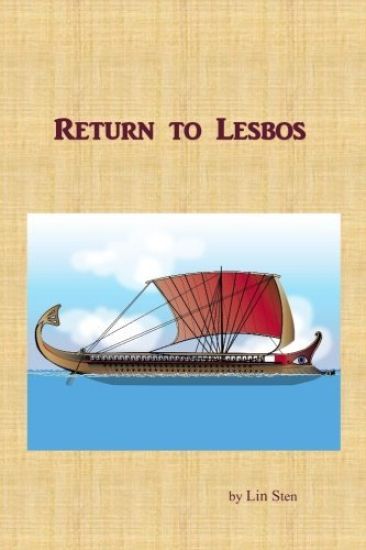
In Return to Lesbos, during the Peloponnesian War in Classical Greece, just after Athens (the city-state) quells the revolt of Lesbos in 427 BC, Athens' initial impulse is to put to death every male in Mytilene, on Lesbos, and to sell all the women and children into slavery. At this very time, Arion must return to Mytilene to retrieve the family estate from his treacherous uncle, find his mate and free her, and then return to Athens to make an enormous payment against the (illicit) enslavement-collateral contract held by his longtime nemesis, the banker/pirate Smerdis, or face a return to the mines in Laurion. He has eight days.To assist potential readers in making good choices about whether or not to purchase any of the four volumes of Arion's Odyssey, I offer the following additional information about this tetralogy, which is set in Classical Greece, with the city-state (polis) of Athens as one protagonist and Arion (a human) as the other. Each volume of Arion's Odyssey is a combination of historical novel, ancient travelogue, ancient poetry, mythology, religion, and history. If you would enjoy a saga as detailed as Melville's Moby-Dick, as kaleidoscopic as Michener's Iberia, and as expansive as Hugo's Les Miserable, you might love this tetralogy.Regarding Athens and its empire, the following portion of each novel is similar to an ancient travelogue: one third of Life After Death at Ipsambul (volume 1); one fifth of Aegean Fire (volume 2); one tenth of Beyond the Battle of Naupaktos (volume 3); one tenth of Return to Lesbos (volume 4).Set in the ancient Mediterranean world, Arion's Odyssey is an adult story about Arion, a sensitive Greek (boy becoming a man) from a wealthy mercantile family on the Greek island of Lesbos. It begins fourteen years prior to the inception of the Peloponnesian War, and ends during that war: it spans the period from 445 BC to 427 BC.If you would like to experience life in the ancient Mediterranean world, then you will probably enjoy this adult story about coming-of-age there.
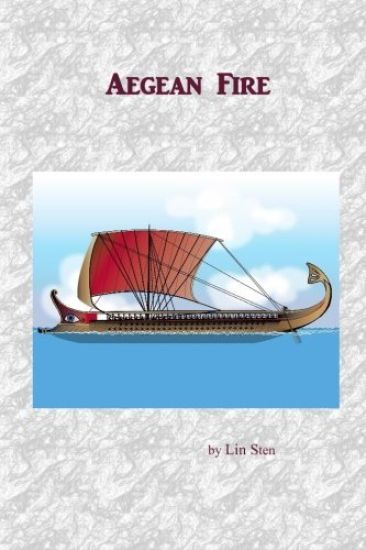
In Aegean Fire, in 433 BC in Classical Greece, from his chained position at his oar, Arion catches a glimpse of Athens' fabled Akropolis through an oarport of the trireme commanded by his nemesis, Smerdis. Despite the fantasies of his childhood as the scion of a wealthy mercantile family on Lesbos, when he had always dreamed of coming here, he now hates Athens. After the Battle of Sybota, due to previous violent insubordination witnessed by Artontes, Arion's new master, Arion is dispatched to the dreaded mines in Laurion. In 431 BC, like all other movable property, Arion is brought back to Athens for the duration of the first Peloponnesian summer occupation of Attica. After Arion nurses Artontes' wife and child through the plague, Artontes shows his appreciation by assigning Arion to an oarbench on one of his cargo ships, but exposure to pirates might be more threatening than the plague, naval battles, or the mines.To assist potential readers in making good choices about whether or not to purchase any of the four volumes of Arion's Odyssey, I offer the following additional information about this tetralogy, which is set in Classical Greece, with the city-state (polis) of Athens as one protagonist and Arion (a human) as the other. Each volume of Arion's Odyssey is a combination of historical novel, ancient travelogue, ancient poetry, mythology, religion, and history. If you would enjoy a saga as detailed as Melville's Moby-Dick, as kaleidoscopic as Michener's Iberia, and as expansive as Hugo's Les Miserable, you might love this tetralogy.Regarding Athens and its empire, the following portion of each novel is similar to an ancient travelogue: one third of Life After Death at Ipsambul (volume 1); one fifth of Aegean Fire (volume 2); one tenth of Beyond the Battle of Naupaktos (volume 3); one tenth of Return to Lesbos (volume 4).Set in the ancient Mediterranean world, Arion's Odyssey is an adult story about Arion, a sensitive Greek (boy becoming a man) from a wealthy mercantile family on the Greek island of Lesbos. It begins fourteen years prior to the inception of the Peloponnesian War, and ends during that war: it spans the period from 445 BC to 427 BC.If you would like to experience life in the ancient Mediterranean world, then you will probably enjoy this adult story about coming-of-age there.