Kirjojen hintavertailu. Mukana 12 000 496 kirjaa ja 12 kauppaa.

Kirjahaku

Etsi kirjoja tekijän nimen, kirjan nimen tai ISBN:n perusteella.

21 kirjaa tekijältä Loïc Wacquant

Body & Soul

Body & Soul

Loïc Wacquant

Oxford University Press Inc
2022
nidottu
When French sociologist Loïc Wacquant signed up at a boxing gym in a black neighborhood of Chicago's South Side, he had never contemplated getting close to a ring, let alone climbing into it. Yet for three years he immersed himself among local fighters, amateur and professional. He learned the Sweet science of bruising, participating in all phases of the pugilist's strenuous preparation, from shadow-boxing drills to sparring to fighting in the Golden Gloves tournament. In this experimental ethnography of incandescent intensity, the scholar-turned-boxer fleshes out Pierre Bourdieu's signal concept of habitus, deepening our theoretical grasp of human practice. And he supplies a model for a "carnal sociology" capable of capturing "the taste and ache of action." This expanded anniversary edition features a new preface and postface that take the reader behind the scenes and reveal the "making of" this classic ethnography. Wacquant reflects on his path to, and uses of, fieldwork based on apprenticeship. He traces the genealogy and draws the anatomy of habitus and explicates how he deployed it as method of inquiry. The postface retraces the trials and tribulations of his gym mates in and out of the gym over the past thirty years, and reflects on what they reveal about the economics of prizefighting, masculinity, and the passion that binds boxers to their craft. Body and Soul marries the analytic rigor of the sociologist with the stylistic grace of the novelist to offer a compelling portrait of a bodily craft and of life and labor in the black American ghetto at century's end. A subtle investigation and provocative extension of habitus, this expanded anniversary will intrige and excite students and scholars across the social sciences and the humanities.

Body & Soul

Body & Soul

Loïc Wacquant

Oxford University Press Inc
2007
nidottu
When French sociologist Loïc Wacquant signed up at a boxing gym in a black neighborhood of Chicago's South Side, he had never contemplated getting close to a ring, let alone climbing into it. Yet for three years he immersed himself among local fighters, amateur and professional. He learned the Sweet science of bruising, participating in all phases of the pugilist's strenuous preparation, from shadow-boxing drills to sparring to fighting in the Golden Gloves tournament. In this experimental ethnography of incandescent intensity, the scholar-turned-boxer dissects the making of prizefighters and supplies a model for a "carnal sociology" capable of capturing "the taste and ache of action." Body & Soul marries the analytic rigor of the sociologist with the stylistic grace of the novelist to offer a compelling portrait of a bodily craft and of life and labor in the black American ghetto at century's end, but also a revealing tale of self transformation and social transcendence. And, by fleshing out Pierre Bourdieu's signal concept of habitus, it deepens our theoretical grasp of human practice.
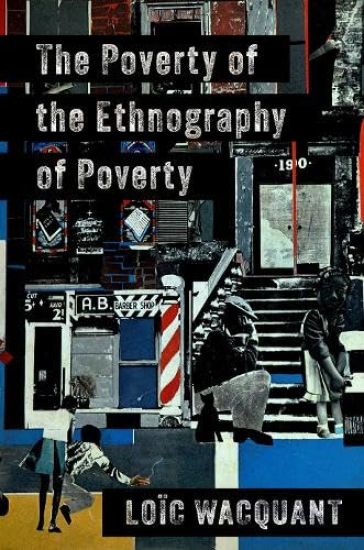
The Poverty of the Ethnography of Poverty

The Poverty of the Ethnography of Poverty

Loïc Wacquant

OXFORD UNIVERSITY PRESS INC
2025
sidottu
Recapitulating the three ages of urban ethnography born in Chicago a century ago, this book puts into historical and analytical perspective a controversy over the ethnography of the nexus of race, class, and morality in and around the black American ghetto in the age of triumphant neoliberalism, in order to draw from it positive lessons for the theory and practice of fieldwork. Thoughtless empiricism, acceptance of problematics prefabricated by ordinary and political common sense, confusion between folk and analytical categories, confinement to the immediate perimeter of interaction, bifurcating moralism: these are all traps that every ethnographer encounters sooner or later on her path and that only collective vigilance can hope to thwart. This epistemological return is an opportunity to pinpoint the danger of ethnographism, the tendency to want to describe, interpret, and explain a phenomenon based solely on the elements discerned through fieldwork, and to call for the correlative practice of an enactive, structural, and historicized ethnography that sets out to embed the micro-actions observed in the interlocking series of nested social spaces that shape them and give them sense. Such an ethnography allows us to avoid falling into one or another of the five fallacies of participant observation: interactionism, inductivism, populism, presentism, and the hermeneutic drift. And to move beyond Clifford Geertz's "thick description" with the "thick construction" inspired by Pierre Bourdieu, whose mission is to construct scientifically the ordinary social construction of reality.
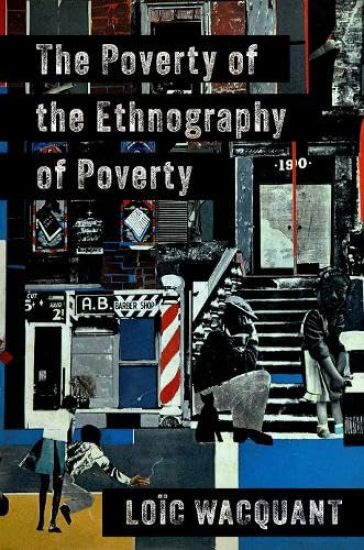
The Poverty of the Ethnography of Poverty

The Poverty of the Ethnography of Poverty

Loïc Wacquant

OXFORD UNIVERSITY PRESS INC
2025
nidottu
Recapitulating the three ages of urban ethnography born in Chicago a century ago, this book puts into historical and analytical perspective a controversy over the ethnography of the nexus of race, class, and morality in and around the black American ghetto in the age of triumphant neoliberalism, in order to draw from it positive lessons for the theory and practice of fieldwork. Thoughtless empiricism, acceptance of problematics prefabricated by ordinary and political common sense, confusion between folk and analytical categories, confinement to the immediate perimeter of interaction, bifurcating moralism: these are all traps that every ethnographer encounters sooner or later on her path and that only collective vigilance can hope to thwart. This epistemological return is an opportunity to pinpoint the danger of ethnographism, the tendency to want to describe, interpret, and explain a phenomenon based solely on the elements discerned through fieldwork, and to call for the correlative practice of an enactive, structural, and historicized ethnography that sets out to embed the micro-actions observed in the interlocking series of nested social spaces that shape them and give them sense. Such an ethnography allows us to avoid falling into one or another of the five fallacies of participant observation: interactionism, inductivism, populism, presentism, and the hermeneutic drift. And to move beyond Clifford Geertz's "thick description" with the "thick construction" inspired by Pierre Bourdieu, whose mission is to construct scientifically the ordinary social construction of reality.
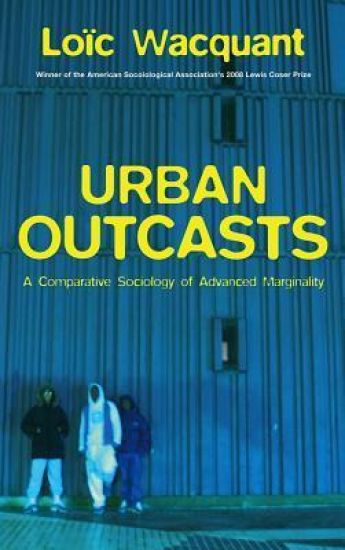
Urban Outcasts

Urban Outcasts

Loïc Wacquant

Polity Press
2007
sidottu
Breaking with the exoticizing cast of public discourse and conventional research, Urban Outcasts takes the reader inside the black ghetto of Chicago and the deindustrializing banlieue of Paris to discover that urban marginality is not everywhere the same. Drawing on a wealth of original field, survey and historical data, Loïc Wacquant shows that the involution of America's urban core after the 1960s is due not to the emergence of an 'underclass', but to the joint withdrawal of market and state fostered by public policies of racial separation and urban abandonment. In European cities, by contrast, the spread of districts of 'exclusion' does not herald the formation of ghettos. It stems from the decomposition of working-class territories under the press of mass unemployment, the casualization of work and the ethnic mixing of populations hitherto segregated, spawning urban formations akin to 'anti-ghettos'. Comparing the US 'Black Belt' with the French 'Red Belt' demonstrates that state structures and policies play a decisive role in the articulation of class, race and place on both sides of the Atlantic. It also reveals the crystallization of a new regime of marginality fuelled by the fragmentation of wage labour, the retrenchment of the social state and the concentration of dispossessed categories in stigmatized areas bereft of a collective idiom of identity and claims-making. These defamed districts are not just the residual 'sinkholes' of a bygone economic era, but also the incubators of the precarious proletariat emerging under neoliberal capitalism. Urban Outcasts sheds new light on the explosive mix of mounting misery, stupendous affluence and festering street violence resurging in the big cities of the First World. By specifying the different causal paths and experiential forms assumed by relegation in the American and the French metropolis, this book offers indispensable tools for rethinking urban marginality and for reinvigorating the public debate over social inequality and citizenship at century's dawn.
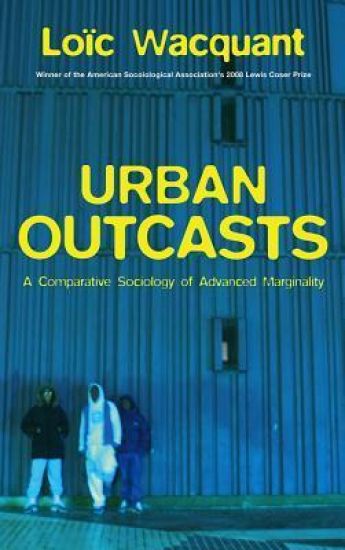
Urban Outcasts

Urban Outcasts

Loïc Wacquant

Polity Press
2007
nidottu
Breaking with the exoticizing cast of public discourse and conventional research, Urban Outcasts takes the reader inside the black ghetto of Chicago and the deindustrializing banlieue of Paris to discover that urban marginality is not everywhere the same. Drawing on a wealth of original field, survey and historical data, Loïc Wacquant shows that the involution of America's urban core after the 1960s is due not to the emergence of an 'underclass', but to the joint withdrawal of market and state fostered by public policies of racial separation and urban abandonment. In European cities, by contrast, the spread of districts of 'exclusion' does not herald the formation of ghettos. It stems from the decomposition of working-class territories under the press of mass unemployment, the casualization of work and the ethnic mixing of populations hitherto segregated, spawning urban formations akin to 'anti-ghettos'. Comparing the US 'Black Belt' with the French 'Red Belt' demonstrates that state structures and policies play a decisive role in the articulation of class, race and place on both sides of the Atlantic. It also reveals the crystallization of a new regime of marginality fuelled by the fragmentation of wage labour, the retrenchment of the social state and the concentration of dispossessed categories in stigmatized areas bereft of a collective idiom of identity and claims-making. These defamed districts are not just the residual 'sinkholes' of a bygone economic era, but also the incubators of the precarious proletariat emerging under neoliberal capitalism. Urban Outcasts sheds new light on the explosive mix of mounting misery, stupendous affluence and festering street violence resurging in the big cities of the First World. By specifying the different causal paths and experiential forms assumed by relegation in the American and the French metropolis, this book offers indispensable tools for rethinking urban marginality and for reinvigorating the public debate over social inequality and citizenship at century's dawn.
Prisons of Poverty

Prisons of Poverty

Loïc Wacquant

University of Minnesota Press
2010
nidottu
An international best seller dissects the globalization of penal policies “made in U.S.A.” as part of the spread of neoliberalismIn the early 1990s, Mayor Rudolph Giuliani launched a zero-tolerance campaign aimed at street disorders and petty offenders, incarnated in the infamous “squeegee man.” New York City soon became a planetary showcase for an aggressive approach to law enforcement that, despite its extravagant costs and the absence of connection to the crime drop, came to be admired and imitated by other cities in the United States, Western Europe, and Latin America.In Prisons of Poverty, Loïc Wacquant tracks the incubation and internationalization of the slogans, theories, and measures composing this new punitive “common sense,” fashioned to curb mounting urban inequality and marginality in the metropolis. He finds that a network of Reagan-era conservative think tanks (led by the Manhattan Institute) forged them as weapons in their crusade to dismantle the welfare state and, in effect, to criminalize poverty. He traces their import and export through the agency of the media and the pro-market policy institutes that have mushroomed across the European Union, particularly in Tony Blair’s Britain. And he shows how academics helped smuggle U.S. techniques of penalization into their countries by dressing them up in scholarly garb.Now available in English for the first time in an expanded edition, Prisons of Poverty reveals how the Washington consensus on economic deregulation and welfare retrenchment was extended to encompass punitive crime control because the invisible hand of the market necessitates and calls forth the iron fist of the penal state.
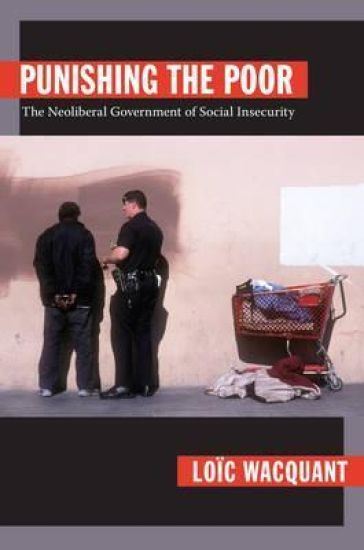
Punishing the Poor

Punishing the Poor

Loïc Wacquant

Duke University Press
2009
sidottu
The punitive turn of penal policy in the United States after the acme of the Civil Rights movement responds not to rising criminal insecurity but to the social insecurity spawned by the fragmentation of wage labor and the shakeup of the ethnoracial hierarchy. It partakes of a broader reconstruction of the state wedding restrictive “workfare” and expansive “prisonfare” under a philosophy of moral behaviorism. This paternalist program of penalization of poverty aims to curb the urban disorders wrought by economic deregulation and to impose precarious employment on the postindustrial proletariat. It also erects a garish theater of civic morality on whose stage political elites can orchestrate the public vituperation of deviant figures-the teenage “welfare mother,” the ghetto “street thug,” and the roaming “sex predator”-and close the legitimacy deficit they suffer when they discard the established government mission of social and economic protection. By bringing developments in welfare and criminal justice into a single analytic framework attentive to both the instrumental and communicative moments of public policy, Punishing the Poor shows that the prison is not a mere technical implement for law enforcement but a core political institution. And it reveals that the capitalist revolution from above called neoliberalism entails not the advent of “small government” but the building of an overgrown and intrusive penal state deeply injurious to the ideals of democratic citizenship.Visit the author’s website.
Punishing the Poor

Punishing the Poor

Loïc Wacquant

Duke University Press
2009
pokkari
The punitive turn of penal policy in the United States after the acme of the Civil Rights movement responds not to rising criminal insecurity but to the social insecurity spawned by the fragmentation of wage labor and the shakeup of the ethnoracial hierarchy. It partakes of a broader reconstruction of the state wedding restrictive “workfare” and expansive “prisonfare” under a philosophy of moral behaviorism. This paternalist program of penalization of poverty aims to curb the urban disorders wrought by economic deregulation and to impose precarious employment on the postindustrial proletariat. It also erects a garish theater of civic morality on whose stage political elites can orchestrate the public vituperation of deviant figures-the teenage “welfare mother,” the ghetto “street thug,” and the roaming “sex predator”-and close the legitimacy deficit they suffer when they discard the established government mission of social and economic protection. By bringing developments in welfare and criminal justice into a single analytic framework attentive to both the instrumental and communicative moments of public policy, Punishing the Poor shows that the prison is not a mere technical implement for law enforcement but a core political institution. And it reveals that the capitalist revolution from above called neoliberalism entails not the advent of “small government” but the building of an overgrown and intrusive penal state deeply injurious to the ideals of democratic citizenship.Visit the author’s website.
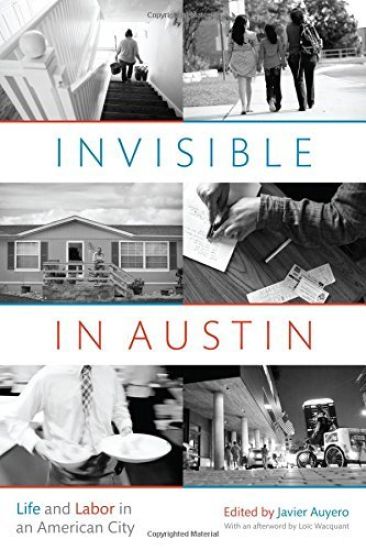
Invisible in Austin

Invisible in Austin

Loïc Wacquant

University of Texas Press
2015
nidottu
Austin, Texas, is renowned as a high-tech, fast-growing city for the young and creative, a cool place to live, and the scene of internationally famous events such as SXSW and Formula 1. But as in many American cities, poverty and penury are booming along with wealth and material abundance in contemporary Austin. Rich and poor residents lead increasingly separate lives as growing socioeconomic inequality underscores residential, class, racial, and ethnic segregation.In Invisible in Austin, the award-winning sociologist Javier Auyero and a team of graduate students explore the lives of those working at the bottom of the social order: house cleaners, office-machine repairers, cab drivers, restaurant cooks and dishwashers, exotic dancers, musicians, and roofers, among others. Recounting their subjects’ life stories with empathy and sociological insight, the authors show us how these lives are driven by a complex mix of individual and social forces. These poignant stories compel us to see how poor people who provide indispensable services for all city residents struggle daily with substandard housing, inadequate public services and schools, and environmental risks. Timely and essential reading, Invisible in Austin makes visible the growing gap between rich and poor that is reconfiguring the cityscape of one of America’s most dynamic places, as low-wage workers are forced to the social and symbolic margins.
The Invention of the 'Underclass'

The Invention of the 'Underclass'

Loïc Wacquant

JOHN WILEY AND SONS LTD
2022
sidottu
At century’s close, American social scientists, policy analysts, philanthropists and politicians became obsessed with a fearsome and mysterious new group said to be ravaging the ghetto: the urban “underclass.” Soon the scarecrow category and its demonic imagery were exported to the United Kingdom and continental Europe and agitated the international study of exclusion in the postindustrial metropolis. In this punchy book, Loïc Wacquant retraces the invention and metamorphoses of this racialized folk devil, from the structural conception of Swedish economist Gunnar Myrdal to the behavioral notion of Washington think-tank experts to the neo-ecological formulation of sociologist William Julius Wilson. He uncovers the springs of the sudden irruption, accelerated circulation, and abrupt evaporation of the “underclass” from public debate, and reflects on the implications for the social epistemology of urban marginality. What accounts for the “lemming effect” that drew a generation of scholars of race and poverty over a scientific cliff? What are the conditions for the formation and bursting of “conceptual speculative bubbles”? What is the role of think tanks, journalism, and politics in imposing “turnkey problematics” upon social researchers? What are the special quandaries posed by the naming of dispossessed and dishonored populations in scientific discourse and how can we reformulate the explosive question of “race” to avoid these troubles? Answering these questions constitutes an exacting exercise in epistemic reflexivity in the tradition of Bachelard, Canguilhem and Bourdieu, and it issues in a clarion call for social scientists to defend their intellectual autonomy against the encroachments of outside powers, be they state officials, the media, think tanks, or philanthropic organizations. Compact, meticulous and forcefully argued, this study in the politics of social science knowledge will be of great interest to students and scholars in sociology, anthropology, urban studies, ethnic studies, geography, intellectual history, the philosophy of science and public policy.
The Invention of the 'Underclass'

The Invention of the 'Underclass'

Loïc Wacquant

JOHN WILEY AND SONS LTD
2022
nidottu
At century’s close, American social scientists, policy analysts, philanthropists and politicians became obsessed with a fearsome and mysterious new group said to be ravaging the ghetto: the urban “underclass.” Soon the scarecrow category and its demonic imagery were exported to the United Kingdom and continental Europe and agitated the international study of exclusion in the postindustrial metropolis. In this punchy book, Loïc Wacquant retraces the invention and metamorphoses of this racialized folk devil, from the structural conception of Swedish economist Gunnar Myrdal to the behavioral notion of Washington think-tank experts to the neo-ecological formulation of sociologist William Julius Wilson. He uncovers the springs of the sudden irruption, accelerated circulation, and abrupt evaporation of the “underclass” from public debate, and reflects on the implications for the social epistemology of urban marginality. What accounts for the “lemming effect” that drew a generation of scholars of race and poverty over a scientific cliff? What are the conditions for the formation and bursting of “conceptual speculative bubbles”? What is the role of think tanks, journalism, and politics in imposing “turnkey problematics” upon social researchers? What are the special quandaries posed by the naming of dispossessed and dishonored populations in scientific discourse and how can we reformulate the explosive question of “race” to avoid these troubles? Answering these questions constitutes an exacting exercise in epistemic reflexivity in the tradition of Bachelard, Canguilhem and Bourdieu, and it issues in a clarion call for social scientists to defend their intellectual autonomy against the encroachments of outside powers, be they state officials, the media, think tanks, or philanthropic organizations. Compact, meticulous and forcefully argued, this study in the politics of social science knowledge will be of great interest to students and scholars in sociology, anthropology, urban studies, ethnic studies, geography, intellectual history, the philosophy of science and public policy.
Bourdieu in the City

Bourdieu in the City

Loïc Wacquant

JOHN WILEY AND SONS LTD
2023
sidottu
Building on three decades of comparative research on marginality, ethnicity, and penality in the postindustrial metropolis, Loïc Wacquant offers a novel interpretation of Pierre Bourdieu as urban theorist. He invites us to explore the city through what he calls the trialectic of symbolic space (the mental categories through which we perceive and organize the world), social space (the distribution of capital in its different forms), and physical space (the built environment). On this reading, Bourdieu's topological sociology gives us the tools both to energize and also to challenge the canon of urban studies and to redraw their theoretical landscape. Compact and incisive, Bourdieu in the City will be of interest to students and scholars in sociology, anthropology, geography, urban studies, urban planning, architecture, and social theory.
Bourdieu in the City

Bourdieu in the City

Loïc Wacquant

JOHN WILEY AND SONS LTD
2023
nidottu
Building on three decades of comparative research on marginality, ethnicity, and penality in the postindustrial metropolis, Loïc Wacquant offers a novel interpretation of Pierre Bourdieu as urban theorist. He invites us to explore the city through what he calls the trialectic of symbolic space (the mental categories through which we perceive and organize the world), social space (the distribution of capital in its different forms), and physical space (the built environment). On this reading, Bourdieu's topological sociology gives us the tools both to energize and also to challenge the canon of urban studies and to redraw their theoretical landscape. Compact and incisive, Bourdieu in the City will be of interest to students and scholars in sociology, anthropology, geography, urban studies, urban planning, architecture, and social theory.
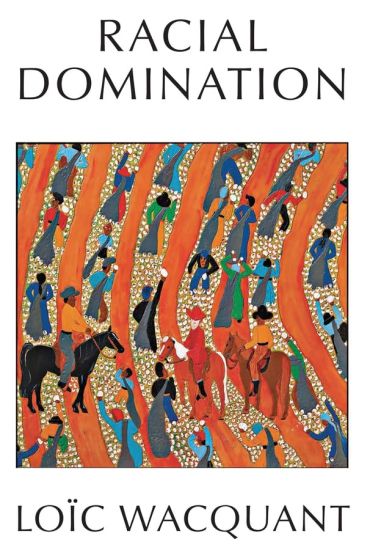
Racial Domination

Racial Domination

Loïc Wacquant

JOHN WILEY AND SONS LTD
2024
sidottu
Race is arguably the single most troublesome and volatile concept of the social sciences in the early 21st century. It is invoked to explain all manner of historical phenomena and current issues, from slavery to police brutality to acute poverty, and it is also used as a term of civic denunciation and moral condemnation. In this erudite and incisive book based on a panoramic mining of comparative and historical research from around the globe, Loïc Wacquant pours cold analytical water on this hot topic and infuses it with epistemological clarity, conceptual precision, and empirical breadth.Drawing on Gaston Bachelard, Max Weber, and Pierre Bourdieu, Wacquant first articulates a series of reframings, starting with dislodging the United States from its Archimedean position, in order to capture race-making as a form of symbolic violence. He then forges a set of novel concepts to rethink the nexus of racial classification and stratification: the continuum of ethnicity and race as disguised ethnicity, the diagonal of racialization and the pentad of ethnoracial domination, the checkerboard of violence and the dialectic of salience and consequentiality. This enables him to elaborate a meticulous critique of such fashionable notions as “structural racism” and “racial capitalism” that promise much but deliver little due to their semantic ambiguity and rhetorical malleability—notions that may even hamper the urgent fight against racial inequality.Wacquant turns to deploying this conceptual framework to dissect two formidable institutions of ethnoracial rule in America: Jim Crow and the prison. He draws on ethnographies and historiographies of white domination in the postbellum South to construct a robust analytical concept of Jim Crow as caste terrorism erected in the late 19th century. He unravels the deadly symbiosis between the black hyperghetto and the carceral archipelago that has coproduced and entrenched the material and symbolic marginality of the African-American precariat in the metropolis of the late 20th century. Wacquant concludes with reflections on the politics of knowledge and pointers on the vexed question of the relationship between social epistemology and racial justice.Both sharply focused and wide ranging, synthetic yet controversial, Racial Domination will be of interest to students and scholars of race and ethnicity, power and inequality, and epistemology and theory across the social sciences and humanities.
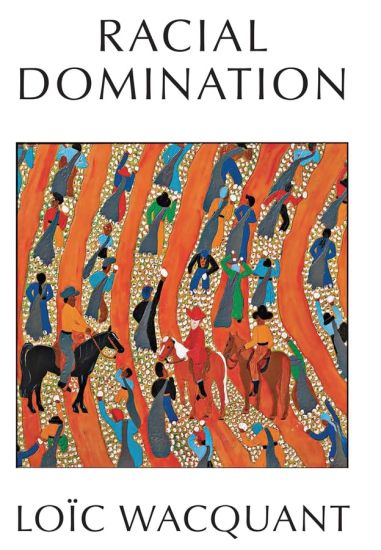
Racial Domination

Racial Domination

Loïc Wacquant

JOHN WILEY AND SONS LTD
2024
nidottu
Race is arguably the single most troublesome and volatile concept of the social sciences in the early 21st century. It is invoked to explain all manner of historical phenomena and current issues, from slavery to police brutality to acute poverty, and it is also used as a term of civic denunciation and moral condemnation. In this erudite and incisive book based on a panoramic mining of comparative and historical research from around the globe, Loïc Wacquant pours cold analytical water on this hot topic and infuses it with epistemological clarity, conceptual precision, and empirical breadth.Drawing on Gaston Bachelard, Max Weber, and Pierre Bourdieu, Wacquant first articulates a series of reframings, starting with dislodging the United States from its Archimedean position, in order to capture race-making as a form of symbolic violence. He then forges a set of novel concepts to rethink the nexus of racial classification and stratification: the continuum of ethnicity and race as disguised ethnicity, the diagonal of racialization and the pentad of ethnoracial domination, the checkerboard of violence and the dialectic of salience and consequentiality. This enables him to elaborate a meticulous critique of such fashionable notions as “structural racism” and “racial capitalism” that promise much but deliver little due to their semantic ambiguity and rhetorical malleability—notions that may even hamper the urgent fight against racial inequality.Wacquant turns to deploying this conceptual framework to dissect two formidable institutions of ethnoracial rule in America: Jim Crow and the prison. He draws on ethnographies and historiographies of white domination in the postbellum South to construct a robust analytical concept of Jim Crow as caste terrorism erected in the late 19th century. He unravels the deadly symbiosis between the black hyperghetto and the carceral archipelago that has coproduced and entrenched the material and symbolic marginality of the African-American precariat in the metropolis of the late 20th century. Wacquant concludes with reflections on the politics of knowledge and pointers on the vexed question of the relationship between social epistemology and racial justice.Both sharply focused and wide ranging, synthetic yet controversial, Racial Domination will be of interest to students and scholars of race and ethnicity, power and inequality, and epistemology and theory across the social sciences and humanities.
Die Verdammten der Stadt

Die Verdammten der Stadt

Loïc Wacquant

Springer vs
2017
nidottu
Die Verdammten der Stadt führt uns mitten ins schwarze Ghetto im Inneren Chicagos und in die sich deindustrialisierende Banlieue in den Außenzonen von Paris und entdeckt, dass städtische Marginalität nicht überall gleich ist. Auf Grundlage von Feld-, statistischen und historischen Daten zeigt Wacquant, dass die Rückbildung der innerstädtischen Gebiete in den Vereinigten Staaten im Anschluss an die 1960er Jahre nicht durch die Entstehung einer underclass erklärt werden kann, sondern durch den gemeinsamen Rückzug von Markt und Staat, der von einer staatlichen Politik der Rassentrennung und der Aufgabe der Städte gefördert wurde. In den europäischen Städten dagegen läutet die Ausbreitung von „Problemquartieren“ nicht die Entstehung von Ghettos amerikanischen Stils ein. Sie rührt vielmehr von der Zersetzung der Arbeiterklassegebiete, von Massenarbeitslosigkeit, der Prekarisierung von Beschäftigung und der ethnischen Durchmischung von bislang getrennten Populationen, wodurch städtische Formationen hervorgebracht wurden, die eher „Anti-Ghettos“ sind.Der Vergleich zwischen dem US-amerikanischen „Schwarzen Gürtel“ und dem „Roten Gürtel“ Frankreichs zeigt, dass staatliche Strukturen und Politiken eine entscheidende Rolle bei der Artikulation von Klasse, Rasse und Raum auf beiden Seiten des Atlantiks spielen. Er zeigt auch die Kristallisation eines neuen Regimes von Marginalität, die von der Fragmentierung der Erwerbsarbeit, dem Rückzug des Sozialstaates und der Konzentration benachteiligter sozialer Kategorien in stigmatisierten Distrikten angeheizt wird, die über kein kollektives Idiom der Identität verfügen. Diese diffamierten Bezirke sind nicht nur die Senkgruben einer vergangenen ökonomischen Ära, sondern auch die Brutstädte des Prekariats im Zeitalter des neoliberalen Kapitalismus.