Kirjojen hintavertailu. Mukana 12 377 406 kirjaa ja 12 kauppaa.

Kirjahaku

Etsi kirjoja tekijän nimen, kirjan nimen tai ISBN:n perusteella.

12 kirjaa tekijältä Lorenzo Valla

The Treatise Of Lorenzo Valla On The Donation Of Constantine
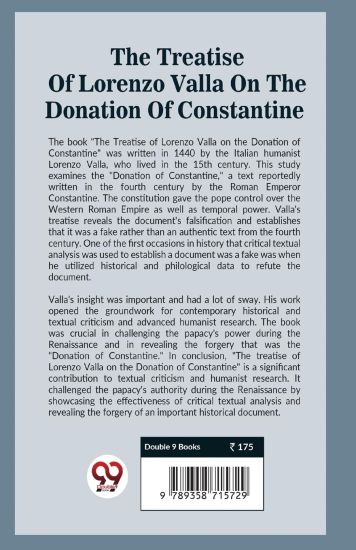
The book "The Treatise of Lorenzo Valla on the Donation of Constantine" was written in 1440 by the Italian humanist Lorenzo Valla, who lived in the 15th century. This study examines the "Donation of Constantine," a text reportedly written in the fourth century by the Roman Emperor Constantine. The constitution gave the pope control over the Western Roman Empire as well as temporal power. Valla's treatise reveals the document's falsification and establishes that it was a fake rather than an authentic text from the fourth century. One of the first occasions in history that critical textual analysis was used to establish a document was a fake was when he utilized historical and philological data to refute the document. Valla's insight was important and had a lot of sway. His work opened the groundwork for contemporary historical and textual criticism and advanced humanist research. The book was crucial in challenging the papacy's power during the Renaissance and in revealing the forgery that was the "Donation of Constantine." In conclusion, "The treatise of Lorenzo Valla on the Donation of Constantine" is a significant contribution to textual criticism and humanist research. It challenged the papacy's authority during the Renaissance by showcasing the effectiveness of critical textual analysis and revealing the forgery of an important historical document.
On the Donation of Constantine

On the Donation of Constantine

Lorenzo Valla

Harvard University Press
2007
sidottu
Lorenzo Valla (1407-1457) was the most important theorist of the humanist movement. He wrote a major work on Latin style, On Elegance in the Latin Language, which became a battle-standard in the struggle for the reform of Latin across Europe, and Dialectical Disputations, a wide-ranging attack on scholastic logic. His most famous work is On the Donation of Constantine, an oration in which Valla uses new philological methods to attack the authenticity of the most important document justifying the papacy's claims to temporal rule. It appears here in a new translation with introduction and notes by G. W. Bowersock, based on the critical text of Wolfram Setz (1976). This volume also includes a text and translation of the Constitutum Constantini, commonly known as the Donation of Constantine.
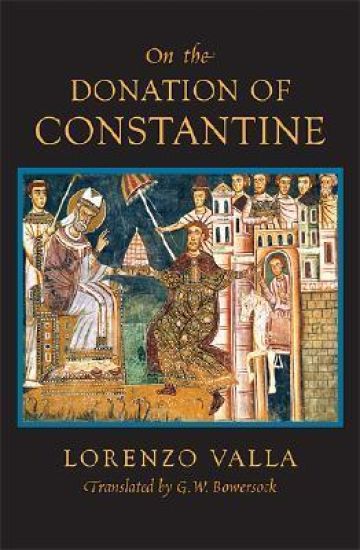
On the Donation of Constantine

On the Donation of Constantine

Lorenzo Valla

Harvard University Press
2008
nidottu
Lorenzo Valla (1407–1457) was the leading theorist of the Renaissance humanist movement and the author of major works on Latin style, scholastic logic, and other topics. In On the Donation of Constantine he uses new philological methods to attack the authenticity of the most important document justifying the papacy’s claims to temporal rule, in a brilliant analysis that is often seen as marking the beginning of modern textual criticism. Widely translated throughout Europe during the Reformation, the work was placed on the Church’s Index of Prohibited Books. This volume provides a new translation with introduction and notes by G. W. Bowersock, commissioned for the I Tatti Renaissance Library, along with a translation of the Donation of Constantine document itself.
Dialectical Disputations

Dialectical Disputations

Lorenzo Valla

Harvard University Press
2012
sidottu
Lorenzo Valla (1407–1457) ranks among the greatest scholars and thinkers of the Renaissance. He secured lasting fame for his brilliant critical skills, most famously in his exposure of the “Donation of Constantine,” the forged document upon which the papacy based claims to political power. Lesser known in the English-speaking world is Valla’s work in the philosophy of language—the basis of his reputation as the greatest philosopher of the humanist movement.Dialectical Disputations, translated here for the first time into any modern language, is his principal contribution to the philosophy of language and logic. With this savage attack on the scholastic tradition of Aristotelian logic, Valla aimed to supersede it with a new logic based on the actual historical usage of classical Latin and on a commonsense approach to semantics and argument. Valla provides a logic that could be used by lawyers, preachers, statesmen, and others who needed to succeed in public debate—one that was stylistically correct and rhetorically elegant, and thus could dispense with the technical language of the scholastics, a “tribe of Peripatetics, perverters of natural meanings.” Valla’s reformed dialectic became a milestone in the development of humanist logic and contains startling anticipations of modern theories of semantics and language.Volume 1 contains Book I, in which Valla refutes Aristotle’s logical works on the categories, transcendentals, and predicables, with excursions into natural and moral philosophy and theology.
Dialectical Disputations

Dialectical Disputations

Lorenzo Valla

Harvard University Press
2012
sidottu
Lorenzo Valla (1407–1457) ranks among the greatest scholars and thinkers of the Renaissance. He secured lasting fame for his brilliant critical skills, most famously in his exposure of the “Donation of Constantine,” the forged document upon which the papacy based claims to political power. Lesser known in the English-speaking world is Valla’s work in the philosophy of language—the basis of his reputation as the greatest philosopher of the humanist movement.Dialectical Disputations, translated here for the first time into any modern language, is his principal contribution to the philosophy of language and logic. With this savage attack on the scholastic tradition of Aristotelian logic, Valla aimed to supersede it with a new logic based on the actual historical usage of classical Latin and on a commonsense approach to semantics and argument. Valla provides a logic that could be used by lawyers, preachers, statesmen, and others who needed to succeed in public debate—one that was stylistically correct and rhetorically elegant, and thus could dispense with the technical language of the scholastics, a “tribe of Peripatetics, perverters of natural meanings.” Valla’s reformed dialectic became a milestone in the development of humanist logic and contains startling anticipations of modern theories of semantics and language.Volume 2 contains Books II–III, in which Valla refutes Aristotle’s logical works on propositions, topics, and the syllogistic.
Correspondence

Correspondence

Lorenzo Valla

Harvard University Press
2014
sidottu
Lorenzo Valla (1406-1457) was the leading philologist of the first half of the fifteenth century, as well as a philosopher, theologian, and translator. His extant Latin letters are fewer than those of many of his contemporaries, since he never collected or consciously preserved them. For that reason they afford a direct and unguarded window into the working life of the most passionate, difficult, and interesting of the Italian humanists. They show him as a teacher and secretary, but above all as a writer who continually worked and reworked his major contributions to dialectic and philology, notably his masterpiece on the Elegances of the Latin Language, a central text of the Renaissance. More plentiful are the letters of others to him, which place him at the center of a humanist network that extended from Venice to Naples. They also shed light on the furious polemics in which he involved himself. These letters, including one previously unpublished, are now edited for the first time alongside Valla's own correspondence. The translation is the first into any modern language.
Sur Le Plaisir

Sur Le Plaisir

Lorenzo Valla

Encre Marine
2004
sidottu
Finalement, je n'aurai aucun scrupule et pendant que je poursuis le plaisir, je ne regarderai rien d'autre, de telle sorte que je n'aurai de respect pas meme pour les religieuses et les moniales, que meme Ovide n'osa pas injurier, recommandant aux femmes mariees et soumises: Loin d'ici, etroites bandelettes, insigne de la pudeur, et toi aussi, robe longue, qui couvres la moitie des pieds.Je ne me soucie pas de ce qu'a dit Ovide car a mon avis, il a parle autrement qu'il a pense. Pour ma part - vois avec quelle liberte et quelle licence je replique -, j'avance ceci: celui qui le premier a invente le statut de religieuse, a introduit une coutume abominable qu'il faut faire reculer vers les confins de la terre; bien qu'ils s'attachent au terme de religion, qui est davantage superstition, bien qu'ils les appellent des religieuses et des moniales, bien qu'ils souhaitent pour ce fait l'autorite de Pythagore, dont la fille, d'apres Timee, fut vouee a un choeur de vierges et souhaitent celle de Diodore le socratique dont les cinq filles admirables pour leur pudeur ont ete citees par Philon, maitre de Carneade. Cependant je dirai le fond de ma pensee: les courtisanes et les prostituees honorent davantage le genre humain que les femmes sages et sanctifiees.