Kirjojen hintavertailu. Mukana 11 342 296 kirjaa ja 12 kauppaa.

Kirjahaku

Etsi kirjoja tekijän nimen, kirjan nimen tai ISBN:n perusteella.

4 kirjaa tekijältä Louis A. Gottschalk

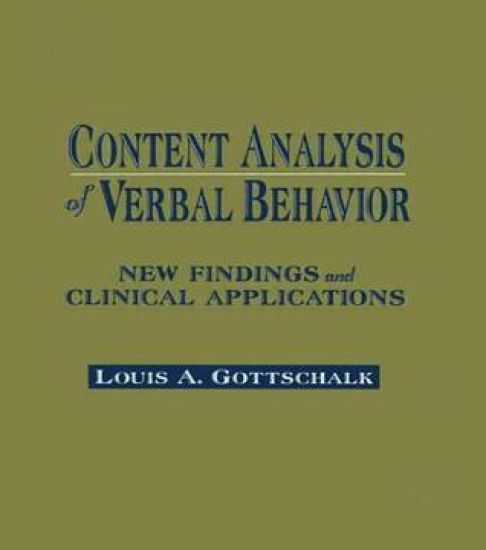
Content Analysis of Verbal Behavior

Content Analysis of Verbal Behavior

Louis A. Gottschalk

Routledge Member of the Taylor and Francis Group
1995
sidottu
Focusing on language and the assessment of its meaning, this volume concentrates on a method of content analysis developed by the author and Goldine Gleser. Applicable to transcripts of speech or verbal texts, this method uses the grammatical clause as its smallest unit of communication, considers whether or not a verb is transitive and involves an object, or is intransitive and describes a state of being. It derives scores on many scales that have been tested for reliability of scoring and for construct validity with concurrently administered measures, such as rating and self-report scales as well as biochemical and pharmacological criteria. Finally, this volume provides detailed descriptions of the clinical and basic research establishing the validity of these scales, so that a reader can locate studies that have pertinence to any special interest area. A major achievement described in this book is the development of computer software that understands grammar and syntax, can parse natural language, knows most of the words in the Merriam-Webster dictionary, has been taught to identify idioms and slang, and is capable of continuing to learn. The program can score all the scales, report whether the scores obtained from a verbal sample are one to three standard deviations from the norms, and suggest APA DSM-IIIR diagnostic classifications the clinician might consider in assessing the patient.

Content Analysis of Verbal Behavior

Content Analysis of Verbal Behavior

Louis A. Gottschalk

Routledge
2016
nidottu
Focusing on language and the assessment of its meaning, this volume concentrates on a method of content analysis developed by the author and Goldine Gleser. Applicable to transcripts of speech or verbal texts, this method uses the grammatical clause as its smallest unit of communication, considers whether or not a verb is transitive and involves an object, or is intransitive and describes a state of being. It derives scores on many scales that have been tested for reliability of scoring and for construct validity with concurrently administered measures, such as rating and self-report scales as well as biochemical and pharmacological criteria. Finally, this volume provides detailed descriptions of the clinical and basic research establishing the validity of these scales, so that a reader can locate studies that have pertinence to any special interest area. A major achievement described in this book is the development of computer software that understands grammar and syntax, can parse natural language, knows most of the words in the Merriam-Webster dictionary, has been taught to identify idioms and slang, and is capable of continuing to learn. The program can score all the scales, report whether the scores obtained from a verbal sample are one to three standard deviations from the norms, and suggest APA DSM-IIIR diagnostic classifications the clinician might consider in assessing the patient.
Methods of Research in Psychotherapy

Methods of Research in Psychotherapy

Louis A. Gottschalk

Springer-Verlag New York Inc.
2012
nidottu
The prospective reader may well ask about the particular merits of this volume, especially in view of several dozen similar offerings, each with its own excellences, and of the easy availability of symposia, conferences, con­ ventional reviews, abstract journals, and serial research reports. In spite of such other attractions, it seems to me that these 34 essays are among the most informative and stimulating which are now available in the areas cov­ ered. The editors have been successful in attracting new articles from many of the most prominent investigators now actively working at research in psychotherapy, who can therefore speak for themselves about what they are doing. Several of the articles have been in the preparatory stage for numerous years. Not only do they represent the vanguard of research, but because of the introduction of relatively new concepts in communication theory in the clinical setting which can be implemented by the new tech­ nology (specifically the use of sound-films and tape), they probably presage the shape of much that is to come. It is commonplace that the history of a science is closely allied to the history of the tools available. Here we see the concepts, attitudes, and working methods on this frontier being set forth frankly and concretely in ways which avoid many of the deficiencies and evasions of previous clini­ cal research.