Kirjojen hintavertailu. Mukana 11 342 296 kirjaa ja 12 kauppaa.

Kirjahaku

Etsi kirjoja tekijän nimen, kirjan nimen tai ISBN:n perusteella.

6 kirjaa tekijältä Louis Marin

To Destroy Painting

To Destroy Painting

Louis Marin

University of Chicago Press
1995
sidottu
The work of the French cultural critic Louis Marin (1931-1992) is of importance to scholars concerned with issues of representation. This text, first published in France in 1977, presents Marin's theories about the aims of painting in Europe in the 16th and 17th centuries. A meditation on the work of Poussin and Caravaggio and on their milieux, the book explores a number of notions implied by theories of painting and offers insight into the aims and effects of visual representaion.
To Destroy Painting

To Destroy Painting

Louis Marin

University of Chicago Press
1994
nidottu
The work of the French cultural critic Louis Marin (1931-1992) is of importance to scholars concerned with issues of representation. This text, first published in France in 1977, presents Marin's theories about the aims of painting in Europe in the 16th and 17th centuries. A meditation on the work of Poussin and Caravaggio and on their milieux, the book explores a number of notions implied by theories of painting and offers insight into the aims and effects of visual representaion.
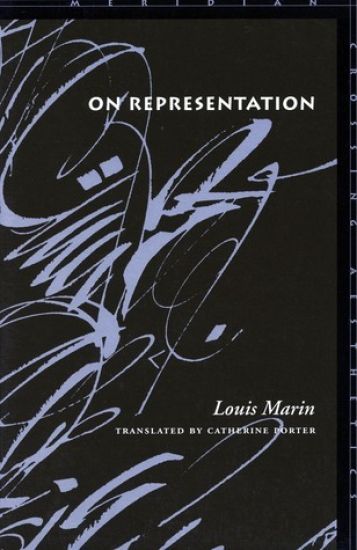
On Representation

On Representation

Louis Marin

Stanford University Press
2002
sidottu
At his death in 1992, the eminent philosopher, critic, and theorist Louis Marin left, in addition to a dozen influential books (including Sublime Poussin, Stanford, 1999), a corpus of some three hundred articles and essays published in journals and anthologies. A collection of twenty-two essays that appeared between 1971 and 1992, this book interrogates the theory and practice of representation as it is carried out by both linguistic and graphic signs, and thus the complex relation between language and image, between perception and conception. The essays are grouped in four parts that reflect the continuity and coherence of Marin's interests in semiology, narrative, visuality, and painting. The interdisciplinary horizon of the book draws on multiple scholarly resources—the cultural history of the seventeenth century, the philosophy of language, the tools of discourse analysis, the history of art and aesthetics, the analysis of reception—to address a stunning diversity of subjects ranging from historical painting through cartography to the processes of deciphering texts, interpreting stories, and reading images. Throughout the essays, Marin's reflection on representation is supported and deepened by his brilliant exegesis of graphic art. His analysis of works by Caravaggio, Philippe de Champaigne, Le Brun, and Poussin, among others, provides the armature that allows him to describe both the structural logic of representation and the intricate processes of production and reception that make it dynamic and unstable. Marin demonstrates with consummate rigor why the pursuit of a general theory of representation is experienced by artists and critics alike as an inevitable, yet unattainable objective.
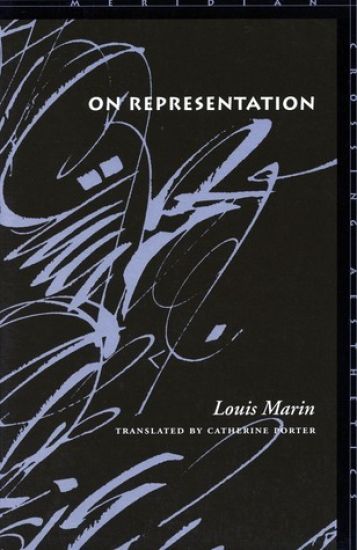
On Representation

On Representation

Louis Marin

Stanford University Press
2002
pokkari
At his death in 1992, the eminent philosopher, critic, and theorist Louis Marin left, in addition to a dozen influential books (including Sublime Poussin, Stanford, 1999), a corpus of some three hundred articles and essays published in journals and anthologies. A collection of twenty-two essays that appeared between 1971 and 1992, this book interrogates the theory and practice of representation as it is carried out by both linguistic and graphic signs, and thus the complex relation between language and image, between perception and conception. The essays are grouped in four parts that reflect the continuity and coherence of Marin's interests in semiology, narrative, visuality, and painting. The interdisciplinary horizon of the book draws on multiple scholarly resources—the cultural history of the seventeenth century, the philosophy of language, the tools of discourse analysis, the history of art and aesthetics, the analysis of reception—to address a stunning diversity of subjects ranging from historical painting through cartography to the processes of deciphering texts, interpreting stories, and reading images. Throughout the essays, Marin's reflection on representation is supported and deepened by his brilliant exegesis of graphic art. His analysis of works by Caravaggio, Philippe de Champaigne, Le Brun, and Poussin, among others, provides the armature that allows him to describe both the structural logic of representation and the intricate processes of production and reception that make it dynamic and unstable. Marin demonstrates with consummate rigor why the pursuit of a general theory of representation is experienced by artists and critics alike as an inevitable, yet unattainable objective.