Kirjojen hintavertailu. Mukana 11 244 527 kirjaa ja 12 kauppaa.

Kirjahaku

Etsi kirjoja tekijän nimen, kirjan nimen tai ISBN:n perusteella.

219 kirjaa tekijältä Lucius Annaeus Seneca

A Treatise of Clemency by Lucius Annæus Seneca the Philosopher. Address'd to Nero in the Beginning of his Reign. Done Into English by Sir Roger L'Estrange
The 18th century was a wealth of knowledge, exploration and rapidly growing technology and expanding record-keeping made possible by advances in the printing press. In its determination to preserve the century of revolution, Gale initiated a revolution of its own: digitization of epic proportions to preserve these invaluable works in the largest archive of its kind. Now for the first time these high-quality digital copies of original 18th century manuscripts are available in print, making them highly accessible to libraries, undergraduate students, and independent scholars.The Age of Enlightenment profoundly enriched religious and philosophical understanding and continues to influence present-day thinking. Works collected here include masterpieces by David Hume, Immanuel Kant, and Jean-Jacques Rousseau, as well as religious sermons and moral debates on the issues of the day, such as the slave trade. The Age of Reason saw conflict between Protestantism and Catholicism transformed into one between faith and logic -- a debate that continues in the twenty-first century.++++The below data was compiled from various identification fields in the bibliographic record of this title. This data is provided as an additional tool in helping to insure edition identification: ++++British LibraryT122170Edinburgh: printed by William Adams junior, in the year 1717, and sold at the printing-house opposite to the Trone-Church, 1717]. iv,16p.; 4
The Epistles of Lucius Annæus Seneca, Wherein, Particularly, the Tenets of the Antient Philosophers are Contrasted With the Divine Precepts of the Gospel, With Regard to the Moral Duties of Mankind. In two Volumes of 2; Volume 1
The 18th century was a wealth of knowledge, exploration and rapidly growing technology and expanding record-keeping made possible by advances in the printing press. In its determination to preserve the century of revolution, Gale initiated a revolution of its own: digitization of epic proportions to preserve these invaluable works in the largest archive of its kind. Now for the first time these high-quality digital copies of original 18th century manuscripts are available in print, making them highly accessible to libraries, undergraduate students, and independent scholars.The Age of Enlightenment profoundly enriched religious and philosophical understanding and continues to influence present-day thinking. Works collected here include masterpieces by David Hume, Immanuel Kant, and Jean-Jacques Rousseau, as well as religious sermons and moral debates on the issues of the day, such as the slave trade. The Age of Reason saw conflict between Protestantism and Catholicism transformed into one between faith and logic -- a debate that continues in the twenty-first century.++++The below data was compiled from various identification fields in the bibliographic record of this title. This data is provided as an additional tool in helping to insure edition identification: ++++British LibraryT100868In this edition, in both volumes, there is a semi-colon after "Seneca" and the imprint includes "G. G. J. and J. Robinson."London: printed by W. Woodfall; and sold by G. G. J. and J. Robinson, 1786. 2v.; 4
The Epistles of Lucius Annæus Seneca, Wherein, Particularly, the Tenets of the Antient Philosophers are Contrasted With the Divine Precepts of the Gospel, With Regard to the Moral Duties of Mankind. In two Volumes of 2; Volume 2
The 18th century was a wealth of knowledge, exploration and rapidly growing technology and expanding record-keeping made possible by advances in the printing press. In its determination to preserve the century of revolution, Gale initiated a revolution of its own: digitization of epic proportions to preserve these invaluable works in the largest archive of its kind. Now for the first time these high-quality digital copies of original 18th century manuscripts are available in print, making them highly accessible to libraries, undergraduate students, and independent scholars.The Age of Enlightenment profoundly enriched religious and philosophical understanding and continues to influence present-day thinking. Works collected here include masterpieces by David Hume, Immanuel Kant, and Jean-Jacques Rousseau, as well as religious sermons and moral debates on the issues of the day, such as the slave trade. The Age of Reason saw conflict between Protestantism and Catholicism transformed into one between faith and logic -- a debate that continues in the twenty-first century.++++The below data was compiled from various identification fields in the bibliographic record of this title. This data is provided as an additional tool in helping to insure edition identification: ++++British LibraryT100868In this edition, in both volumes, there is a semi-colon after "Seneca" and the imprint includes "G. G. J. and J. Robinson".London: printed by W. Woodfall; and sold by G. G. J. and J. Robinson, 1786. 2v.; 4
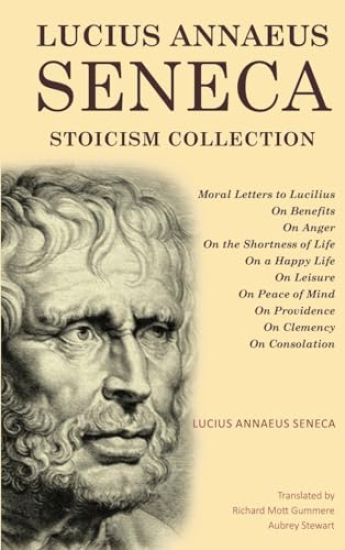
Lucius Annaeus Seneca Stoicism Collection

Lucius Annaeus Seneca Stoicism Collection

Lucius Annaeus Seneca

Classy Publishing
2023
nidottu
Lucius Annaeus Seneca, usually known as Seneca, was a Roman Stoic philosopher, statesman, and dramatist of the Silver Age of Latin literature. He was tutor and later advisor to emperor Nero, who later forced him to commit suicide for alleged complicity in the Pisonian conspiracy to have him assassinated.As a writer, Seneca is known for his philosophical works, and for his plays, which are all tragedies. His prose works include 12 essays and 124 letters dealing with moral issues. These writings constitute one of the most important bodies of primary material for ancient Stoicism.This collection of stoic essays by Lucius Annaeus Seneca, is perfect for any student of philosophy or those inclined toward the ideas of stoicism. This collection contains Seneca's 10 most famous essays including On Benefits, On Anger, On the Shortness of Life, On a Happy Life, On Leisure, On Peace of Mind, On Providence, On the Firmness of the Wise Person, On Clemency, and On Consolation.
Lucius Annaeus Seneca Stoicism Collection

Lucius Annaeus Seneca Stoicism Collection

Lucius Annaeus Seneca

Classy Publishing
2023
sidottu
Lucius Annaeus Seneca, usually known as Seneca, was a Roman Stoic philosopher, statesman, and dramatist of the Silver Age of Latin literature. He was tutor and later advisor to emperor Nero, who later forced him to commit suicide for alleged complicity in the Pisonian conspiracy to have him assassinated.As a writer, Seneca is known for his philosophical works, and for his plays, which are all tragedies. His prose works include 12 essays and 124 letters dealing with moral issues. These writings constitute one of the most important bodies of primary material for ancient Stoicism.This collection of stoic essays by Lucius Annaeus Seneca, is perfect for any student of philosophy or those inclined toward the ideas of stoicism. This collection contains Seneca's 10 most famous essays including On Benefits, On Anger, On the Shortness of Life, On a Happy Life, On Leisure, On Peace of Mind, On Providence, On the Firmness of the Wise Person, On Clemency, and On Consolation.
Select Epistles on Several Moral Subjects. Newly Translated From the Latin of L. Annæus Seneca. With Select Notes From Justus Lipsius. By a Gentleman of Christ-Church, Oxon. Part II
The 18th century was a wealth of knowledge, exploration and rapidly growing technology and expanding record-keeping made possible by advances in the printing press. In its determination to preserve the century of revolution, Gale initiated a revolution of its own: digitization of epic proportions to preserve these invaluable works in the largest archive of its kind. Now for the first time these high-quality digital copies of original 18th century manuscripts are available in print, making them highly accessible to libraries, undergraduate students, and independent scholars.The Age of Enlightenment profoundly enriched religious and philosophical understanding and continues to influence present-day thinking. Works collected here include masterpieces by David Hume, Immanuel Kant, and Jean-Jacques Rousseau, as well as religious sermons and moral debates on the issues of the day, such as the slave trade. The Age of Reason saw conflict between Protestantism and Catholicism transformed into one between faith and logic -- a debate that continues in the twenty-first century.++++The below data was compiled from various identification fields in the bibliographic record of this title. This data is provided as an additional tool in helping to insure edition identification: ++++British LibraryN036413With a half-title preceded by a preliminary leaf of contents to parts 1 and 2, and a final advertisement leaf.London: printed for C. Rivington, 1740. 4], viii,72, 2]p.; 8
The Tragedies of L. Annæus Seneca the Philosopher; viz. Medea, Phædra and Hippolytus, Troades, ... and the Rape of Helen, ... of Coluthus; Translated Into English Verse; ... To Which is Prefixed the Life and Death of Seneca
The 18th century was a wealth of knowledge, exploration and rapidly growing technology and expanding record-keeping made possible by advances in the printing press. In its determination to preserve the century of revolution, Gale initiated a revolution of its own: digitization of epic proportions to preserve these invaluable works in the largest archive of its kind. Now for the first time these high-quality digital copies of original 18th century manuscripts are available in print, making them highly accessible to libraries, undergraduate students, and independent scholars.Western literary study flows out of eighteenth-century works by Alexander Pope, Daniel Defoe, Henry Fielding, Frances Burney, Denis Diderot, Johann Gottfried Herder, Johann Wolfgang von Goethe, and others. Experience the birth of the modern novel, or compare the development of language using dictionaries and grammar discourses. ++++The below data was compiled from various identification fields in the bibliographic record of this title. This data is provided as an additional tool in helping to insure edition identification: ++++British LibraryT100883The titles of the plays are bracketted together on the titlepage following "viz." - Horizontal chain-lines. With two final advertisement leaves. Each tragedy and 'The rape of Helen' has a separate dated titlepage. A reissue, with a new titlepage, of 'TLondon: printed for S. Smith and B. Walford, 1702. 16], xxxix, 9],377, 23]p., plates: ill.port.; 8
L. Annaeus Seneca On Benefits

L. Annaeus Seneca On Benefits

Lucius Annaeus Seneca

Lector House
2020
pokkari
L. Annaeus Seneca On Benefits: Edited By Aubrey Stewart This book is a result of an effort made by us towards making a contribution to the preservation and repair of original classic literature. In an attempt to preserve, improve and recreate the original content, we have worked towards: 1. Type-setting & Reformatting: The complete work has been re-designed via professional layout, formatting and type-setting tools to re-create the same edition with rich typography, graphics, high quality images, and table elements, giving our readers the feel of holding a 'fresh and newly' reprinted and/or revised edition, as opposed to other scanned & printed (Optical Character Recognition - OCR) reproductions. 2. Correction of imperfections: As the work was re-created from the scratch, therefore, it was vetted to rectify certain conventional norms with regard to typographical mistakes, hyphenations, punctuations, blurred images, missing content/pages, and/or other related subject matters, upon our consideration. Every attempt was made to rectify the imperfections related to omitted constructs in the original edition via other references. However, a few of such imperfections which could not be rectified due to intentional\unintentional omission of content in the original edition, were inherited and preserved from the original work to maintain the authenticity and construct, relevant to the work. We believe that this work holds historical, cultural and/or intellectual importance in the literary works community, therefore despite the oddities, we accounted the work for print as a part of our continuing effort towards preservation of literary work and our contribution towards the development of the society as a whole, driven by our beliefs. We are grateful to our readers for putting their faith in us and accepting our imperfections with regard to preservation of the historical content. HAPPY READING
Seneca

Seneca

Lucius Annaeus Seneca

University of Chicago Press
2021
sidottu
In the year 62, citing health issues, the Roman philosopher Seneca withdrew from public service and devoted his time to writing. His letters from this period offer a window into his experience as a landowner, a traveler through Roman Italy, and a man coping with the onset of old age. They describe the roar of the arena, the festival of Saturnalia, and the perils of the Adriatic Sea, and they explain his thoughts about political power, the treatment of slaves, the origins of civilization, and the key points of Stoic philosophy. This selection of fifty of his letters brings Seneca to readers in a fresh modern voice and shows how, as a philosopher, he speaks to our time. Above all, these letters explore the inner life of the individual: from the life of heedless vanity to the first interest in philosophy, to true friendship, self-determination, and personal excellence.
Seneca

Seneca

Lucius Annaeus Seneca

University of Chicago Press
2021
pokkari
In the year 62, citing health issues, the Roman philosopher Seneca withdrew from public service and devoted his time to writing. His letters from this period offer a window into his experience as a landowner, a traveler through Roman Italy, and a man coping with the onset of old age. They describe the roar of the arena, the festival of Saturnalia, and the perils of the Adriatic Sea, and they explain his thoughts about political power, the treatment of slaves, the origins of civilization, and the key points of Stoic philosophy. This selection of fifty of his letters brings Seneca to readers in a fresh modern voice and shows how, as a philosopher, he speaks to our time. Above all, these letters explore the inner life of the individual: from the life of heedless vanity to the first interest in philosophy, to true friendship, self-determination, and personal excellence.
The Stoic Philosophy of Seneca: Essays and Letters

The Stoic Philosophy of Seneca: Essays and Letters

Lucius Annaeus Seneca

W. W. Norton Company
1968
nidottu
In The Stoic Philosophy of Seneca, representative selections from Seneca's writings offer the reader an excellent introduction to the range of his work. The selections are drawn from the essays, or dialogues, and the "Consolations;" from the treatises, of which "On Clemency," addressed to the young Nero, is included here; and from the Letters to Lucilius, which have to do not only with philosophical subjects but also with Seneca's personal experiences, such as journeys and visits. Moses Hadas has selected letters and essays which reveal Seneca's major philosophical themes--the relationship of the individual to society and to the gods; the meaning of pain and misfortune; man's attitudes to change, time, and death; and the nature of the highest good and of the happy life. In his Introduction, Professor Hadas discusses Seneca's life and work, tracing the history of his reputation; comments on Seneca's style; and outlines the origins and tenets of Stoicism.