Kirjojen hintavertailu. Mukana 11 717 486 kirjaa ja 12 kauppaa.

Kirjahaku

Etsi kirjoja tekijän nimen, kirjan nimen tai ISBN:n perusteella.

13 kirjaa tekijältä Ludwig Huber

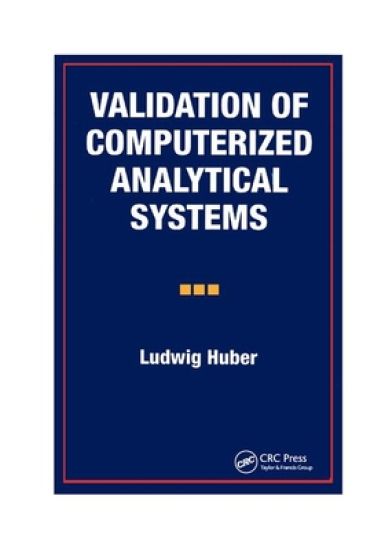
Validation of Computerized Analytical Systems
Validation of Computerized Analytical and Networked Systems provides the definitive rationales, logic, and methodology for validation of computerized analytical systems. Whether you are involved with formulation or analytical development laboratories, chemical or microbiological quality control laboratories, LIMS installations, or any aspect of robotic in a healthcare laboratory, this book furnishes complete validation details. International and FDA regulations and requirements are discussed and juxtaposed with numerous practical examples that show you how to cost-effectively and efficiently accomplish validation acceptable to FDA GCP/GLP/GMP, NAMAS, and EN45001 standards. The templates included provide documentation examples and the many checklists found throughout the book assure that all aspects of covered in a logical sequence. The chapters describe and explain such topics as the Product Life Cycle revalidation, change control, documentation requirements, qualifications, testing, data validation and traceability, inspection, SOPs, and many other that help streamline the validation process.
Validation and Qualification in Analytical Laboratories
This Second Edition discusses ways to improve pharmaceutical product quality while achieving compliance with global regulatory standards. With comprehensive step-by-step instructions, practical recommendations, standard operating procedures (SOPs), checklists, templates, and graphics for easy incorporation in a laboratory. This title serves as a complete source to the subject, and explains how to develop and implement a validation strategy for routine, non-routine, and standard analytical methods, covering the entire equipment, hardware, and software qualification process. It also provides guidance on qualification of certified standards, in-house reference materials, and people qualification, as well as internal and third party laboratory audits and inspections.
Validation of Computerized Analytical Systems
Validation of Computerized Analytical and Networked Systems provides the definitive rationales, logic, and methodology for validation of computerized analytical systems. Whether you are involved with formulation or analytical development laboratories, chemical or microbiological quality control laboratories, LIMS installations, or any aspect of robotic in a healthcare laboratory, this book furnishes complete validation details. International and FDA regulations and requirements are discussed and juxtaposed with numerous practical examples that show you how to cost-effectively and efficiently accomplish validation acceptable to FDA GCP/GLP/GMP, NAMAS, and EN45001 standards. The templates included provide documentation examples and the many checklists found throughout the book assure that all aspects of covered in a logical sequence. The chapters describe and explain such topics as the Product Life Cycle revalidation, change control, documentation requirements, qualifications, testing, data validation and traceability, inspection, SOPs, and many other that help streamline the validation process.
The Rational Animal

The Rational Animal

Ludwig Huber

Springer International Publishing AG
2024
sidottu
In this book, the major and at the same time most difficult questions of comparative cognition research - here called the sextet of animal intelligence - are presented using good examples, discussed in all their facets and finally answered with due caution. Starting with the question of human rationality, which is illuminated historically at the beginning and presented as a framework concept, the latest research is dealt with, which either revises preferred interpretation schemes or calls for new ones. It is particularly important to critically question hastily conceived categorisations, often derived from research on the human species and from everyday psychological notions, and to consider so-called animal irrationality, a.k.a. (mis)performance, from the perspective of species-specific, natural requirements. Why is it at all important to know whether animals can act rationally, intentionally or consciously? The answer is because it is of both theoretical and practical relevance. Theoretical relevance is twofold: because it is good in itself to understand animals better, but this knowledge is then also of great importance for assessing ourselves. This brings up the practical relevance: we are not only surrounded by animals, we live with animals, we live from animals. Yet we see ourselves as separate from them in important ways. Consciousness, language and rationality are essential characteristics with which we justify our human uniqueness and thus our superiority and ultimately our right to dominate and use animals in many ways. If an animal can feel pain, we feel obliged to avoid inflicting unnecessary pain on it. But yet we do not accord it the special inherent value and dignity associated with consciousness and rationality. This has far-reaching consequences for human action and the coexistence of humans and animals.
Validierung computergesteuerter Analysensysteme

Validierung computergesteuerter Analysensysteme

Ludwig Huber

Springer-Verlag Berlin and Heidelberg GmbH Co. K
2012
nidottu
Die Computer zur Steuerung analytischer Systeme sollen einer Validierung unterzogen werden, unabhangig davon, ob es sich z.B. um Laboratorien in den Bereichen Umwelt, Lebensmittel, klinische Chemie, Pharmakologie oder Toxikologie, chemische oder pharmazeutische Qualitatssicherungslaboratorien oder LIMS-Installationen handelt. Der Autor fuhrt mit diesem unverzichtbaren Ratgeber den Praktiker durch den gesamten komplexen Validierungsprozess fur computergesteuerte Analysensysteme. Er liefert den roten Faden, die logischen Grunduberlegungen und die Methodologie, um Validierung effizient durchzufuhren. Das Buch ist eine Pflichtlekture fur Labormanager, Analytiker, Validierungs- und Auditingteams, Qualitatssicherungsbeauftragte und Informationsmanager.