Kirjojen hintavertailu. Mukana 12 390 323 kirjaa ja 12 kauppaa.

Kirjahaku

Etsi kirjoja tekijän nimen, kirjan nimen tai ISBN:n perusteella.

11 kirjaa tekijältä Lutz Koepnick

On Slowness

On Slowness

Lutz Koepnick

Columbia University Press
2014
sidottu
Speed is an obvious facet of contemporary society, whereas slowness has often been dismissed as conservative and antimodern. Challenging a long tradition of thought, Lutz Koepnick instead proposes we understand slowness as a strategy of the contemporary-a decidedly modern practice that gazes firmly at and into the present's velocity. As he engages with late twentieth- and early twenty-first-century art, photography, video, film, and literature, Koepnick explores slowness as a critical medium to intensify our temporal and spatial experiences. Slowness helps us register the multiple layers of time, history, and motion that constitute our present. It offers a timely (and untimely) mode of aesthetic perception and representation that emphasizes the openness of the future and undermines any conception of the present as a mere replay of the past. Discussing the photography and art of Janet Cardiff, Olafur Eliasson, Hiroshi Sugimoto, and Michael Wesely; the films of Peter Weir and Tom Tykwer; the video installations of Douglas Gordon, Willie Doherty, and Bill Viola; and the fiction of Don DeLillo, Koepnick shows how slowness can carve out spaces within processes of acceleration that allow us to reflect on alternate temporalities and durations.
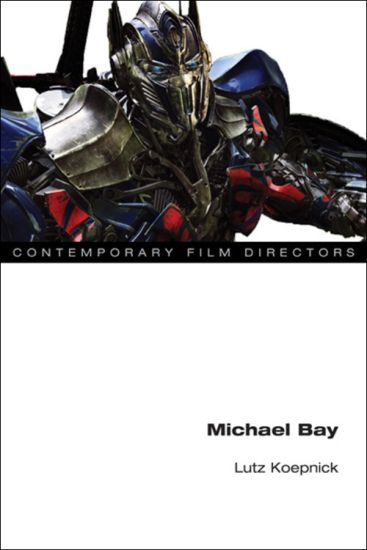
Michael Bay

Michael Bay

Lutz Koepnick

University of Illinois Press
2018
sidottu
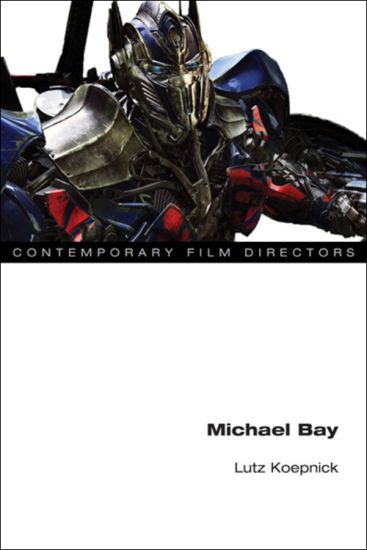
If size counts for anything, Michael Bay towers over his contemporaries. His summer-defining event films involve extraordinary production costs and churn enormous box office returns. His ability to mastermind breathtaking spectacles of action, mayhem, and special effects continually push the movie industry as much as the medium of film toward new frontiers. Lutz Koepnick engages the bigness of works like Armageddon and the Transformers movies to explore essential questions of contemporary filmmaking and culture. Combining close analysis and theoretical reflection, Koepnick shows how Bay's films, knowingly or not, address profound issues about what it means to live in the late twentieth- and early twenty-first centuries. According to Koepnick's astute readings, no one eager to understand the state of cinema today can ignore Bay's work. Bay's cinema of world-making and transnational reach not only exemplifies interlocking processes of cultural and economic globalization. It urges us to contemplate the future of moving images, of memory, matter, community, and experience, amid a time of rampant political populism and ever-accelerating technological change. An eye-opening look at one of Hollywood's most polarizing directors, Michael Bay illuminates what energizes the films of this cinematic and cultural force.
Michael Bay

Michael Bay

Lutz Koepnick

University of Illinois Press
2018
nidottu
If size counts for anything, Michael Bay towers over his contemporaries. His summer-defining event films involve extraordinary production costs and churn enormous box office returns. His ability to mastermind breathtaking spectacles of action, mayhem, and special effects continually push the movie industry as much as the medium of film toward new frontiers. Lutz Koepnick engages the bigness of works like Armageddon and the Transformers movies to explore essential questions of contemporary filmmaking and culture. Combining close analysis and theoretical reflection, Koepnick shows how Bay's films, knowingly or not, address profound issues about what it means to live in the late twentieth- and early twenty-first centuries. According to Koepnick's astute readings, no one eager to understand the state of cinema today can ignore Bay's work. Bay's cinema of world-making and transnational reach not only exemplifies interlocking processes of cultural and economic globalization. It urges us to contemplate the future of moving images, of memory, matter, community, and experience, amid a time of rampant political populism and ever-accelerating technological change. An eye-opening look at one of Hollywood's most polarizing directors, Michael Bay illuminates what energizes the films of this cinematic and cultural force.
The Dark Mirror

The Dark Mirror

Lutz Koepnick

University of California Press
2002
pokkari
Lutz Koepnick analyzes the complicated relationship between two cinemas--Hollywood's and Nazi Germany's--in this theoretically and politically incisive study. The Dark Mirror examines the split course of German popular film from the early 1930s until the mid 1950s, showing how Nazi filmmakers appropriated Hollywood conventions and how German film exiles reworked German cultural material in their efforts to find a working base in the Hollywood studio system. Through detailed readings of specific films, Koepnick provides a vivid sense of the give and take between German and American cinema.
Framing Attention

Framing Attention

Lutz Koepnick

Johns Hopkins University Press
2007
sidottu
In Framing Attention, Lutz Koepnick explores different concepts of the window-in both a literal and a figurative sense-as manifested in various visual forms in German culture from the nineteenth century to the present. He offers a new interpretation of how evolving ways of seeing have characterized and defined modernity. Koepnick examines the role and representation of window frames in modern German culture-in painting, photography, architecture, and literature, on the stage and in public transportation systems, on the film screen and on television. He presents such frames as interfaces that negotiate competing visions of past and present, body and community, attentiveness and distraction. From Adolph Menzel's window paintings of the 1840s to Nam June Paik's experiments with television screens, from Richard Wagner's retooling of the proscenium stage to Adolf Hitler's use of a window as a means of political self-promotion, Framing Attention offers a theoretically incisive understanding of how windows shape and reframe the way we see the world around us and our place within it.
Walter Benjamin and the Aesthetics of Power

Walter Benjamin and the Aesthetics of Power

Lutz Koepnick

University of Nebraska Press
1999
sidottu
Walter Benjamin and the Aesthetics of Power explores Walter Benjamin's seminal writings on the relationship between mass culture and fascism. The book offers a nuanced reading of Benjamin's widely influential critique of aesthetic politics, while it contributes to current debates about the cultural projects of Nazi Germany, the changing role of popular culture in the twentieth century, and the way in which Nazi aesthetics have persisted into the present. Lutz Koepnick first explores the development of the aestheticization thesis in Benjamin's work from the early 1920s to his death in 1940. Pushing Benjamin's fragmentary remarks to a logical conclusion, Koepnick sheds light on the ways in which the Nazis employed industrial mass culture to redress the political as a self-referential space of authenticity and self-assertion. Koepnick then examines to what extent Benjamin's analysis of fascism holds up to recent historical analyses of the National Socialist period and whether Benjamin's aestheticization thesis can help conceptualize cultural politics today. Although Koepnick insists on crucial differences between the stage-managing of political action in modern and postmodern societies, he argues throughout that it is in Benjamin's emphatic insistence on experience that we may find the relevance of his reflections today. Walter Benjamin and the Aesthetics of Power is both an important contribution to Benjamin studies and a revealing addition to our understanding of the Third Reich and of contemporary culture's uneasy relationship to Nazi culture.
The Long Take

The Long Take

Lutz Koepnick

University of Minnesota Press
2017
sidottu
In The Long Take, Lutz Koepnick posits extended shot durations as a powerful medium for exploring different modes of perception and attention in our fast-paced world of mediated stimulations. Grounding his inquiry in the long takes of international filmmakers such as Béla Tarr, Tsai Ming-liang, Abbas Kiarostami, Apichatpong Weerasethakul, and Michael Haneke, Koepnick reveals how their films evoke wondrous experiences of surprise, disruption, enchantment, and reorientation. He proceeds to show how the long take has come to thrive in diverse artistic practices across different media platforms: from the work of photographer Hiroshi Sugimoto to the screen-based installations of Sophie Calle and Tacita Dean, from experimental work by Francis Alÿs and Janet Cardiff to durational images in contemporary video games.Deeply informed by film and media theory, yet written in a fluid and often poetic style, The Long Take goes far beyond recent writing about slow cinema. In Koepnick’s account, the long take serves as a critical hallmark of international art cinema in the twenty-first century. It invites viewers to probe the aesthetics of moving images and to recalibrate their sense of time. Long takes unlock windows toward the new and unexpected amid the ever-mounting pressures of 24/7 self-management.
The Long Take

The Long Take

Lutz Koepnick

University of Minnesota Press
2017
nidottu
In The Long Take, Lutz Koepnick posits extended shot durations as a powerful medium for exploring different modes of perception and attention in our fast-paced world of mediated stimulations. Grounding his inquiry in the long takes of international filmmakers such as Béla Tarr, Tsai Ming-liang, Abbas Kiarostami, Apichatpong Weerasethakul, and Michael Haneke, Koepnick reveals how their films evoke wondrous experiences of surprise, disruption, enchantment, and reorientation. He proceeds to show how the long take has come to thrive in diverse artistic practices across different media platforms: from the work of photographer Hiroshi Sugimoto to the screen-based installations of Sophie Calle and Tacita Dean, from experimental work by Francis Alÿs and Janet Cardiff to durational images in contemporary video games.Deeply informed by film and media theory, yet written in a fluid and often poetic style, The Long Take goes far beyond recent writing about slow cinema. In Koepnick’s account, the long take serves as a critical hallmark of international art cinema in the twenty-first century. It invites viewers to probe the aesthetics of moving images and to recalibrate their sense of time. Long takes unlock windows toward the new and unexpected amid the ever-mounting pressures of 24/7 self-management.
Resonant Matter

Resonant Matter

Lutz Koepnick

Bloomsbury Academic USA
2021
sidottu
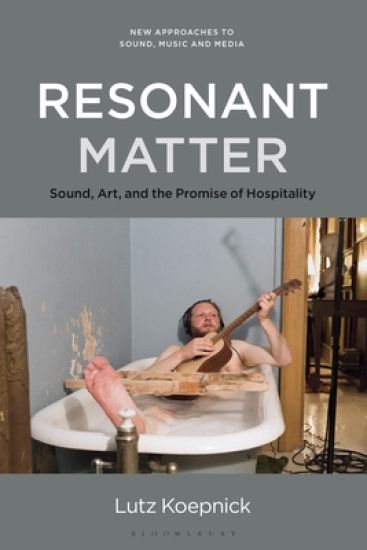
In Resonant Matter, Lutz Koepnick considers contemporary sound and installation art as a unique laboratory of hospitality amid inhospitable times. Inspired by Ragnar Kjartansson’s nine-channel video installation The Visitors (2012), the book explores resonance—the ability of objects to be affected by the vibrations of other objects—as a model of art’s fleeting promise to make us coexist with things strange and other. In a series of nuanced readings, Koepnick follows the echoes of distant, unexpected, and unheard sounds in twenty-first century art to reflect on the attachments we pursue to sustain our lives and the walls we need to tear down to secure possible futures. The book’s nine chapters approach The Visitors from ever-different conceptual angles while bringing it into dialogue with the work of other artists and musicians such as Lawrence Abu Hamdan, Guillermo Galindo, Mischa Kuball, Philipp Lachenmann, Alvien Lucier, Teresa Margolles, Carsten Nicolai, Camille Norment, Susan Philipsz, David Rothenberg, Juliana Snapper, and Tanya Tagaq. With this book, Koepnick situates resonance as a vital concept of contemporary art criticism and sound studies. His analysis encourages us not only to expand our understanding of the role of sound in art, of sound art, but to attune our critical encounter with art to art’s own resonant thinking.
Resonant Matter

Resonant Matter

Lutz Koepnick

Bloomsbury Academic USA
2021
nidottu
In Resonant Matter, Lutz Koepnick considers contemporary sound and installation art as a unique laboratory of hospitality amid inhospitable times. Inspired by Ragnar Kjartansson’s nine-channel video installation The Visitors (2012), the book explores resonance—the ability of objects to be affected by the vibrations of other objects—as a model of art’s fleeting promise to make us coexist with things strange and other. In a series of nuanced readings, Koepnick follows the echoes of distant, unexpected, and unheard sounds in twenty-first century art to reflect on the attachments we pursue to sustain our lives and the walls we need to tear down to secure possible futures. The book’s nine chapters approach The Visitors from ever-different conceptual angles while bringing it into dialogue with the work of other artists and musicians such as Lawrence Abu Hamdan, Guillermo Galindo, Mischa Kuball, Philipp Lachenmann, Alvien Lucier, Teresa Margolles, Carsten Nicolai, Camille Norment, Susan Philipsz, David Rothenberg, Juliana Snapper, and Tanya Tagaq. With this book, Koepnick situates resonance as a vital concept of contemporary art criticism and sound studies. His analysis encourages us not only to expand our understanding of the role of sound in art, of sound art, but to attune our critical encounter with art to art’s own resonant thinking.
Fitzcarraldo

Fitzcarraldo

Lutz Koepnick

Camden House Inc
2019
pokkari
Revisits Herzog's classic film from a decisively contemporary standpoint, bringing into play the development of his filmmaking career. When it was released in 1982, Werner Herzog's Fitzcarraldo was widely criticized for its demanding use of human and natural resources as well as its director's uncompromising aesthetic vision. Critics and scholars saw little difference between the film's protagonist's obsession with hauling a ship over a mountain in the Amazon and Herzog's own mode of cinematic production and storytelling. And yet Fitzcarraldo stands out as one of the defining moments of New German Cinema and, as the years pass, continues to raise new questions about the relation of film and society, art and nature, progress and subjectivity, the known and the unknown. This book revisits Herzog's taleof operatic entrepreneurialism from a decisively contemporary standpoint. It draws on recent writing on the Anthropocene to probe the relationship of art, civilization, and the natural world in Fitzcarraldo. It discusses the role of opera and music in Herzog's Amazon spectacle. And it brings into play the development of Herzog's own career as a filmmaker over the last few decades to offer a fresh look at this by-now classical contribution to twentieth-century German film art. Lutz Koepnick is Gertrude Conaway Vanderbilt Professor of German, Cinema and Media Arts at Vanderbilt University.