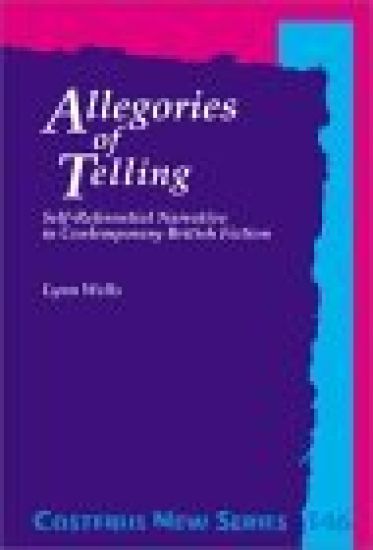
Allegories of Telling: Self-Referential Narrative in Contemporary British Fiction has as its founding premise Ross Chambers’s notion that “one of the important powers of fiction is its power to theorize the act of storytelling in and through the act of storytelling.” In this critical study, Lynn Wells presents detailed readings of novels by five prominent British authors – John Fowles, Angela Carter, Graham Swift, A.S. Byatt and Salman Rushdie – with an emphasis on how the texts' self-referential aspects illuminate the acts of reading and writing fiction in contemporary Britain and, by extension, around the world. The book begins by situating contemporary British fiction historically as the product of an “aesthetics of compromise” arising from the “realism versus experimentalism” debate that consumed the English literary establishment during the 1960s. In her discussion of the texts, Lynn Wells then draws on a wide range of theoretical approaches, from narrative and psychoanalytic theory to existentialist philosophy and the historiographic ideas of thinkers such as Walter Benjamin, Michel Foucault and Giambattista Vico. These original readings challenge superficial “postmodern” interpretations of contemporary British fiction as pessimistically anti-historical, and reassert the value of readerly engagement and narrative reconstruction of the past.