Kirjojen hintavertailu. Mukana 12 016 292 kirjaa ja 12 kauppaa.

Kirjahaku

Etsi kirjoja tekijän nimen, kirjan nimen tai ISBN:n perusteella.

4 kirjaa tekijältä M. L. Stapleton

Marlowe's Ovid

Marlowe's Ovid

M. L. Stapleton

Taylor Francis Ltd
2021
nidottu
The first book of its kind, Marlowe's Ovid explores and analyzes in depth the relationship between the Elegies-Marlowe's translation of Ovid's Amores-and Marlowe's own dramatic and poetic works. Stapleton carefully considers Marlowe's Elegies in the context of his seven known dramatic works and his epyllion, Hero and Leander, and offers a different way to read Marlowe. Stapleton employs Marlowe's rendition of the Amores as a way to read his seven dramatic productions and his narrative poetry while engaging with previous scholarship devoted to the accuracy of the translation and to bibliographical issues. The author focuses on four main principles: the intertextual relationship of the Elegies to the rest of the author's canon; its reflection of the influence of Erasmian humanist pedagogy, imitatio and aemulatio; its status as the standard English Amores until the Glorious Revolution, part of the larger phenomenon of pan-European Renaissance Ovidianism; its participation in the genre of the sonnet sequence. He explores how translating the Amores into the Elegies profited Marlowe as a writer, a kind of literary archaeology that explains why he may have commenced such an undertaking. Marlowe's Ovid adds to the body of scholarly work in a number of subfields, including classical influences in English literature, translation, sexuality in literature, early modern poetry and drama, and Marlowe and his milieu.
Marlowe's Ovid

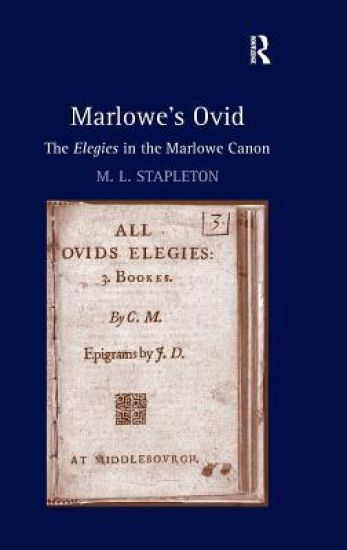
Marlowe's Ovid

M. L. Stapleton

Routledge
2014
sidottu
The first book of its kind, Marlowe's Ovid explores and analyzes in depth the relationship between the Elegies-Marlowe's translation of Ovid's Amores-and Marlowe's own dramatic and poetic works. Stapleton carefully considers Marlowe's Elegies in the context of his seven known dramatic works and his epyllion, Hero and Leander, and offers a different way to read Marlowe. Stapleton employs Marlowe's rendition of the Amores as a way to read his seven dramatic productions and his narrative poetry while engaging with previous scholarship devoted to the accuracy of the translation and to bibliographical issues. The author focuses on four main principles: the intertextual relationship of the Elegies to the rest of the author's canon; its reflection of the influence of Erasmian humanist pedagogy, imitatio and aemulatio; its status as the standard English Amores until the Glorious Revolution, part of the larger phenomenon of pan-European Renaissance Ovidianism; its participation in the genre of the sonnet sequence. He explores how translating the Amores into the Elegies profited Marlowe as a writer, a kind of literary archaeology that explains why he may have commenced such an undertaking. Marlowe's Ovid adds to the body of scholarly work in a number of subfields, including classical influences in English literature, translation, sexuality in literature, early modern poetry and drama, and Marlowe and his milieu.
Spenser's Ovidian Poetics

Spenser's Ovidian Poetics

M. L. Stapleton

University of Delaware Press
2009
sidottu
No history of the longstanding critical tradition of exploring the Spenser-Ovid relationship has been written. In this book Professor Stapleton constructs such a critical history: the annotations of E. K. in The Shepheardes Calender (1579), the Enlightenment editions of The Faerie Queene, the philological mode of the Spenser Variorum (1932–57), and the recent, innovative work of Harry Berger and Colin Burrow. Aside from occasional articles, no truly comprehensive analysis of their kinship as love poets exists, either. The author explores Spenser’s emulation of Ovid’s amatory poetics. His humanist education trained him to find or construct analogues and etiological patterns in classical texts. Therefore, his early study of translation, intensive reading, and "versifying" as an interrelated process guaranteed a densely allusive, metamorphic Ovidian poetics as a natural result. The author's predecessors focus almost exclusively on the Metamorphoses as intertext, but do not often distinguish between early modern Latin editions of the poem and translations such as Arthur Golding's. Although Spenser read Ovid in his native language, during the quarter-century of his writing career, his countrymen such as Shakespeare, Donne, and Lodge imitate and recast the ancient author. During this English aetas Ovidiana, a translation industry arises simultaneously so that the entire corpus is rendered into English, from Golding's Metamorphoses (1567) to Wye Saltonstall's Ex Ponto (1638). Since the sixteenth century did not often read or hear a Roman poet in prose renditions, the author uses Renaissance poetical verse translations (with the Latin text) to explore Spenser's variegated use of Ovid: how he sounded as early modern English poetry. The introduction traces a history of the Spenser-Ovid site then accounts for the importance of imitatio and moralization to Spenser's developing poetics. The first four chapters analyze the influence of the Tristia, Heroides, and Metamorphoses on the 1590 Faerie Queene and The Shepheardes Calender. The concluding chapters demonstrate the presence of the Ars amatoria and Amores in Amoretti and Epithalamion and Fowre Hymnes. Spenser's Ovidian Poetics is intended to complement works such as Leonard Barkan's The Gods Made Flesh, Jonathan Bate's Shakespeare and Ovid, Raphael Lyne's Ovid's Changing Worlds: English Metamorphoses 1567–1632, and important essays by Colin Burrow. In the words of Paul Alpers, Professor Stapleton does not wish "to oppose the historical aesthetic" but to understand Spenser's "claim to relative autonomy" in his emulation and reconfiguration of his predecessors.
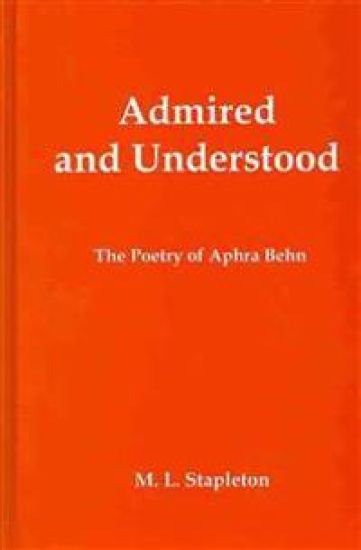
Admired and Understood

Admired and Understood

M. L. Stapleton

University of Delaware Press
2004
sidottu
Admired and Understood analyzes Behn's only pure verse collection, Poems upon Several Occasions (1684), and situates her in her literary milieu. Her book demonstrates her desire for acceptance in her literary culture, to be 'admired and understood,' the antithesis of what many surmise from reading her other works—that she saw herself primarily as a guerilla critic of her culture's views on race, class, and gender. Although the collapse of the market for new plays in the 1680s probably drove Behn to poetry and later to fiction, other factors explain her devotion to her collection. One may have been the status associated with writing poetry as opposed to plays and stories. The title of poet was her culture's ultimate literary currency. She apparently never wished to be seen as a 'woman writer,' and viewed such labels as reductive, unfair, and inaccurate. Published in 1684, playwright Aphra Behn's Poems Upon Several Occasions is her only collection of pure verse. In this study, Stapleton analyzes these poems and situates Behn in her literary milieu. Topics include the influence of Abraham Cowley on Behn's poetics, Behn's understanding of libertinism, and the textual history of 'On a Juniper-Tree.'