Kirjojen hintavertailu. Mukana 11 717 486 kirjaa ja 12 kauppaa.

Kirjahaku

Etsi kirjoja tekijän nimen, kirjan nimen tai ISBN:n perusteella.

7 kirjaa tekijältä M.J. Cresswell

Entities and Indices

Entities and Indices

M.J. Cresswell

Springer
1990
sidottu
In ordinary discourse we appear to ta1k about many things that have seemed mysterious to philosophers. We say that there has been a hitch in our arrangements or that the solution to the problem required us to examine all the probable outcomes of our action. So it would seem that we speak as if in addition to eloeks, mountains, queens and grains of sand there are hitches, arrangements, solutions, probiems, and probable outcomes. It is not immediately obvious when we must take such ta1k as really assuming that there are such to develop tests for things, and one of the tasks in this book is discerning what has eome to be called ontological commitment, in naturallanguage. Among the entities that natural language appears to make reference to are those connected with temporal and modal discourse, times, possibilities, and so on. Such entities play a crueial role in the kind of semantieal theories that I and others have defended over many years. These theories are based on the idea that an essential part of the meaning of a sentence is constituted by the conditions under whieh that sentenee is true. To know what a sentence says is to know what the world would have to be !ike for that sentence to be true.
Entities and Indices

Entities and Indices

M.J. Cresswell

Springer
1990
nidottu
In ordinary discourse we appear to ta1k about many things that have seemed mysterious to philosophers. We say that there has been a hitch in our arrangements or that the solution to the problem required us to examine all the probable outcomes of our action. So it would seem that we speak as if in addition to eloeks, mountains, queens and grains of sand there are hitches, arrangements, solutions, probiems, and probable outcomes. It is not immediately obvious when we must take such ta1k as really assuming that there are such to develop tests for things, and one of the tasks in this book is discerning what has eome to be called ontological commitment, in naturallanguage. Among the entities that natural language appears to make reference to are those connected with temporal and modal discourse, times, possibilities, and so on. Such entities play a crueial role in the kind of semantieal theories that I and others have defended over many years. These theories are based on the idea that an essential part of the meaning of a sentence is constituted by the conditions under whieh that sentenee is true. To know what a sentence says is to know what the world would have to be !ike for that sentence to be true.
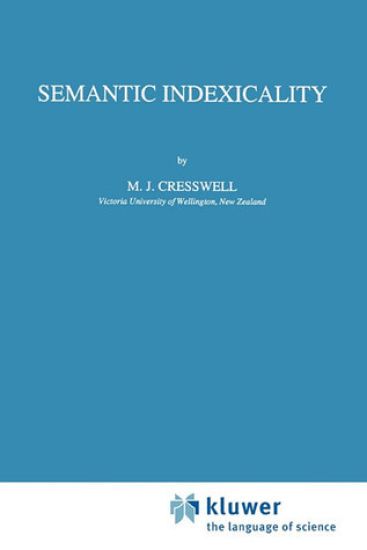
Semantic Indexicality

Semantic Indexicality

M.J. Cresswell

Springer
1996
sidottu
Semantic Indexicality shows how a simple syntax can be combined with a propositional language at the level of logical analysis. It is the adoption of such a base language which has not been attempted before, and it is this which constitutes the originality of the book. Cresswell's simple and direct style makes this book accessible to a wider audience than the somewhat specialized subject matter might initially suggest.
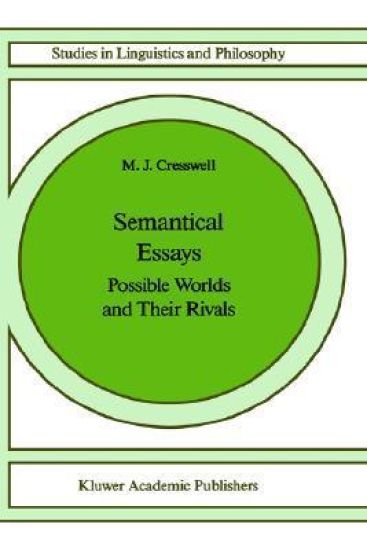
Semantical Essays

Semantical Essays

M.J. Cresswell

Kluwer Academic Publishers
1988
sidottu
Over a longer period than I sometimes care to contemplate I have worked on possible-worlds semantics. The earliest work was in modal logic, to which I keep returning, but a sabbatical in 1970 took me to UCLA, there to discover the work of Richard Montague in applying possible-worlds semantics to natural lan­ guage. My own version of this appeared in Cresswell (1973) and was followed up in a number of articles, most of which were collected in Cresswell (1985b). A central problem for possible­ worlds semantics is how to accommodate propositional attitudes. This problem was addressed in Cresswell (1985a), and the three books mentioned so far represent a reasonably complete picture of my positive views on formal semantics. I have regarded the presentation of a positive view as more important than the criticism of alternatives, although the works referred to do contain many passages in which I have tried to defend my own views against those of others. But such criticism is important in that a crucial element in establishing the content of a theory is that we be able to evaluate it in relation to its com­ petitors. It is for that reason that I have collected in this volume a number of articles in which I attempt to defend the positive semantical picture I favour against objections and competing theories.
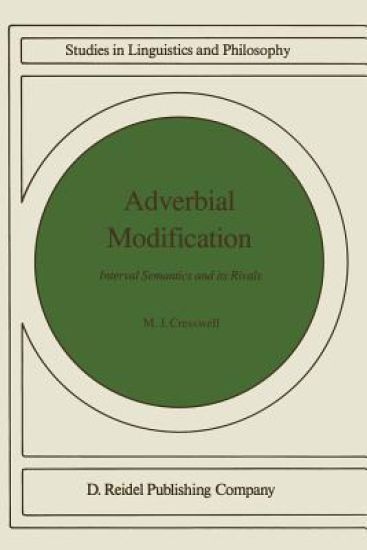
Adverbial Modification

Adverbial Modification

M.J. Cresswell

Kluwer Academic Publishers
1985
nidottu
Adverbial modification is probably one of the least understood areas of linguistics. The essays in this volume all address the problem of how to give an analysis of adverbial modifiers within truth-conditional semantics. Chapters I-VI provide analyses of particular modifiers within a possible­ worlds framework, and were written between 1974 and 1981. Original publication details of these chapters may be found on p. vi. Of these, all but Chapter I make essential use of the idea that the time reference involved in tensed sentences should be a time interval rather than a single instant. The final chapter (Chapter VII) was written especially for this volume and investigates the question of how the 'situation semantics' recently devised by Jon Barwise and John Perry, as a rival to possible-worlds semantics, might deal with adverbs. In addition I have included an appendix to Chapter III and an introduction which links all the chapters together.
Semantic Indexicality

Semantic Indexicality

M.J. Cresswell

Springer
2010
nidottu
Semantic Indexicality shows how a simple syntax can be combined with a propositional language at the level of logical analysis. It is the adoption of such a base language which has not been attempted before, and it is this which constitutes the originality of the book. Cresswell's simple and direct style makes this book accessible to a wider audience than the somewhat specialized subject matter might initially suggest.
Semantical Essays

Semantical Essays

M.J. Cresswell

Springer
2010
nidottu
Over a longer period than I sometimes care to contemplate I have worked on possible-worlds semantics. The earliest work was in modal logic, to which I keep returning, but a sabbatical in 1970 took me to UCLA, there to discover the work of Richard Montague in applying possible-worlds semantics to natural lan­ guage. My own version of this appeared in Cresswell (1973) and was followed up in a number of articles, most of which were collected in Cresswell (1985b). A central problem for possible­ worlds semantics is how to accommodate propositional attitudes. This problem was addressed in Cresswell (1985a), and the three books mentioned so far represent a reasonably complete picture of my positive views on formal semantics. I have regarded the presentation of a positive view as more important than the criticism of alternatives, although the works referred to do contain many passages in which I have tried to defend my own views against those of others. But such criticism is important in that a crucial element in establishing the content of a theory is that we be able to evaluate it in relation to its com­ petitors. It is for that reason that I have collected in this volume a number of articles in which I attempt to defend the positive semantical picture I favour against objections and competing theories.