Kirjojen hintavertailu. Mukana 11 627 466 kirjaa ja 12 kauppaa.

Kirjahaku

Etsi kirjoja tekijän nimen, kirjan nimen tai ISBN:n perusteella.

8 kirjaa tekijältä Mabel Moraña

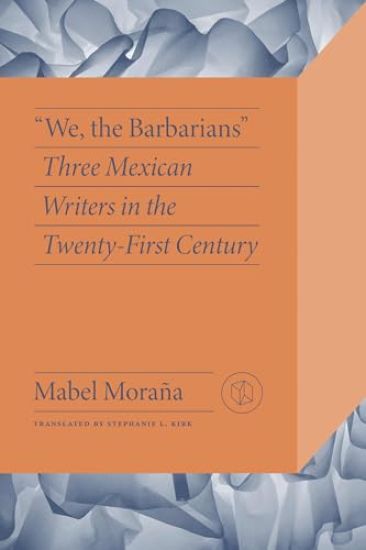
We the Barbarians

We the Barbarians

Mabel Moraña

VANDERBILT UNIVERSITY PRESS
2024
nidottu
We the Barbarians embarks on a careful and exhaustive reading of three of the most prominent authors in the latest wave of Mexican fiction: Yuri Herrera, Fernanda Melchor, and Valeria Luiselli. Originally published in Mexico in December of 2021, the work is divided into three parts that correspond to the analysis of each author’s narrative production. The book analyzes all the literary works published by Herrera, Melchor, and Luiselli from the beginning of their writing careers until 2021, allowing for a diachronic interpretation of their respective narrative projects as well as for comparative approaches to their aesthetic and ideological contours. Characterized by the fragmentation of civil society and the decomposition of the myths that accompanied the consolidation of the modern nation, Mexican visual and literary arts have been exploring a myriad of representational avenues to approach the phenomena of violence, institutional decay, and political instability. We the Barbarians analyzes the ways in which the transformations of national culture intersect with global developments, discussing the insertion of literary works at transnational levels. In the works of the authors studied here, the uses of language reveal the experimental integration of regional idiolects, colloquialisms, slang, and neologisms derived from multiple and diverse cultural registers, including the terminologies of social media. Urban and rural subcultures interplay with traditional currents and with the languages of film, performance, and popular music. Thematically, innovations introduced through the genre of chronicles, science fiction, journalism, and autobiographical writing produce powerful combinations in which "canonical" authors are re-interpreted and re-vitalized for a changing and diversified cultural market. The critical and theoretical approaches used here explore a variety of alternative symbolic representations of topics such as nationalism, community, and affect in times impacted by systemic violence, precariousness, and radical inequality. MoraÑa's goal is to perceive the negotiations between regional/local imaginaries and global scenarios characterized by the devaluation and re-signification of life, both at individual and at collective levels. Though it uses three authors as its focus, the book seeks to more broadly theorize the question of the relationship between literature and the social in the twenty-first century.
We the Barbarians

We the Barbarians

Mabel Moraña

VANDERBILT UNIVERSITY PRESS
2024
sidottu
We the Barbarians embarks on a careful and exhaustive reading of three of the most prominent authors in the latest wave of Mexican fiction: Yuri Herrera, Fernanda Melchor, and Valeria Luiselli. Originally published in Mexico in December of 2021, the work is divided into three parts that correspond to the analysis of each author’s narrative production. The book analyzes all the literary works published by Herrera, Melchor, and Luiselli from the beginning of their writing careers until 2021, allowing for a diachronic interpretation of their respective narrative projects as well as for comparative approaches to their aesthetic and ideological contours. Characterized by the fragmentation of civil society and the decomposition of the myths that accompanied the consolidation of the modern nation, Mexican visual and literary arts have been exploring a myriad of representational avenues to approach the phenomena of violence, institutional decay, and political instability. We the Barbarians analyzes the ways in which the transformations of national culture intersect with global developments, discussing the insertion of literary works at transnational levels. In the works of the authors studied here, the uses of language reveal the experimental integration of regional idiolects, colloquialisms, slang, and neologisms derived from multiple and diverse cultural registers, including the terminologies of social media. Urban and rural subcultures interplay with traditional currents and with the languages of film, performance, and popular music. Thematically, innovations introduced through the genre of chronicles, science fiction, journalism, and autobiographical writing produce powerful combinations in which "canonical" authors are re-interpreted and re-vitalized for a changing and diversified cultural market. The critical and theoretical approaches used here explore a variety of alternative symbolic representations of topics such as nationalism, community, and affect in times impacted by systemic violence, precariousness, and radical inequality. MoraÑa's goal is to perceive the negotiations between regional/local imaginaries and global scenarios characterized by the devaluation and re-signification of life, both at individual and at collective levels. Though it uses three authors as its focus, the book seeks to more broadly theorize the question of the relationship between literature and the social in the twenty-first century.
Arguedas / Vargas Llosa

Arguedas / Vargas Llosa

Mabel Moraña

Palgrave Macmillan
2016
sidottu
An English-language translation of the MLA Katherine Singer Kovacs Prize and LASA Premio Iberoamericano award-winning Spanish-language book, Arguedas/ Vargas Llosa. Dilemas y ensamblajes, Mabel Moraña offers the first comparative study of two of contemporary Latin America's central literary figures: Mario Vargas Llosa and Jose Maria Arguedas.
The Monster as War Machine

The Monster as War Machine

Mabel Moraña

Cambria Press
2018
sidottu
In The Monster as War Machine, European monster tradition intersects with American mass-media production and new philosophical approaches to examine topics of community, political power, alternative representations of race and gender, identity, hybridity, political agency, and collective subjectivity. In this book, cultural theory, close readings of literary texts, and interpretations of visual materials come together, covering a wide and diversified cultural territory.Some of the authors included in this study are Agamben, Badiou, Baudrillard, Deleuze, Esposito, Foucault, Freud, Haraway, Hardt, Kristeva, Marx, Negri, and Zizek, whose works illuminate the disruptive and at times emancipatory role of monstrosity as a representation of excess, instinct, evil, truth, and rebelliousness.This book is an important resource for those studying film, contemporary literature, and popular culture.This book is in the Cambria Latin American Literatures and Cultures Series headed by Rom n de la Campa, the Edwin B. and Lenore R. Williams Professor of Romance Languages at the University of Pennsylvania.
Philosophy and Criticism in Latin America
This book is in the Cambria Latin American Literatures and Cultures Series headed by Rom n de la Campa, the Edwin B. and Lenore R. Williams Professor of Romance Languages at the University of Pennsylvania.The objective of this book is not to recognize once again the sources of pre-Hispanic Amerindian or Afro-Hispanic thought in different regions and historical moments--a task that other critics have already accomplished admirably. Nor does this book attempt to return to the debates around the existence of a properly Latin American philosophy--a question that has also been thoroughly addressed. Rather, this book offers timely contributions to the process of conceptualizing a Latin American specificity and its forms of integration in larger contexts, both on the level of thought and the level of political and social praxis. To produce a critical reading of philosophy while also developing a philosophy of criticism is essential in cultures that continue to struggle for the decolonization of both thought and life.The first part of the book, "Biopower, Coloniality, and Emancipation in Latin America," examines authors and addressses questions from Latin American contexts in dialogue with some of the greatest thinkers of the twentieth century. These texts analyze the contributions of these authors to debates on such topics as the problems of colonialism and coloniality, the critique of modernity, and violence. Discussions of these issues give rise to other questions linked to the notions of freedom, social change, post/trans/modernity, biopolitics, and other topics that are particularly relevant for interpreting the processes of national formation and modernization and for understanding the developments that have taken place in the decades following the end of the Cold War.The second part of the book, titled "Critico-Philosophical Re-Readings and Debates," brings together texts that cover the work of philosophers whose ideas have strong links to Latin American thought. Benjamin, Foucault, and Bourdieu are all quite different thinkers, but they have in common the objective of deconstructing the discourse of power from different angles, providing forms of social consciousness that are in dialogue with Latin American critical and emancipatory projects on multiple levels. In addition to the above-mentioned philosophical directions, Peter Sloterdijk's undeniably polemical thought opens up a new path for the critique of humanism. These approaches are studied in the present book in texts that constitute moments of critical reflection which, while recognizing these authors' contributions to the development of critico-philosophical thought in peripheral areas, analyze aspects of their thought that can be interrogated and even challenged from a Latin American perspective. In this sense, this book suggests that, from the vantage point of Latin American cultural and political history, European philosophy, in spite of its claims of universality, clearly lacks satisfactory approaches to issues related to post/neo/colonial realities.With its interdisciplinary focus, this book will be an important resource for scholars and students in Latin American studies, comparative literature, world literature, and philosophy.
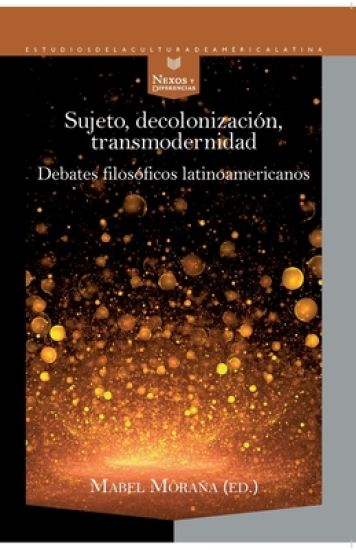
Sujeto, decolonización, transmodernidad

Sujeto, decolonización, transmodernidad

Mabel Moraña

Iberoamericana
2021
pokkari
A partir de un abordaje plural a los temas del sujeto, la modernidad y la decolonizaci n, este volumen ofrece una imprescindible reflexi n sobre aspectos pujantes de nuestro tiempo: c mo redefinir la noci n de sujeto de cara a los procesos de globalizaci n, que incluyen din micas migratorias, flujos fantasm ticos de capitales reales y simb licos y proliferaci n de mundos virtuales? A partir de qu principios se negocia la relaci n entre contingencia y universalidad, tica y pol tica, cultura y mercado?