
Kirjojen hintavertailu. Mukana 11 699 587 kirjaa ja 12 kauppaa.

Kirjahaku

Etsi kirjoja tekijän nimen, kirjan nimen tai ISBN:n perusteella.

5 kirjaa tekijältä Maciej Dunajski

Solitons, Instantons, and Twistors

Solitons, Instantons, and Twistors

Maciej Dunajski

Oxford University Press
2009
nidottu
Most nonlinear differential equations arising in natural sciences admit chaotic behaviour and cannot be solved analytically. Integrable systems lie on the other extreme. They possess regular, stable, and well behaved solutions known as solitons and instantons. These solutions play important roles in pure and applied mathematics as well as in theoretical physics where they describe configurations topologically different from vacuum. While integrable equations in lower space-time dimensions can be solved using the inverse scattering transform, the higher-dimensional examples of anti-self-dual Yang-Mills and Einstein equations require twistor theory. Both techniques rely on an ability to represent nonlinear equations as compatibility conditions for overdetermined systems of linear differential equations. The book provides a self-contained and accessible introduction to the subject. It starts with an introduction to integrability of ordinary and partial differential equations. Subsequent chapters explore symmetry analysis, gauge theory, gravitational instantons, twistor transforms, and anti-self-duality equations. The three appendices cover basic differential geometry, complex manifold theory, and the exterior differential system.

Solitons, Instantons, and Twistors

Solitons, Instantons, and Twistors

Maciej Dunajski

Oxford University Press
2024
sidottu
Most nonlinear differential equations arising in natural sciences admit chaotic behaviour and cannot be solved analytically. Integrable systems lie on the other extreme. They possess regular, stable, and well-behaved solutions known as solitons and instantons. These solutions play important roles in pure and applied mathematics as well as in theoretical physics where they describe configurations topologically different from vacuum. While integrable equations in lower space-time dimensions can be solved using the inverse scattering transform, the higher-dimensional examples of anti-self-dual Yang-Mills and Einstein equations require twistor theory. Both techniques rely on an ability to represent nonlinear equations as compatibility conditions for overdetermined systems of linear differential equations. The book provides a self-contained and accessible introduction to the subject. It starts with an introduction to integrability of ordinary and partial differential equations. Subsequent chapters explore symmetry analysis, gauge theory, vortices, gravitational instantons, twistor transforms, and anti-self-duality equations. The three appendices cover basic differential geometry, complex manifold theory, and the exterior differential system.

Solitons, Instantons, and Twistors

Solitons, Instantons, and Twistors

Maciej Dunajski

Oxford University Press
2024
nidottu
Most nonlinear differential equations arising in natural sciences admit chaotic behaviour and cannot be solved analytically. Integrable systems lie on the other extreme. They possess regular, stable, and well-behaved solutions known as solitons and instantons. These solutions play important roles in pure and applied mathematics as well as in theoretical physics where they describe configurations topologically different from vacuum. While integrable equations in lower space-time dimensions can be solved using the inverse scattering transform, the higher-dimensional examples of anti-self-dual Yang-Mills and Einstein equations require twistor theory. Both techniques rely on an ability to represent nonlinear equations as compatibility conditions for overdetermined systems of linear differential equations. The book provides a self-contained and accessible introduction to the subject. It starts with an introduction to integrability of ordinary and partial differential equations. Subsequent chapters explore symmetry analysis, gauge theory, vortices, gravitational instantons, twistor transforms, and anti-self-duality equations. The three appendices cover basic differential geometry, complex manifold theory, and the exterior differential system.
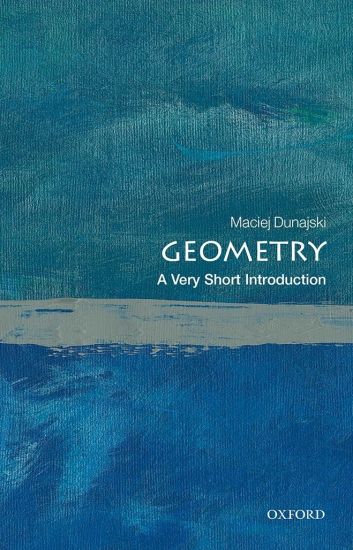
Geometry

Geometry

Maciej Dunajski

Oxford University Press
2022
nidottu
The study of geometry is at least 2500 years old, and it is within this field that the concept of mathematical proof - deductive reasoning from a set of axioms - first arose. To this day geometry remains a very active area of research in mathematics. This Very Short Introduction covers the areas of mathematics falling under geometry, starting with topics such as Euclidean and non-Euclidean geometries, and ranging to curved spaces, projective geometry in Renaissance art, and geometry of space-time inside a black hole. Starting from the basics, Maciej Dunajski proceeds from concrete examples (of mathematical objects like Platonic solids, or theorems like the Pythagorean theorem) to general principles. Throughout, he outlines the role geometry plays in the broader context of science and art. Very Short Introductions: Brilliant, Sharp, Inspiring ABOUT THE SERIES: The Very Short Introductions series from Oxford University Press contains hundreds of titles in almost every subject area. These pocket-sized books are the perfect way to get ahead in a new subject quickly. Our expert authors combine facts, analysis, perspective, new ideas, and enthusiasm to make interesting and challenging topics highly readable.
Solitons, Instantons, and Twistors

Solitons, Instantons, and Twistors

Maciej Dunajski

Oxford University Press
2009
sidottu
Most nonlinear differential equations arising in natural sciences admit chaotic behaviour and cannot be solved analytically. Integrable systems lie on the other extreme. They possess regular, stable, and well behaved solutions known as solitons and instantons. These solutions play important roles in pure and applied mathematics as well as in theoretical physics where they describe configurations topologically different from vacuum. While integrable equations in lower space-time dimensions can be solved using the inverse scattering transform, the higher-dimensional examples of anti-self-dual Yang-Mills and Einstein equations require twistor theory. Both techniques rely on an ability to represent nonlinear equations as compatibility conditions for overdetermined systems of linear differential equations. The book provides a self-contained and accessible introduction to the subject. It starts with an introduction to integrability of ordinary and partial differential equations. Subsequent chapters explore symmetry analysis, gauge theory, gravitational instantons, twistor transforms, and anti-self-duality equations. The three appendices cover basic differential geometry, complex manifold theory, and the exterior differential system.