Kirjojen hintavertailu. Mukana 11 460 291 kirjaa ja 12 kauppaa.

Kirjahaku

Etsi kirjoja tekijän nimen, kirjan nimen tai ISBN:n perusteella.

4 kirjaa tekijältä Madhavi Menon

Wanton Words

Wanton Words

Madhavi Menon

University of Toronto Press
2004
sidottu
In Wanton Words, Madhavi Menon intimately and expertly couples classical and Renaissance handbooks of rhetoric with canonical Renaissance plays and demonstrates their shared propensity to speak about sex - often transgressive sex - in the same instance that they speak about the workings of language. While other studies of rhetoric have confined their analyses to local questions of interpretive interest, Menon introduces rhetoric into the largely medico-juridical realm of studies on Renaissance sexuality. In doing so, she suggests that rhetoric allows us to think through the erotics of language in ways that pay most attention to the frisson of English Renaissance drama. Sustained deconstructive parsings of tropes - metaphor, metonymy, allegory, catechresis, and more - enables their wantonness to emerge in subjects usually considered unrelated to rhetoric: race in Othello, colonialism in The Tempest, tragedy in Romeo and Juliet, and cowardice in The Roaring Girl.
Indifference to Difference

Indifference to Difference

Madhavi Menon

University of Minnesota Press
2015
nidottu
Indifference to Difference organizes around Alain Badiou’s suggestion that, in the face of increasing claims of identitarian specificity, one might consider the politics and practice of being indifferent to difference. Such a politics would be based on the superabundance of desire and its inability to settle into identity. Madhavi Menon shows that if we turn to another kind of universalism-not one that insists we are all different but one that recognizes we are all similar in our powerlessness to contain desire-then difference no longer becomes the focus of our identity.Instead, we enter the worlds of desire. Following up on ideas of sameness and difference that have animated queer theory, Menon argues that what is most queer about indifference is not that it gives us queerness as an identity but that it is able to change queerness into a resistance of ontology. Firmly committed to the detours of desire, queer universalism evades identity.This polemical book demonstrates that queerness is the condition within which we labor. Our desires are not ours to be owned; they are indifferent to our differences.
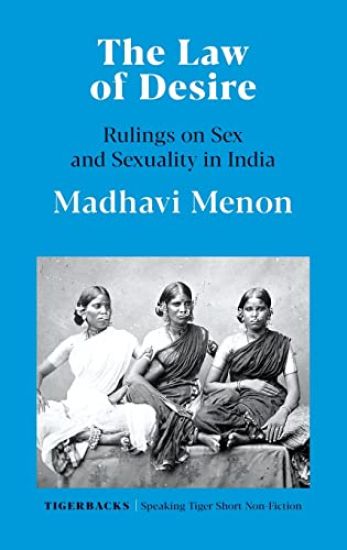
The Law of Desire Rulings on Sex and Sexuality in India
DescriptionCan a woman choose whom to marry if her father disapproves of the match? Does sexremain sex when it becomes work? Can a man become a woman because he feels like one?Is it the law's task to ensure heterosexuality? Does reproduction need to be regulated?The State attempts, with law as its instrument, to answer these questions forus, through legislation and, when contested, through court judgments. Thisbrilliantly insightful and superbly argued book calls into serious question thewisdom-indeed, the intent-of our lawmakers and the judiciary. ThoughIndia's laws and courts claim to know what they mean when they declare anexpression of desire immoral or criminal, obscene or unnatural, upon inquiry, they turn out to be building on very weak and often casteist and patriarchalassumptions. Thus we have the law struggling to 'rescue' 'fallen women', forsex work cannot be work, but a sign of immorality; a Supreme Court judgecan exonerate the artist M.F. Husain on charges of obscenity, but also claimthat 'obscenity lies in the eyes of the beholder', leaving us wondering how, then, the law can ever define what's obscene; and while a court may declarethat the 'third gender' has fundamental rights, no one really knows whatfundamental rights have to do with gender in the first place.Teacher and queer theorist Madhavi Menon-author of Infinite Variety, acelebrated study of desire in India-shows us the 'conundrums and paradoxes'that result when the law is entangled with sex and sexuality-and why we'need to play with, rather than stay with, the Law of Desire'.
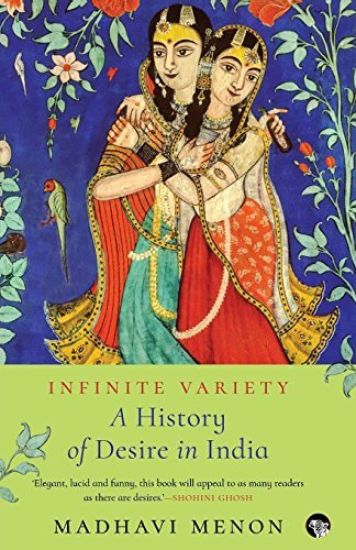
Infinite Variety

Infinite Variety

Madhavi Menon

Speaking Tiger Books
2018
pokkari
'Elegant, lucid and funny, this book will appeal to as many readers as there are desires.'--Shohini Ghosh'The history of desire in India, ' writes Madhavi Menon in this splendid book, 'reveals not purity but impurity as a way of life. Not one answer, but many. Not a single history, but multiple tales cutting across laws and boundaries.' In Bhakti poetry, Radha and Krishna disregard marital fidelity, age, time and gender for erotic love. In Sufi dargahs, pirs (spiritual guides) who were married to women are buried alongside their male disciples, as lovers are. Vatsyayana, author of the world's most famous manual of sex, insists that he did not compose it 'for the sake of passion', and remained celibate through the writing of it. Long hair is widely seen as a symbol of sexuality; and yet, shaved off in a temple, it is a sacred offering. Even as the country has a draconian law to punish homosexuality, heterosexual men share the same bed without comment. Hijras are increasingly marginalized; yet gender has historically been understood as fluid rather than fixed.Menon navigates centuries, geographies, personal and public histories, schools of philosophy, literary and cinematic works, as she examines the many--and often surprising--faces of desire in the Indian subcontinent. Her study ranges from the erotic sculptures of Khajuraho to the shrine of the celibate god Ayyappan; from army barracks to public parks; from Empress Nur Jahan's paan to home-made kohl; from cross-dressing mystics to androgynous gods. It shows us the connections between grammar and sex, between hair and war, between abstinence and pleasure, between love and death.Gloriously subversive, full of extraordinary analyses and insights, this is a book you will read to be enlightened and entertained for years.